US President Donald Trump welcomed Chinese President Xi Jinping to the White House on Thursday for a high-profile summit focused on trade, artificial intelligence, Taiwan and other major issues shaping US-China relations.
The Trump-Xi summit featured an elaborate ceremonial welcome. However, expectations for major policy breakthroughs remained limited, with both governments placing emphasis on maintaining stable relations despite significant disagreements.
Taiwan Takes Center Stage at Trump-Xi Summit
Taiwan emerged as one of the most sensitive subjects during the bilateral talks.
According to China’s state-run Xinhua news agency, Xi called on the United States to oppose Taiwanese independence during his meeting with Trump. At the time of the initial report, the White House had not released its own detailed account of that part of the discussion.
The issue has become increasingly important in US-China relations.
Beijing considers Taiwan part of China and has not ruled out the use of force to bring the democratically governed island under its control. Washington, meanwhile, maintains unofficial relations with Taipei and has traditionally avoided formally supporting Taiwanese independence.
Xi was also expected to raise US arms sales to Taiwan.
Following Trump’s visit to China in May, the US president said an arms package for Taiwan worth approximately $14 billion had been placed on hold and described it as a negotiating tool. The decision prompted concern among some US lawmakers and Asian allies over how Taiwan could feature in broader negotiations with Beijing.
Trump and Xi Emphasize Stable US-China Relations
Despite the disagreements, both leaders used their public remarks to emphasize the importance of managing competition between the world’s two largest economies.
Trump highlighted his relationship with Xi and said progress had been made on trade since his visit to China in May.
He also identified security, technology and what he calls “super intelligence” as major areas for discussion, referring to the rapid development of artificial intelligence.
Xi, meanwhile, said competition between the United States and China should remain healthy. He also called for fair treatment of Chinese companies operating in the US while saying American businesses remained welcome in China.
Artificial Intelligence Becomes a Key Issue
AI has increasingly become one of the most important areas of competition between Washington and Beijing.
Trump indicated before the meeting that artificial intelligence would feature prominently in his discussions with Xi. However, he continued to signal a preference for limited new regulation.
Xi said China and the United States have a responsibility to ensure that AI development remains beneficial and under human control.
Nevertheless, deep technological competition between the two countries could make a substantial bilateral AI agreement difficult. Analysts therefore see more limited cooperation, including discussions around AI safety and crisis prevention, as more realistic near-term possibilities.
Washington Rolls Out a Ceremonial Welcome
Xi’s visit was accompanied by extensive ceremony.
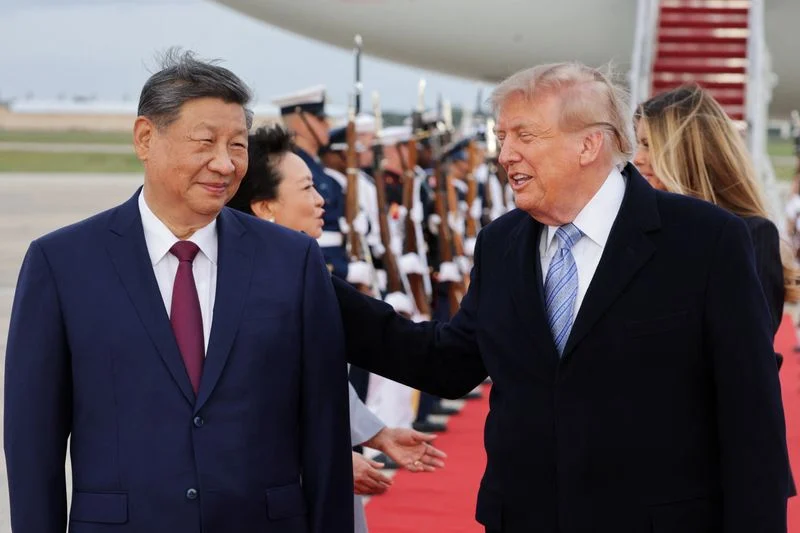
Trump personally welcomed the Chinese president at Joint Base Andrews following his arrival on Wednesday. According to Xinhua, the reception included a red carpet, military honors, national anthems and a flyover.
The White House then hosted a formal state arrival ceremony on Thursday.
The visit is Xi’s first trip to Washington in more than a decade and represents his second meeting with Trump this year. The White House had described the September 23-25 visit as an official state visit.
The ceremonial focus also reflected Trump’s effort to reciprocate the reception he received during his trip to China earlier in the year.
Major US-China Breakthroughs Remain Uncertain
Despite the attention surrounding the summit, expectations for sweeping agreements remained modest.
Trade is one area where more concrete progress appears possible. US Treasury Secretary Scott Bessent said Washington and Beijing had agreed to extend their existing trade truce until January 10.
The agreement had paused an escalation in which tariffs imposed by the two sides had exceeded 100% on some goods.
Other potential outcomes include adjustments to selected tariffs, additional cooperation against drug trafficking and expanded communication between the US and Chinese militaries.
Trump was also expected to raise the cases of Americans and other foreign nationals detained in China.
Trade and Rare Earths Remain Major Sources of Leverage
Economic relations remain central to the broader US-China relationship.
China’s position in global rare-earth supply chains gives Beijing significant leverage in negotiations, while Washington continues to use tariffs, export restrictions and access to advanced technologies as important policy tools.
Both governments therefore have incentives to prevent economic tensions from escalating further.
However, disagreements over trade policy, technology exports, Taiwan and national security continue to create the potential for renewed friction.
Iran Conflict Also Expected to Feature in Talks
The conflict involving the United States, Israel and Iran is another major geopolitical issue surrounding the summit.
Trump and Xi were expected to discuss Iran, although there had been little public indication before the meeting that Beijing was prepared to significantly change its position in response to US pressure.
For both governments, maintaining stable bilateral relations may provide advantages while they manage separate economic and geopolitical challenges.
Tech CEOs Attend White House State Dinner
The economic and technology dimensions of the summit are also reflected in the guest list for the White House state dinner.
Executives expected to attend include Apple CEO Tim Cook, Amazon founder Jeff Bezos, Alphabet CEO Sundar Pichai, OpenAI CEO Sam Altman, Tesla CEO Elon Musk and Nvidia CEO Jensen Huang.
The White House confirmed that the state dinner would bring together official delegations, business executives and government officials.
The presence of major technology leaders underscores the importance of AI, semiconductors and advanced technology in the economic relationship between the two countries.
However, US export controls on sensitive technologies remain a major point of disagreement, and significant changes to those restrictions were not expected from the summit.
Trump-Xi Summit Focuses on Managing Competition
The Washington summit highlights the complicated nature of US-China relations.
Both governments have expressed an interest in keeping communication open and avoiding uncontrolled escalation. At the same time, major disagreements remain over Taiwan, trade, artificial intelligence, technology restrictions and geopolitical security.
As a result, the immediate significance of the Trump-Xi summit may depend less on a single major agreement and more on whether Washington and Beijing can maintain dialogue while managing their strategic competition.