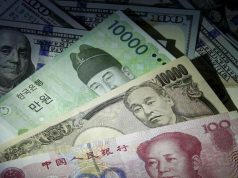
Most Asian currencies traded in a narrow range on Monday as holiday-thinned markets kept activity subdued. Meanwhile, the U.S. dollar edged higher as investors turned their attention to a high-level U.S.-China summit scheduled for later this week in Washington.
Japanese markets were closed on Monday and are expected to remain shut for much of the week. Markets in China and South Korea will also close later in the week for public holidays, potentially keeping regional trading volumes relatively light.
Asian Markets Show Limited Reaction to Falling Oil Prices
Asian currencies took little direction from the continued decline in oil prices. Crude extended losses from the previous week after U.S. President Donald Trump indicated that he was open to meeting Iranian President Masoud Pezeshkian on the sidelines of the United Nations summit in New York.
However, geopolitical tensions across the Middle East remain elevated, leaving investors cautious despite the recent weakness in energy prices.
Japanese Yen Holds Near 157 After BOJ Rate Hike
The Japanese yen showed little movement on Monday, with USD/JPY trading close to the 157 level.
The muted reaction came after the Bank of Japan raised interest rates by 25 basis points on Friday. Although the increase was widely expected, the move provided only limited support to the yen.
Markets viewed the BOJ’s accompanying comments as less hawkish than anticipated. Policymakers did not provide a strong signal that additional rate increases would follow in the coming months.
As a result, traders remain uncertain about the pace of future monetary tightening in Japan.
Dollar Strengthens Ahead of Trump-Xi Summit
The U.S. dollar moved slightly higher on Monday. Both the dollar index and dollar index futures gained around 0.1%, extending the greenback’s advance after it rose more than 1% during the previous week.
Support for the dollar also came from the Federal Reserve’s latest interest-rate increase and its continued commitment to bringing annual inflation back toward its 2% target.
That stance suggests monetary policy could remain restrictive as the Fed continues its efforts to control inflation.
However, the main focus for currency markets this week is the upcoming meeting between U.S. President Donald Trump and Chinese President Xi Jinping in Washington.
Trade and AI Expected to Dominate U.S.-China Talks
Trump and Xi are expected to discuss several major economic and geopolitical issues, with trade tariffs and artificial intelligence likely to feature prominently.
U.S. Treasury Secretary Scott Bessent and Chinese Vice Premier He Lifeng began preliminary talks in New York on Sunday to prepare the agenda for the summit.
According to Bessent, discussions included the possibility of establishing a new U.S.-China notification framework for artificial intelligence. Such a system could help the two countries identify shared objectives and potential AI-related threats.
Trade policy will also remain a major issue.
Trump and Xi are widely expected to discuss extending the existing U.S.-China trade truce, which is currently scheduled to expire in early November.
Any developments surrounding tariffs could have a significant impact on the Chinese yuan, Asian currencies and broader global markets.
Chinese Yuan Steady as PBOC Keeps Rates Unchanged
The Chinese yuan was little changed on Monday after the People’s Bank of China kept its benchmark lending rates unchanged, as markets had broadly expected.
The PBOC maintained its one-year loan prime rate at 3.0% and its five-year loan prime rate at 3.50%.
Both rates remain at historically low levels as Beijing attempts to stimulate borrowing, domestic demand and economic activity.
Despite the low-rate environment, pressure on the yuan has remained relatively limited. The Chinese currency reached a four-year high in September, supported by a series of stronger midpoint settings from the PBOC.
Asian Currencies Trade in a Tight Range
Elsewhere in Asia, major currencies remained relatively stable as investors prepared for a week of reduced market activity.
Trading volumes are expected to remain subdued because of holidays across several major Asian financial centers.
The Singapore dollar was largely unchanged against the U.S. dollar, while USD/KRW declined around 0.16%, indicating modest strength in the South Korean won.
The Australian dollar was also broadly flat against the greenback.
Meanwhile, USD/INR fell around 0.16%, reflecting a modest advance for the Indian rupee.
Currency markets are now likely to focus heavily on developments surrounding the U.S.-China summit, particularly any announcements involving tariffs, artificial intelligence and the future of the current trade truce.