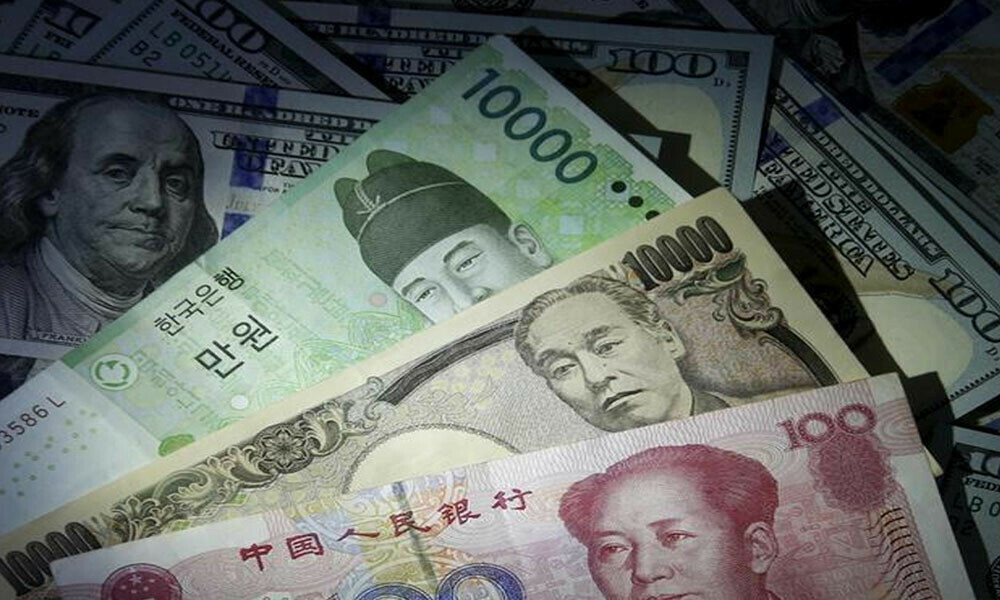
Asian currencies traded in mixed territory on Thursday as the U.S. dollar remained close to a two-month high.
Stronger-than-expected U.S. economic data revived concerns over inflation and increased expectations that the Federal Reserve could raise interest rates again.
The Japanese yen stabilized near a three-week low as markets reopened following a holiday. Meanwhile, South Korean markets remained closed for the Chuseok holiday.
U.S. Dollar Holds Near Two-Month High
The U.S. Dollar Index traded around 101.09 after briefly reaching 101.2 earlier in the session.
USD/JPY slipped about 0.2% to 157.94, although the yen remained close to its weakest level in three weeks.
The dollar strengthened after U.S. manufacturing data exceeded expectations, renewing concerns that persistent economic strength could keep inflation elevated.
Pressure also increased in the bond market following a weakly received $70 billion auction of five-year U.S. Treasury notes.
The selloff pushed the five-year Treasury yield above 5% for the first time since 2007.
Fed Rate-Hike Expectations Increase
Expectations for further Federal Reserve tightening also supported the dollar.
Federal Reserve Governor Michael Barr said that a resilient U.S. economy and rising inflation risks could require additional interest-rate increases.
Markets subsequently increased their expectations for an October rate hike.
According to CME FedWatch pricing, traders were assigning nearly a 70% probability to an October increase, compared with roughly 50% a week earlier.
Higher Oil Prices Add to Inflation Concerns
Rising oil prices have added another layer of inflation pressure.
Brent crude settled near $103 per barrel after climbing almost 4% on Wednesday.
The increase followed comments from Iranian President Masoud Pezeshkian, who said Tehran would not surrender amid ongoing tensions with the United States.
Investors were also assessing U.S. efforts to restrict diesel exports.
Iran has separately said it would not guarantee freedom of navigation through the Strait of Hormuz while U.S. sanctions and a naval blockade remain in place.
The situation has increased uncertainty surrounding global energy supplies.
Japanese Yen Remains Under Pressure
Japanese financial markets reopened on Thursday following a holiday.
Japan’s 10-year government bond yield climbed to around 3.06%, its highest level in approximately three decades.
Despite the sharp rise in domestic bond yields, the yen remained weak as investors continued to assess the Bank of Japan’s latest monetary policy decision.
USD/JPY traded close to 157.94, keeping markets alert to the possibility of currency intervention.
The Bank of Japan raised interest rates to a 31-year high last week. However, investors viewed the decision as providing limited guidance about the pace of future tightening.
Japan’s latest economic data also showed some moderation. The flash manufacturing PMI declined to 54.1 in September from 54.9 in August.
South Korean Won and Indonesian Rupiah Weaken
The South Korean won weakened in the latest foreign-exchange trading, with USD/KRW rising around 0.5% to 1,372.1.
South Korean stock markets were closed on Thursday for the Chuseok holiday and are scheduled to remain shut on Friday.
Elsewhere, the Australian dollar traded around $0.70, while the New Zealand dollar stood near $0.57.
The Singapore dollar was little changed, with USD/SGD edging higher to around 1.2801.
The Indonesian rupiah was among the weaker Asian currencies. USD/IDR rose approximately 0.6% to 17,903.5.
Bank Indonesia kept its benchmark interest rate unchanged at 5.75% on Wednesday, in line with market expectations.
The central bank also said it would continue using measures aimed at stabilizing the rupiah and encouraging foreign capital inflows.
Indian Rupee Holds Firm
The Indian rupee was slightly stronger, with USD/INR declining around 0.02% to 95.915.
The Reserve Bank of India has also been withdrawing excess liquidity from the banking system through bond sales and foreign-exchange swaps.
These measures are aimed at limiting the risk that excess liquidity could increase domestic inflation pressure.
Chinese Yuan in Focus Ahead of U.S.-China Talks
The Chinese yuan remained under modest pressure following its recent rally.
USD/CNH gained around 0.1% to 6.72, while USD/CNY also rose approximately 0.1% to 6.71.
The yuan had previously strengthened beyond the 6.70 level, reaching its strongest point in more than three and a half years.
Attention is now turning toward an upcoming meeting between U.S. President Donald Trump and Chinese President Xi Jinping.
The existing U.S.-China trade truce is expected to be extended by another two months.
However, several issues remain unresolved, including artificial intelligence, rare-earth exports, U.S. aircraft purchases and agricultural trade.
Developments from those negotiations could play an important role in determining the yuan’s next major move.