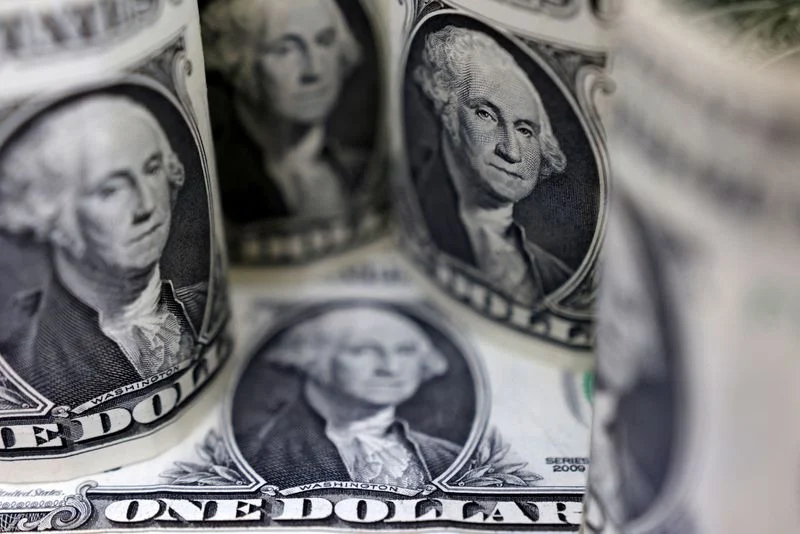
The U.S. dollar climbed to its highest level in two months on Wednesday as investors increased bets that the Federal Reserve could deliver additional interest rate hikes.
Persistent inflation remains a key concern, while stronger U.S. business activity has reinforced expectations that monetary policy may stay restrictive for longer.
The Dollar Spot Index rose 0.5%. Meanwhile, short-term interest rate markets priced in a 55% chance of another Federal Reserve rate hike in October.
Strong U.S. Business Activity Supports the Dollar
The latest economic data added further support to the U.S. dollar.
S&P Global reported that its flash U.S. Composite PMI Output Index rose to 58.4 in September, up from 56.0 in August. This marked the strongest reading since July 2021.
The improvement was largely driven by a sharp rise in new orders across manufacturing and services.
However, stronger demand also placed additional pressure on supply chains and contributed to higher prices. That trend reinforced concerns that inflation could remain elevated.
As a result, traders continued to expect a relatively hawkish Federal Reserve policy outlook.
Major Currency Pairs Trade Near Key Levels
Across global foreign exchange markets, major currency pairs remained close to important technical levels.
Investors were also cautious ahead of Chinese President Xi Jinping’s arrival in Washington for high-level talks with U.S. President Donald Trump.
The diplomatic meeting added another layer of uncertainty to markets already focused on interest rates, inflation and global trade.
Euro Falls as Fed Expectations and European Risks Weigh
The euro declined around 0.3%, trading near its weakest levels since late July.
The currency faced pressure from stronger expectations for higher U.S. interest rates. At the same time, political uncertainty in Europe weighed on sentiment.
Concerns over relatively low European gas storage levels also remained in focus. Traders fear that higher winter energy prices could add renewed inflation pressure across the region.
These factors helped widen the relative appeal of the U.S. dollar against the euro.
Japanese Yen Remains Under Pressure
The Japanese yen weakened by around 0.2%, trading near 157.58 per dollar.
The currency remained close to recent lows in relatively thin trading conditions.
Investors continued to watch for signs of possible intervention from Japanese authorities. Recent central bank rate checks have increased speculation that officials could respond if the yen weakens further.
Australian Dollar Falls After Weak PMI Data
The Australian dollar also underperformed, falling around 0.25%.
Preliminary September Purchasing Managers’ Index data showed Australia’s manufacturing sector slipping into contraction.
The weaker data raised questions about how much room the Reserve Bank of Australia has to continue raising interest rates.
That uncertainty added further pressure to the Australian dollar while supporting broader U.S. dollar strength.
U.S. Economic Strength Keeps Dollar Supported
Elias Haddad, global head of markets strategy at Brown Brothers Harriman, said tighter monetary policy from other major central banks may reduce policy divergence with the Federal Reserve.
However, he noted that stronger U.S. economic performance could continue to support the dollar.
The latest PMI figures suggest that the United States is maintaining a growth advantage over several other major developed economies.
This relative economic strength remains an important factor for foreign exchange markets.
Lower Oil Prices Provide Some Relief
While interest rate expectations continue to favor the dollar, falling oil prices offered some relief to global markets.
Crude oil dropped below $100 per barrel following reports that Saudi Arabia had restarted its East-West pipeline.
Progress in U.S.-Iran discussions also helped ease some concerns surrounding energy supply.
Lower oil prices could reduce inflationary pressure if the decline proves sustainable. However, traders remain sensitive to any renewed geopolitical disruption in global energy markets.
Trump-Xi Talks Move Into Focus
Attention is now turning toward Washington, where Donald Trump and Xi Jinping are expected to discuss several major economic and geopolitical issues.
Possible topics include the existing U.S.-China tariff truce, artificial intelligence policies, rare-earth exports and Chinese purchases of U.S. agricultural products.
The meeting could therefore have important implications for global trade and financial markets.
Currency traders are watching closely for any signals that could affect tariffs, supply chains or relations between the world’s two largest economies.
Dollar Outlook Depends on Fed and Geopolitical Signals
The U.S. dollar remains supported by expectations for tighter Federal Reserve policy and stronger domestic economic data.
However, geopolitical developments are becoming increasingly important for foreign exchange markets.
Traders are now balancing the prospect of additional Fed rate hikes against changes in energy prices, U.S.-China trade relations and broader diplomatic developments.
These factors could determine whether the dollar extends its recent gains or enters a period of consolidation.