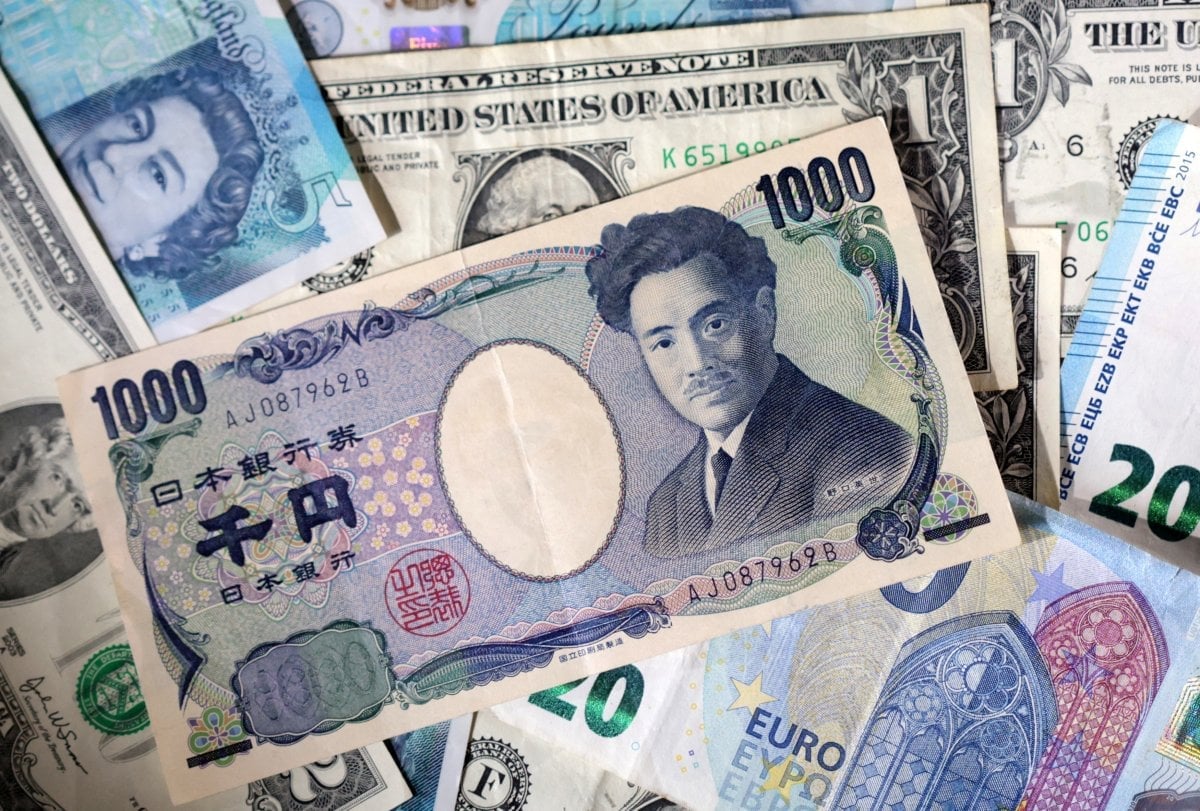
Asian currencies weakened against the U.S. dollar on Monday as traders increased expectations for a Federal Reserve interest rate hike this week.
The Japanese yen, however, remained close to a seven-month high as investors also positioned for potentially tighter policy from the Bank of Japan.
The U.S. Dollar Index rose around 0.2% to 99.35 after gaining 0.12% on Friday. That move ended two consecutive weeks of modest declines for the greenback.
Meanwhile, the euro and British pound came under pressure. EUR/USD fell about 0.3% to 1.1564, while GBP/USD slipped roughly 0.2% to 1.3501.
Yen Holds Near Seven-Month High
USD/JPY rose around 0.3% to 154.03 on Monday.
Despite the move, the yen remained close to the 152.89 level reached last week, which marked its strongest position since February.
The Japanese currency has gained roughly 4% this month.
Investors are increasingly betting that the Bank of Japan could accelerate its monetary tightening cycle. Expectations that Japanese investors may bring overseas capital back into the country have also supported the yen.
Dollar Gains as Fed Rate Hike Bets Increase
The U.S. dollar strengthened as markets increased their expectations for another Federal Reserve rate hike.
Traders are now pricing in roughly an 86% probability of a rate increase at the Fed’s September 16 meeting.
The shift followed stronger U.S. inflation data for August, which showed consumer prices accelerating.
Higher rate expectations have supported the dollar while also pushing U.S. Treasury yields higher.
The benchmark 10-year Treasury yield traded near 4.97%, while the two-year yield remained above 4.6%.
The two-year yield is particularly sensitive to expectations surrounding Federal Reserve policy.
Major Central Banks Take Center Stage
Currency markets face a busy week, with three major central banks scheduled to announce monetary policy decisions.
The Federal Reserve will make its decision on Wednesday.
The Bank of England follows on Thursday, while the Bank of Japan is due to announce its policy decision on Friday.
These meetings could significantly influence expectations for global interest rates during the final months of the year.
Although the dollar has strengthened, its gains have remained relatively limited.
Other major central banks are also expected to tighten monetary policy, reducing the dollar’s relative advantage.
At the same time, concerns surrounding the credibility and future direction of Federal Reserve policy have limited further upside for the U.S. currency.
Oil Prices Add to Inflation Risks
Energy markets are adding another layer of uncertainty for central banks.
Brent crude climbed nearly 3% to around $107.60 per barrel after fresh attacks in the Middle East increased concerns about global oil supplies.
Oil prices have remained firmly above $100 per barrel.
Persistently high energy costs could make inflation more difficult to control and force central banks to maintain restrictive monetary policy for longer.
That possibility is particularly important for currency markets, as higher interest rates can significantly influence capital flows and exchange rates.
Bank of Japan Guidance Could Drive the Yen
The yen’s recent rally now faces an important test from the Bank of Japan.
Markets are almost fully pricing in another 25-basis-point rate hike at Friday’s meeting.
As a result, investors may pay more attention to the Bank of Japan’s guidance than to the rate increase itself.
Traders will be looking for clues about how quickly policymakers intend to raise interest rates after this week’s decision.
The yen’s roughly 4% monthly gain has already shifted market positioning.
Speculators have reportedly turned net long on the Japanese currency for the first time since February.
Australian and New Zealand Dollars Weaken
Elsewhere in Asia-Pacific currency markets, the Australian dollar moved lower.
USD/AUD rose around 0.4% to 1.3991.
The New Zealand dollar also weakened, with NZD/USD falling approximately 0.5% to $0.5782.
Both currencies are sensitive to global risk sentiment, commodity prices and expectations surrounding interest rates.
Chinese Yuan Remains Relatively Stable
The Chinese yuan traded largely unchanged.
The offshore USD/CNH pair edged around 0.01% higher to 6.7080.
Meanwhile, the onshore USD/CNY pair slipped approximately 0.01% to 6.7073.
Elsewhere, USD/KRW gained around 0.25% to 1,344.86, while USD/SGD advanced approximately 0.16% to 1.2691.
Indian financial markets were closed for a public holiday.
Currency Markets Brace for a Volatile Week
The upcoming Federal Reserve, Bank of England and Bank of Japan meetings could determine the next major direction for global currency markets.
Traders will be focused not only on individual rate decisions but also on guidance regarding future monetary policy.
Renewed inflation pressure from higher oil prices could also complicate the outlook.
If energy costs remain elevated, central banks may be forced to keep interest rates higher for longer.
For now, the U.S. dollar remains supported by expectations of tighter Federal Reserve policy, while the Japanese yen continues to benefit from growing expectations of additional Bank of Japan rate hikes.