Hegseth Says Iran Conflict Has “Only Just Begun” as U.S. Expands Military Operations
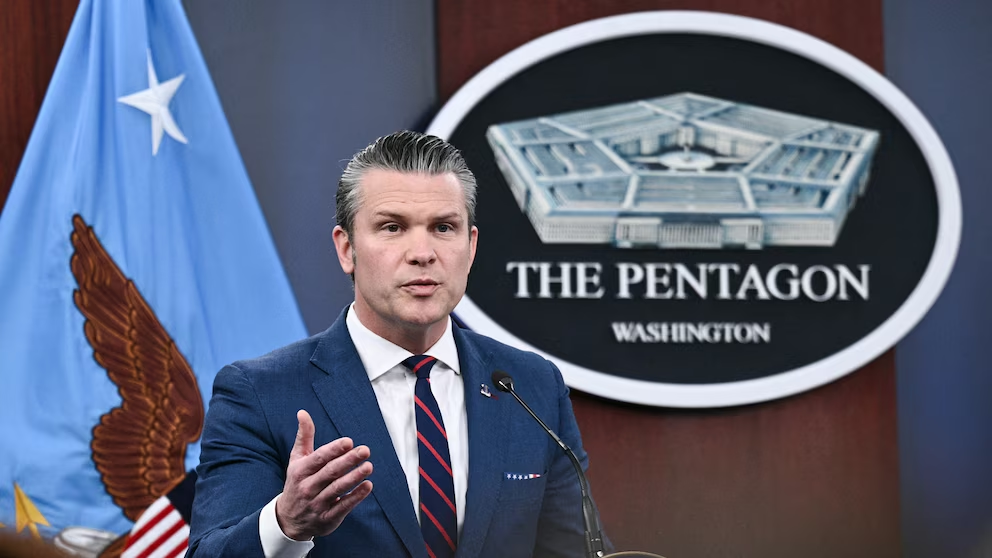
U.S. Defense Secretary Pete Hegseth said Washington is prepared to continue its military campaign against Iran for as long as necessary, highlighting the success of joint U.S. and Israeli operations, including the reported sinking of an Iranian warship in the Indian Ocean.
Speaking at a press conference, Hegseth emphasized that the conflict is still in its early stages and warned that additional U.S. warplanes are being deployed to the Middle East to support ongoing operations.
“We are only four days into this conflict,” Hegseth said. “Conditions are still evolving, additional forces are arriving, and as President Donald Trump has stated, we will take whatever time is necessary to ensure success.”
NATO Intercepts Iranian Missile Near Turkish Airspace
The conflict expanded further after a ballistic missile launched from Iran toward Turkish airspace was intercepted by NATO defense systems in the eastern Mediterranean.
This incident marked the first time Turkey has been directly drawn into the conflict, raising concerns about broader regional escalation. Turkey, which borders Iran to the northwest, is a member of the NATO alliance. According to reports, the missile interception caused no casualties or injuries.
Meanwhile, the United States continues to conduct military operations against Iranian targets, while Israel has intensified airstrikes on sites linked to Iran’s missile and air-defense infrastructure.
In response, Iran has launched attacks on targets inside Israel as well as U.S. military bases and diplomatic facilities across the Middle East.
Iran Searches for New Leader After Khamenei’s Death
Iran is also facing political uncertainty after the death of Supreme Leader Ayatollah Ali Khamenei, who was reportedly killed during an airstrike over the weekend.
Iranian authorities have stated that they will soon appoint a new leader to replace him. However, Israeli Defense Minister Israel Katz warned that any successor could become a potential military target.
Markets React as Investors Monitor Conflict Developments
Financial markets closely monitored developments in the conflict. Wall Street stocks traded higher in early trading, partly supported by reports suggesting possible diplomatic outreach between Iran and the United States.
According to a New York Times report, Iranian officials had explored the possibility of opening discussions with the U.S. regarding terms for ending the conflict. However, U.S. officials remain skeptical about the likelihood of near-term negotiations.
Israeli officials reportedly urged Washington to ignore the outreach, arguing that continued military pressure could further weaken Iran’s military capabilities and possibly destabilize the government in Tehran.
Iran has denied that it contacted the United States regarding potential peace talks.
U.S. Military Conducts Continuous Operations
Concerns are growing that the conflict could last longer than President Trump’s initial estimate of four to five weeks.
A senior U.S. military commander stated that American forces are conducting continuous operations against Iran across multiple domains, including air, sea, cyber, and space.
Admiral Brad Cooper, the commander of U.S. Central Command’s campaign, said the sustained strikes have significantly weakened Iran’s air defense systems and eliminated the country’s operational naval presence in several strategic waterways.
Oil Prices Moderate After Sharp Weekly Gains
The ongoing conflict has also had a major impact on global energy markets. Fears that fighting could disrupt oil and gas shipments have pushed prices sharply higher.
Brent crude, which traded near $73 per barrel before the conflict escalated, has climbed roughly 15% this week. However, prices eased slightly on Wednesday, with Brent futures falling 0.7% to $80.83 per barrel, while U.S. West Texas Intermediate (WTI) crude declined 0.8% to $73.93 per barrel.
Oil prices had surged as much as 8% on Tuesday, but later retreated after President Trump suggested the U.S. Navy could escort oil tankers through the Strait of Hormuz, helping ensure safe shipping routes.
Natural Gas Prices Surge as Supply Disruptions Grow
The conflict has also disrupted natural gas markets, particularly in Europe and Asia. Iranian attacks on a major natural gas facility in Qatar temporarily halted exports from the country, tightening global supply.
Because many countries rely on shipments passing through the Strait of Hormuz, the conflict has increased fears of prolonged energy shortages.
Asian Markets Hit by Rising Energy Costs
Stock markets in Asia were particularly affected by rising energy prices, as many regional economies depend heavily on imported oil and gas transported through the Strait of Hormuz.
Countries such as South Korea and Japan are especially exposed to supply disruptions. South Korea’s Kospi index fell sharply on Wednesday, forcing a temporary halt in trading.
Rising Energy Prices Push Treasury Yields Higher
On Tuesday, concerns about higher energy prices and rising inflation pushed U.S. Treasury yields higher, creating volatility in global financial markets.
Investors now worry that persistent inflation could delay expected interest rate cuts by the Federal Reserve, adding further uncertainty to financial markets already affected by geopolitical tensions.