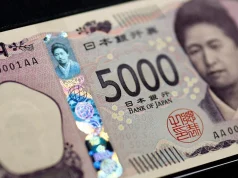
The Japanese yen rose sharply on Monday, keeping currency traders alert for signs of further intervention by Japanese authorities. The move came only days after Japan and the United States reportedly acted together to support the historically weak currency.
Yen Reaches Three-Month High
The yen gained as much as 1% during Asian trading and briefly reached 155.20 against the US dollar. This marked its strongest level in roughly three months.
The currency later gave back part of its advance but remained around 0.7% higher at 156.46 per dollar.
The yen also strengthened against the euro and British pound. These broad gains increased speculation that Japanese authorities may have returned to the foreign exchange market.
Intervention Speculation Grows
Hirofumi Suzuki, chief foreign exchange strategist at SMBC, said the size and timing of the USD/JPY decline meant intervention could not be ruled out.
He also noted that traders had built significant short positions against the yen. As those positions were closed, the resulting buying pressure may have accelerated the currency’s recovery.
An unnamed trader also attributed Monday’s move to a large-scale unwinding of bearish yen positions.
Coordinated Action Supports the Yen
Monday’s advance followed a gain of more than 3% across the final two trading sessions of the previous week.
Japan’s Ministry of Finance confirmed that it had participated in coordinated yen-buying intervention with the United States on Friday. Meanwhile, Bank of Japan data indicated that Tokyo may have purchased as much as $58.97 billion worth of yen on Thursday.
Elias Haddad, global head of markets strategy at BBH, said coordinated currency intervention can have a strong market impact. He added that previous joint US foreign exchange interventions since 1998 had achieved their intended results.
Long-Term Pressure Remains
Despite its latest recovery, the yen has faced persistent pressure for several years.
One major reason has been the Bank of Japan’s cautious approach to raising interest rates. This has kept the gap between Japanese bond yields and overseas yields relatively wide, making the yen less attractive to some investors.
Goldman Sachs analysts said policies encouraging Japanese investors to bring overseas capital back home could provide stronger and more lasting support for the currency.
Dollar Weakens Against Major Currencies
The latest yen-buying activity also placed pressure on the US dollar.
The euro climbed to a six-week high of $1.1559 during early Asian trading. Sterling also remained close to a two-week peak of $1.3470.
The US Dollar Index traded near 99.70 after falling by more than 1.5% during the previous week.
Falling Oil Prices Weigh on the Greenback
Lower oil prices added to the pressure on the dollar.
Oil declined after US President Donald Trump said he had cancelled a planned attack on Iran and confirmed that talks between the two countries would take place on Monday.
Other risk-sensitive currencies also strengthened. The Australian dollar reached a one-month high of $0.7069, while the New Zealand dollar climbed to a two-month peak of $0.59075.
US Jobs Report Comes Into Focus
Investor attention will now turn to Friday’s US nonfarm payrolls report.
The figures could provide fresh information about the strength of the US labour market and influence expectations for the Federal Reserve’s next policy decision.
OCBC analysts said a resilient labour market or signs that inflation is no longer easing could increase pressure on the Fed to maintain a firm stance against rising prices.
With two inflation reports and two employment releases scheduled before the September Federal Open Market Committee meeting, incoming economic data is likely to play a major role in shaping interest-rate expectations.