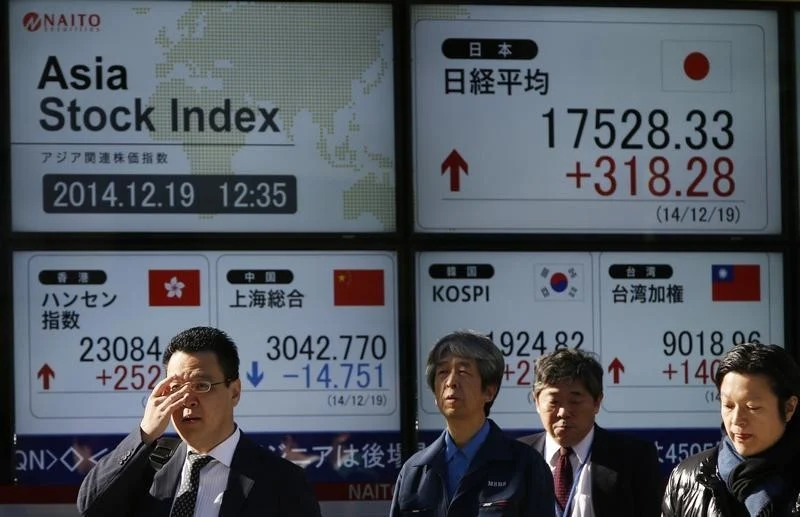
Asian stocks were mostly lower on Friday as a global bond selloff pushed long-term U.S. Treasury yields to multi-year highs.
The rise in borrowing costs weighed on risk appetite across the region, while investors also assessed the latest developments from talks between U.S. President Donald Trump and Chinese President Xi Jinping.
U.S. stock index futures edged slightly higher during Asian trading after Wall Street finished the previous session broadly unchanged.
Nikkei Gains While Other Asian Markets Struggle
Japan’s Nikkei 225 was one of the few major regional indexes to move higher, gaining around 1.3%.
The broader TOPIX index also advanced about 1.4%.
Japanese stocks were supported by a recovery in technology shares following a three-day holiday break. A weaker yen also helped exporters.
Elsewhere, Hong Kong stocks came under pressure.
The Hang Seng Index fell nearly 1.5%, while the Hang Seng TECH Index dropped around 2%.
Australia’s S&P/ASX 200 declined 0.5%.
Markets in mainland China, South Korea and Taiwan were closed for holidays, which kept trading activity relatively light across the region.
U.S. Treasury Yields Reach Multi-Year Highs
The weakness in Asian equities followed a sharp selloff in global government bonds.
The U.S. 10-year Treasury yield traded near 5.19%, after reaching 5.2251% in the previous session.
That marked its highest level in about 19 years.
The 30-year Treasury yield stood near 5.47% after climbing as high as 5.5016%, its strongest level since 2004.
Higher bond yields can reduce the appeal of equities by increasing borrowing costs and offering investors more attractive returns in fixed-income markets.
Bond Yields Rise Across Asia-Pacific
Government bond yields also climbed in other major markets.
Japan’s 10-year government bond yield rose to around 3.115%, its highest level since 1996.
Australia’s 10-year yield also increased, reaching approximately 5.408%.
The move reflected broader concerns that inflation could remain elevated for longer than expected.
Oil Prices Add to Inflation Concerns
Higher oil prices have added to those inflation fears.
Brent crude eased slightly on Friday after gaining more than 3% in the previous session.
The earlier rally followed a Houthi missile attack on Saudi Arabia, which renewed concerns about possible disruptions to Middle Eastern energy supplies.
However, oil prices later gave back some gains after reports suggested that the United States and Iran were discussing a phased agreement to reopen the Strait of Hormuz.
Fed Rate Hike Expectations Increase
The combination of higher energy prices and elevated bond yields has strengthened expectations for further Federal Reserve tightening.
U.S. interest-rate futures were pricing in around a 70% chance of another Fed rate hike in October.
That compares with approximately 53% earlier in the week.
Expectations for higher interest rates have placed additional pressure on risk assets, including equities.
Investors Assess Trump-Xi Summit
Investors were also focused on the outcome of Thursday’s meeting between Donald Trump and Xi Jinping at the White House.
The United States and China agreed to extend their existing trade truce by another two months.
According to U.S. Treasury Secretary Scott Bessent, the extension gives both sides more time to negotiate over several major issues.
These include tariffs, Chinese purchases of U.S. goods, rare-earth supplies and technology restrictions.
Trade Truce Offers Stability but Few Breakthroughs
The extension provided some short-term stability for markets, but several important disagreements between Washington and Beijing remain unresolved.
Investors are now watching to see whether the additional negotiating period can lead to a more durable trade agreement.
For now, the Trump-Xi summit offered limited relief to markets already under pressure from rising bond yields and concerns about tighter monetary policy.
Singapore and India Edge Higher
Elsewhere in Asia, Singapore’s Straits Times Index and India’s Nifty 50 each traded around 0.1% higher.
However, the broader regional picture remained cautious as investors balanced trade developments against rising global borrowing costs.
With Treasury yields elevated and Federal Reserve rate expectations shifting higher, Asian markets are likely to remain sensitive to inflation data, oil prices and upcoming policy signals.