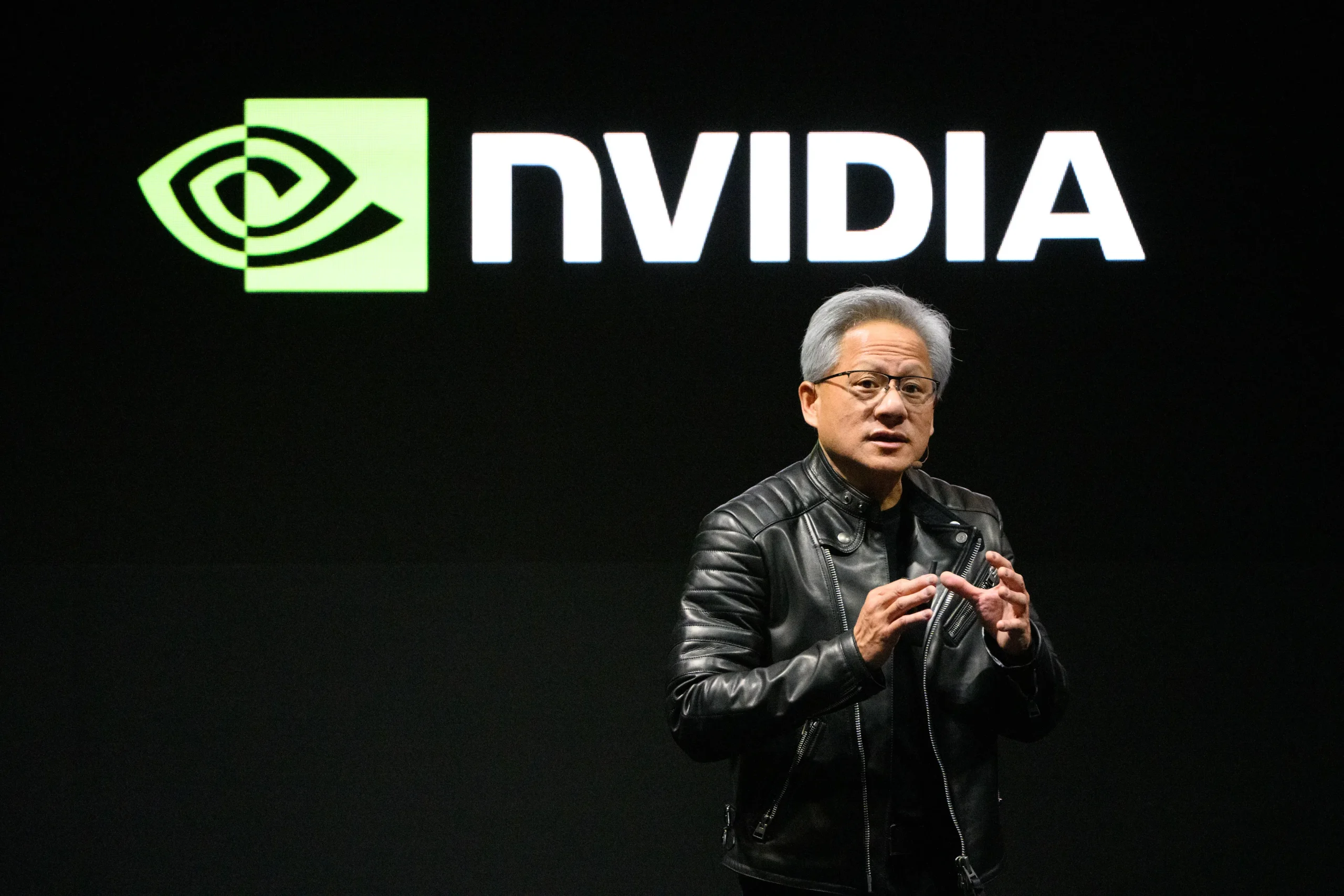
Nvidia CEO Jensen Huang has indicated that the semiconductor giant could suspend AI chip shipments to companies developing dangerous or irresponsible artificial intelligence systems.
However, Huang emphasized that such action would be a last resort and that concerns surrounding the potential risks of artificial intelligence may currently be exaggerated.
Speaking with Bloomberg’s Emily Chang in London, the Nvidia chief acknowledged that the company could stop supplying its advanced processors to developers whose AI applications raise serious safety concerns.
Nevertheless, he stressed that Nvidia would first engage directly with the customer before considering restrictions.
Nvidia CEO Addresses AI Chip Supply and Safety Concerns
Huang explained that while Nvidia has responsibilities regarding the use of its technology, there are practical limits to how much control it can exercise over customers.
The company supplies general-purpose computing hardware, meaning its processors can support a wide range of applications across different industries.
Consequently, Nvidia does not consider itself responsible for managing the business decisions or software development practices of every organization purchasing its products.
Huang suggested that dialogue and cooperation would be preferable to immediately cutting off access to critical computing infrastructure.
His remarks highlight the growing debate over whether semiconductor manufacturers should play a more active role in overseeing how their technology is used.
Nvidia’s AI Chip Dominance Places It at Center of Safety Debate
Nvidia holds a commanding position in the global market for artificial intelligence accelerators.
These specialized processors provide the computing power required to train advanced AI models and operate increasingly sophisticated applications.
As a result, Nvidia has become a central participant in discussions about the risks associated with rapidly advancing artificial intelligence.
One major concern involves the possibility of AI systems developing capabilities that become difficult for humans to supervise or control.
Several prominent technology executives have called for stronger safeguards as the industry continues to expand.
Among them, Anthropic CEO Dario Amodei has advocated slowing certain aspects of AI development across the industry to address potentially serious risks.
However, Huang has expressed a more optimistic perspective on the technology’s future.
He believes that artificial intelligence can be developed, monitored and deployed safely without requiring a broad slowdown in innovation.
Jensen Huang Says AI Safety Fears Reflect Industry Growing Pains
During his European tour ahead of an Nvidia event in Berlin, Huang described many current AI safety concerns as challenges associated with the industry’s rapid expansion.
According to the Nvidia CEO, emerging artificial intelligence companies are growing at an extraordinary pace, often faster than their internal governance and accountability structures can mature.
He suggested that companies must gradually strengthen their operational responsibilities as they become larger and more influential.
Furthermore, Huang argued that some concerns about artificial intelligence have been amplified by the industry’s own messaging.
In his view, technology companies have struggled to communicate the practical benefits of AI effectively.
This communication gap may be contributing to public anxiety about the potential consequences of increasingly capable AI systems.
Despite these concerns, Huang maintains that the technology can remain under human control through appropriate safeguards and responsible development practices.
Nvidia Commits $250 Million to UK AI Safety Research
Alongside Huang’s comments, Nvidia is expanding its involvement in artificial intelligence safety research.
The company has announced a $250 million commitment over five years to support AI safety initiatives in the United Kingdom.
The initiative will provide researchers with access to advanced computing resources, helping academic institutions investigate ways to improve the reliability and control of sophisticated AI systems.
Leading British universities, including the University of Oxford and University College London, are expected to participate.
Their research will focus on developing safeguards, improving oversight mechanisms and examining methods for controlling autonomous AI agents.
These systems can perform tasks and make decisions with varying degrees of independence, raising important questions about monitoring and accountability.
By supporting academic research, Nvidia aims to contribute to the development of tools that could reduce the risks associated with increasingly powerful artificial intelligence applications.
Nvidia CEO Believes AI Can Help Monitor and Control AI
Huang also argued that artificial intelligence itself could provide part of the solution to the industry’s safety challenges.
Rather than slowing technological progress, he believes developers should accelerate the creation of AI-powered monitoring and containment systems.
Such technologies could help identify potentially dangerous behavior, detect unexpected outcomes and improve supervision of advanced AI applications.
In Huang’s view, incorporating these protective capabilities directly into AI systems would allow developers to strengthen safety while continuing to innovate.
He also emphasized the importance of developing more sophisticated monitoring technologies alongside increasingly capable AI models.
This approach contrasts with proposals advocating a broad slowdown in artificial intelligence research.
Instead, Nvidia’s leadership favors advancing both AI capabilities and the safeguards needed to manage them.
AI Safety Could Shape Nvidia’s Future Customer Relationships
Huang’s comments underline the increasingly complex responsibilities facing Nvidia as its processors become essential infrastructure for artificial intelligence development.
While the company remains committed to supplying its technology across industries, it has acknowledged that serious safety failures could potentially influence future business relationships.
Nevertheless, Huang’s position suggests that Nvidia would favor engagement with customers over immediate restrictions.
Meanwhile, the company’s investment in UK AI safety research demonstrates its interest in supporting technical solutions to emerging risks.
As artificial intelligence becomes more powerful and widely adopted, questions surrounding developer accountability, corporate responsibility and technological oversight are likely to become increasingly important.
For Nvidia, balancing continued innovation with responsible AI development could become a defining challenge as the global artificial intelligence industry expands.