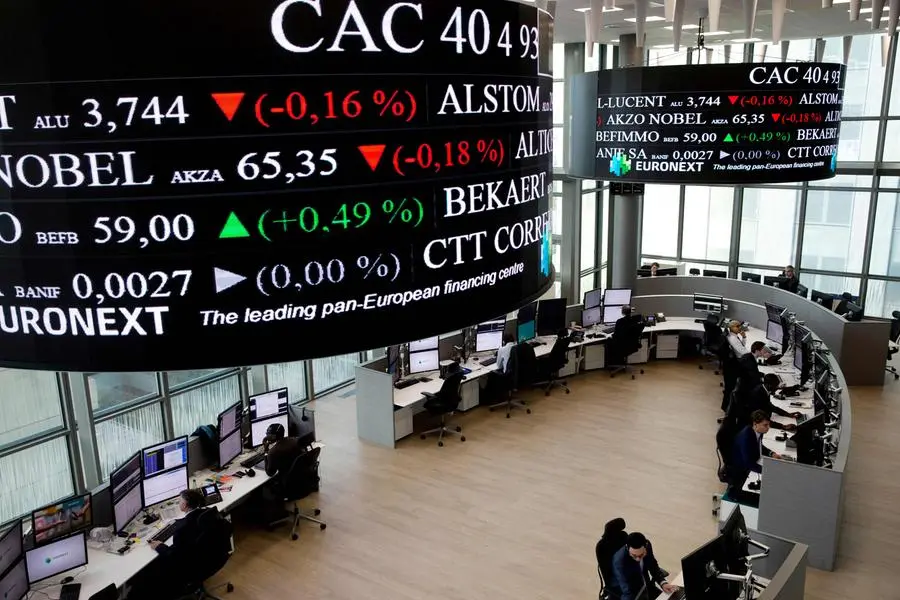
European stocks declined on Tuesday, October 20, as growing political instability in France and escalating Middle East tensions weighed on investor confidence. Concerns about rising oil prices and the financial sustainability of artificial intelligence investments added further pressure to regional markets.
The pan-European STOXX 600 index fell 0.3%, reversing some of its recent gains as investors reduced exposure to European equities and government bonds.
France’s escalating civil unrest remained a major concern, while rising energy prices threatened to intensify inflationary pressures across the continent.
European Stocks Fall as French Political Unrest Intensifies
Major European stock indexes moved lower as investors assessed the economic and political consequences of widespread protests in France.
France’s CAC 40 declined 0.1%, extending losses after falling more than 1% during the previous trading session.
Germany’s DAX dropped 0.4%, while London’s FTSE 100 and Italy’s FTSE MIB each retreated 0.2%.
The declines reflected growing uncertainty surrounding France’s political stability and its potential impact on broader European financial markets.
Following several days of violent demonstrations, looting and clashes with police, French authorities introduced nighttime curfews in parts of major cities, including Paris and Nice.
The unrest was largely driven by public frustration over rising living costs and deteriorating public services.
French Bond Market Faces Rising Investor Concerns
Political instability also affected France’s sovereign debt market, increasing uncertainty among international investors.
French government bonds experienced their sharpest daily selloff in nearly a month on Monday as concerns about the country’s fiscal and political outlook intensified.
Market indicators of sovereign credit risk also came under pressure, reflecting increased caution toward French government debt.
Investors became increasingly concerned about the government’s ability to maintain stability while addressing economic challenges and public dissatisfaction.
However, Tuesday’s decline in European equities remained relatively contained compared with the previous session’s bond market turbulence.
Institutional investors continued to balance French political risks against upcoming corporate earnings announcements, which could provide fresh direction for European stocks.
AI Investment Concerns Weigh on Global Stock Markets
Artificial intelligence remained another major influence on investor sentiment as global markets prepared for a busy corporate earnings week.
Investors are increasingly examining how technology companies finance their expanding AI operations and whether substantial infrastructure investments can generate sustainable profits.
Concerns about debt-funded AI spending and uncertain returns contributed to a sharp selloff in global technology stocks during the previous week.
As a result, corporate capital expenditure plans have become an important indicator for assessing the outlook for technology shares.
Upcoming financial updates from major companies, including Meta Platforms, are expected to provide additional insight into AI infrastructure spending.
Meta’s results on Wednesday will be particularly important as investors assess the company’s investment plans and expectations for future profitability.
The broader earnings calendar also includes anticipated updates from other major technology and industrial businesses.
ABB Shares Drop Despite Strong AI Data Centre Demand
European industrial stocks also faced selling pressure as investors reacted to corporate earnings announcements.
Shares of Swiss engineering group ABB declined 4.7%, despite the company reporting continued strong demand for equipment supporting artificial intelligence data centres.
ABB’s third-quarter results were broadly in line with market expectations.
The company highlighted ongoing investment in data centre infrastructure, reflecting the growing electricity and technology requirements associated with AI development.
However, the share price decline suggested that investors were looking for stronger financial performance or more encouraging guidance.
Additional corporate updates from EssilorLuxottica and Michelin are expected to offer further insight into European consumer spending, manufacturing activity and industrial profitability.
These results could help investors evaluate the broader economic environment across Europe.
Oil Prices Approach Five-Month Highs Amid Houthi Attacks
Oil prices climbed on Tuesday as renewed geopolitical tensions raised concerns about energy supply disruptions in the Middle East.
Brent crude futures traded near their highest levels in five months, supported by increasing uncertainty surrounding regional oil production and transportation.
The latest gains followed claims from Yemen’s Houthi movement that it had launched coordinated drone and missile attacks against strategic Saudi Arabian infrastructure.
According to the group, the operations targeted several energy and transportation facilities, including a Saudi Aramco installation in Yanbu and the Shaybah oilfield.
The Houthis also claimed attacks involving military and airport facilities in Riyadh and Abha.
The claims raised concerns about potential risks to Saudi Arabia’s oil infrastructure, although the extent of any resulting damage was not established in the report.
Strait of Hormuz Risks Add to Global Energy Supply Fears
Energy traders were also monitoring reports of renewed threats to commercial shipping routes in the Persian Gulf.
The developments increased concerns about the reliability of crude oil and liquefied natural gas shipments from the region.
Disruptions to major maritime energy routes could affect global supply availability and increase transportation expenses.
As a result, traders have incorporated a higher geopolitical risk premium into crude oil prices.
Elevated energy prices may benefit certain oil and gas producers by increasing revenues.
However, sustained increases could also raise operating costs for businesses, weaken household purchasing power and intensify inflationary pressures.
These risks are particularly important for European economies that depend on imported energy supplies.
European Stock Market Outlook: Political Risks and Earnings in Focus
The outlook for European stocks remains uncertain as investors assess several overlapping economic and geopolitical challenges.
Political instability in France has increased concerns about sovereign debt, financial stability and investor confidence across the region.
Meanwhile, rising oil prices threaten to complicate the inflation outlook, potentially affecting expectations for European Central Bank monetary policy.
Artificial intelligence investment spending is another important factor, particularly as major technology companies prepare to release financial results.
Stronger-than-expected earnings and encouraging corporate guidance could help stabilise markets.
However, further political unrest, disappointing financial results or additional disruptions to Middle Eastern energy supplies could maintain downward pressure on European equities.
For now, investors remain cautious as European stocks struggle to regain momentum amid persistent political, economic and geopolitical uncertainty.