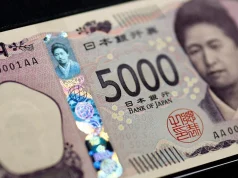
The Japanese yen weakened on Monday and was on track for its fifth decline in six trading sessions. Investors remained alert for any signs that Japanese authorities could step into the currency market, while the US dollar strengthened as traders reassessed the outlook for US interest rates.
Yen Traders Watch for Possible Intervention
Market participants were closely monitoring Tokyo for indications of possible currency intervention. Japanese markets were closed for a three-day holiday, which reduced liquidity and increased the risk of larger-than-normal price swings.
The yen fell 0.38% against the US dollar to around 157.48 per dollar.
Thin trading conditions have previously created opportunities for Japanese authorities to intervene in the foreign exchange market. As a result, traders remained cautious despite uncertainty over whether officials would act at current exchange-rate levels.
Bank of Japan Rate Hike Fails to Support Yen
The Bank of Japan raised interest rates on Friday to 1.25%, the highest level in 31 years.
However, the decision failed to provide lasting support for the Japanese yen. Two policymakers voted against the move, while the central bank offered limited guidance suggesting further aggressive tightening.
This left investors hesitant to increase their exposure to the currency.
Following the BOJ decision, the yen initially dropped sharply before recovering some ground. The rebound came after the Nikkei newspaper reported that Japanese authorities had carried out rate checks.
Rate checks are closely watched by currency traders because they can sometimes precede direct foreign exchange intervention.
Marc Chandler, chief market strategist at Bannockburn Capital Markets, said investors were particularly cautious because previous Japanese intervention had taken place during holiday periods.
However, he suggested that intervention around the 157 to 157.50 area was not necessarily the most likely scenario.
The dollar-yen pair has recently traded as high as the mid-158 region, while firm US interest rates continue to support the dollar.
Dollar Strengthens as US Rate Expectations Rise
The US dollar gained as traders continued to assess the possibility of further Federal Reserve interest rate increases.
The dollar index, which tracks the greenback against a basket of major currencies including the euro and yen, rose 0.13% to 100.40.
The index had already gained 1.1% during the previous week, marking its strongest weekly performance since early June.
Higher US rate expectations have helped support the dollar because rising yields can make dollar-denominated assets more attractive to global investors.
Markets Price in Higher Chance of Fed Rate Hike
Expectations for another Federal Reserve rate increase have risen significantly.
According to CME FedWatch data, traders were pricing in a 55.4% probability of at least a 25-basis-point rate hike at the Federal Reserve’s October meeting.
That compared with a probability of 43.5% one week earlier.
Comments from Federal Reserve officials also reinforced expectations that monetary policy could remain restrictive.
Chicago Fed President Austan Goolsbee said US inflation may be moving beyond the impact of tariff and energy shocks experienced over the past 18 months.
Instead, strong domestic demand may now be contributing more heavily to inflationary pressure.
If that continues, the Federal Reserve could need to raise interest rates at a faster pace to bring inflation under control.
St. Louis Fed President Alberto Musalem expressed a similar view. He said further rate increases may be required to control inflation caused by strong demand and broader commodity price pressures.
Global Central Banks Remain Focused on Inflation
The Bank of Japan is not the only major central bank tightening monetary policy.
Both the Federal Reserve and the European Central Bank have also raised interest rates this month.
Policymakers have warned that additional tightening may be required as inflation remains elevated. Commodity and energy prices linked partly to the continuing conflict in the Middle East have added further pressure to the global inflation outlook.
As a result, expectations for interest rates remain an important driver across currency markets.
Euro Falls After German Election Result
The euro weakened 0.14% against the US dollar to around $1.1467.
Political developments in Germany added pressure to the currency after the Alternative for Germany party finished first in state elections in northeastern Germany.
Chancellor Friedrich Merz’s conservative party suffered its weakest regional election result in Germany’s postwar era, adding another layer of political uncertainty for Europe’s largest economy.
Meanwhile, the British pound fell 0.18% to approximately $1.3369.
Yen Reverses Earlier Gains
The yen had strengthened significantly earlier in September, reaching its highest level in seven months below 153 per dollar.
At the time, traders were expecting the Bank of Japan to accelerate its interest rate increases. Early indications that Japanese investors were bringing capital back into the country also supported the currency.
However, the yen has since reversed much of that advance.
The combination of strong US interest rates, cautious BOJ guidance and uncertainty over future Japanese monetary policy has again placed downward pressure on the currency.
Chinese Yuan Steady Ahead of US-China Summit
Elsewhere in the foreign exchange market, the US dollar slipped 0.03% against the offshore Chinese yuan to around 6.693.
Investors were preparing for a summit in Washington between US President Donald Trump and Chinese President Xi Jinping.
The meeting comes as the world’s two largest economies continue discussions on trade, technology and broader economic relations.
US Treasury Secretary Scott Bessent also said senior officials from the United States and China are expected to meet again in roughly two months in Shenzhen.
Those discussions are expected to focus partly on artificial intelligence risks and communication protocols between the two countries.
Yen Intervention Risk Remains in Focus
For currency traders, the possibility of Japanese intervention remains one of the main risks surrounding USD/JPY.
The yen’s decline toward the 157-158 area has increased market attention on comments and actions from Japanese officials.
At the same time, strong US interest-rate expectations continue to support the dollar.
Unless the gap between US and Japanese monetary policy expectations begins to narrow significantly, USD/JPY could remain sensitive to both Federal Reserve signals and any indication that Tokyo is preparing to intervene in currency markets.