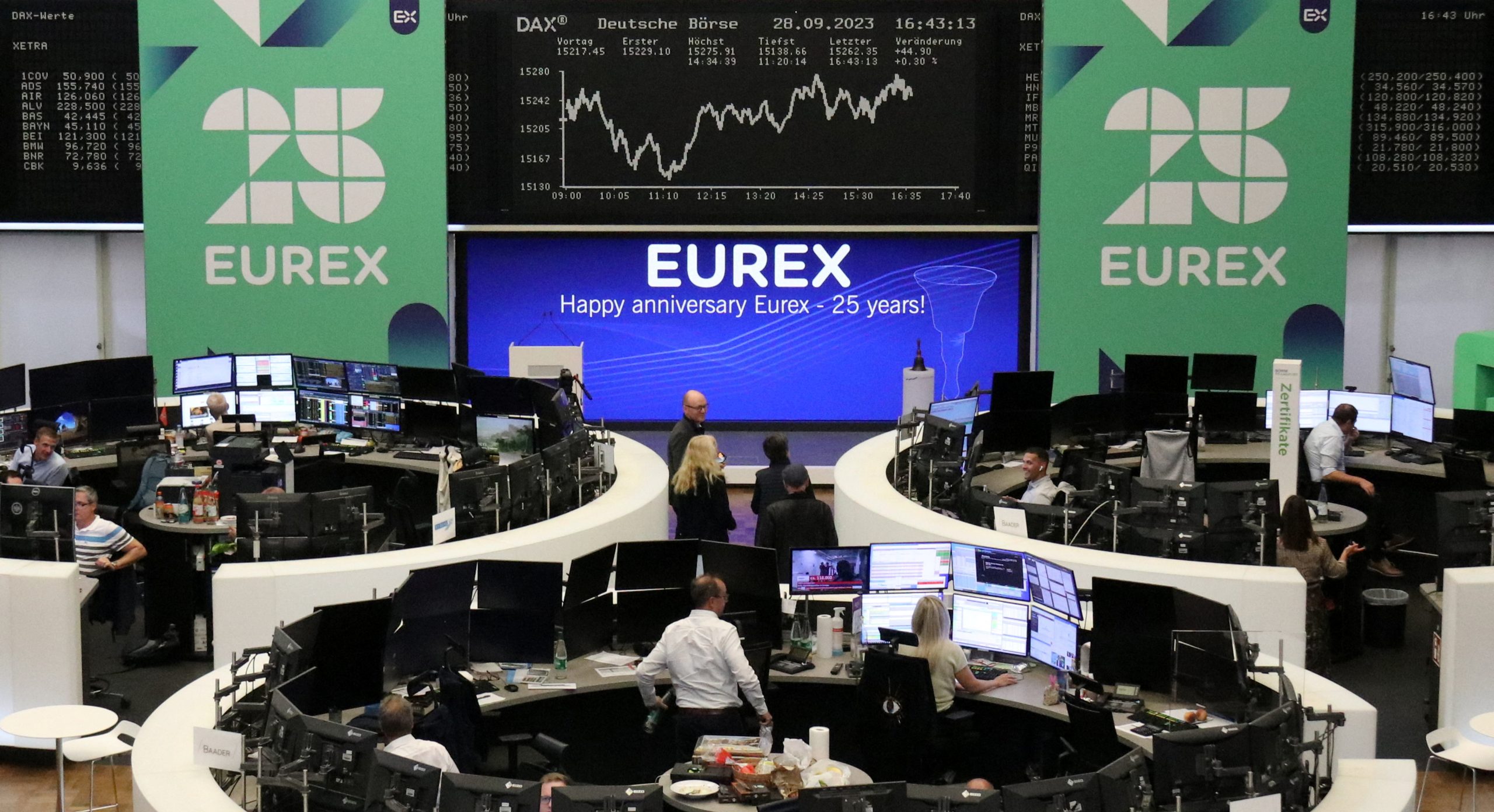
European stocks traded mostly flat on Monday, staying close to three-week lows as escalating tensions between the United States and Iran kept investors cautious.
The Stoxx Europe 600 Index slipped 0.1% in early trading, remaining near levels last seen in early August.
Germany’s DAX, France’s CAC 40, and the FTSE 100 in London were little changed as markets waited for more clarity on geopolitical and monetary policy risks.
U.S.-Iran Tensions Weigh on European Markets
Investor attention remained firmly focused on the Persian Gulf after Washington intensified its economic pressure on Tehran over the weekend.
The United States announced plans for a sweeping new sanctions package aimed not only at Iran, but also at foreign countries and trading partners that continue supporting the Iranian economy.
U.S. officials described the measures as an unprecedented financial offensive designed to increase pressure on Tehran.
Iran responded with a warning that it could halt energy exports from the Persian Gulf if Washington continues its economic campaign.
Markets Await Details of New Iran Sanctions
U.S. Treasury Secretary Scott Bessent is expected to hold a press conference at 1:00 p.m. EDT on Monday to provide further details of the sanctions.
Investors are particularly interested in whether the measures will target countries, companies or financial institutions that continue doing business with Iran.
The possibility of secondary sanctions has increased uncertainty across energy, currency and equity markets.
Brent Oil Pulls Back After Strong Weekly Gain
Oil prices provided some temporary relief for European markets on Monday.
Brent crude futures fell around 1.5% to approximately $91.80 per barrel, following a gain of roughly 5% during the previous week.
However, concerns over global energy supplies remain elevated.
Shipping restrictions through the Strait of Hormuz continue to limit crude oil and liquefied natural gas flows through one of the world’s most important energy routes.
The disruption has added a risk premium to oil prices and contributed to concerns about higher global inflation.
Nvidia Earnings Become Major Market Catalyst
Investors are also preparing for a major week of corporate earnings and central-bank events.
Nvidia is scheduled to release its second-quarter results after the U.S. market close, with the report expected to have a major influence on global technology stocks.
The company’s results will be closely watched for signs that spending on artificial intelligence infrastructure remains strong.
Technology companies have invested heavily in data centers and AI computing capacity, often supported by substantial bond issuance.
Any signs of weaker Nvidia revenue growth or disappointing guidance could therefore put pressure on technology-heavy stock markets in both the United States and Europe.
AI Spending Remains Key for Tech Valuations
Nvidia’s earnings could also provide an important test for the elevated valuations of major technology companies.
Investors want to know whether strong demand for AI chips and data-center infrastructure can continue to justify current market expectations.
A slowdown in AI-related capital spending could trigger broader selling across semiconductor and technology stocks.
On the other hand, stronger-than-expected results could help restore confidence in the sector.
Jackson Hole Speech in Focus
Monetary policy will also remain a key driver for markets this week.
Federal Reserve Chair Kevin Warsh is expected to deliver a closely watched speech at the Jackson Hole Economic Policy Symposium.
Investors will analyze his comments for clues about the Federal Reserve’s next interest-rate decision.
Markets are trying to determine whether the Fed will keep rates unchanged in September or consider another increase if inflationary pressures remain persistent.
Higher energy prices caused by Middle East tensions could complicate the central bank’s outlook.
Bond Yields and Inflation Could Drive Market Volatility
Bond and equity investors will pay particular attention to any comments regarding inflation, interest rates and financial conditions.
Persistent energy inflation could make it more difficult for the Federal Reserve to ease monetary policy.
At the same time, elevated bond yields could continue putting pressure on equity valuations, especially in high-growth sectors such as technology.
BW Offshore Shares Drop After Forecast Cut
Among individual European stocks, BW Offshore fell around 14% after the company lowered its pre-tax profit forecast.
The sharp decline highlighted the importance of company-specific earnings updates during an already uncertain trading environment.
European Stocks Remain Cautious
European markets could remain volatile as investors assess several major risks at the same time.
The upcoming U.S. sanctions on Iran, continued disruption in the Strait of Hormuz, Nvidia earnings and the Federal Reserve’s Jackson Hole meeting are all likely to influence market sentiment.
Until investors receive greater clarity on geopolitical tensions and monetary policy, European equities may continue to struggle for a clear direction.