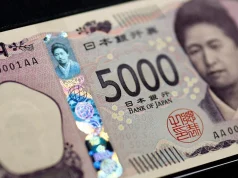
The U.S. dollar and euro traded within narrow ranges on Tuesday, while the Japanese yen weakened slightly. Currency markets were assessing fresh comments from U.S. Treasury Secretary Scott Bessent supporting Japan’s efforts to stabilize its currency.
The Bloomberg Dollar Spot Index was nearly unchanged. Meanwhile, the euro and British pound also showed little movement.
The yen slipped around 0.1% against the dollar, pausing after a strong multi-day rally sparked by coordinated intervention from U.S. and Japanese authorities.
U.S. Pledges Support for Japan’s Yen Strategy
During a CNBC interview, Bessent said the U.S. administration was prepared to take all necessary measures to help Japan stabilize the yen.
His comments followed confirmation that the U.S. Treasury had participated alongside Japanese authorities in an aggressive currency market operation.
Bessent stressed that any support would be designed to benefit both the U.S. economy and American taxpayers.
The dollar initially fell by about 30 basis points against the yen after his remarks. However, it later recovered some of those losses as wider financial markets stabilized.
Historic U.S.-Japan Currency Intervention
The coordinated yen-buying operation was the first joint currency intervention by the United States and Japan since 1998.
Authorities acted after the yen weakened beyond 162 per dollar, reaching its lowest level in approximately 40 years during late July.
Despite the volatility, the Japanese currency recorded a monthly gain of around 1.6% against the dollar in July.
Intervention Puts Pressure on USD/JPY
Market strategists said Washington’s willingness to commit resources could make the intervention more effective than action taken by Japan alone.
Unilateral intervention often faces limits because a central bank has only a finite amount of foreign currency reserves. However, direct U.S. support could reduce that constraint and increase the cost of betting against the yen.
Both countries have also indicated that they may use the Federal Reserve’s Foreign and International Monetary Authorities Repo Facility during future operations. This could help limit disruption across global financial markets.
Brown Brothers Harriman strategist Elias Haddad said rebounds in USD/JPY could remain limited. He argued that any strengthening of the pair may provide selling opportunities because coordinated intervention has created a stronger ceiling for the exchange rate.
Geopolitical Uncertainty Limits Risk Appetite
Most major G-10 currencies remained confined to narrow trading ranges.
Investors also monitored conflicting geopolitical reports involving negotiations over access through the Strait of Hormuz. U.S. President Donald Trump described the discussions as a final opportunity for an agreement, although Iranian officials reportedly rejected that characterization.
The uncertainty discouraged investors from taking larger risks in the currency market.
At the same time, a drop of around 4% in global crude oil prices helped ease some short-term inflation concerns.
U.S. Jobs Data Moves Into Focus
Foreign exchange traders are now preparing for several important U.S. economic reports.
The week’s data calendar begins with the JOLTS job openings report and concludes with Friday’s closely watched nonfarm payrolls figures.
Signs of resilient U.S. economic activity have supported the dollar. However, analysts said that support has been partly offset by doubts over whether the Federal Reserve’s inflation concerns will lead to a convincing change in monetary policy.
Asian Currencies Trade Mixed
Elsewhere in Asia, the South Korean won strengthened slightly, with the USD/KRW pair falling around 0.3%.
The Indian rupee remained largely unchanged ahead of the Reserve Bank of India’s policy decision. Economists expect the central bank to keep its benchmark repo rate at 5.25%.
Inflation remains within the RBI’s permitted range, although it moved above the central bank’s 4% target in June.
The Australian dollar performed more strongly, with the AUD/USD pair rising approximately 0.4%.