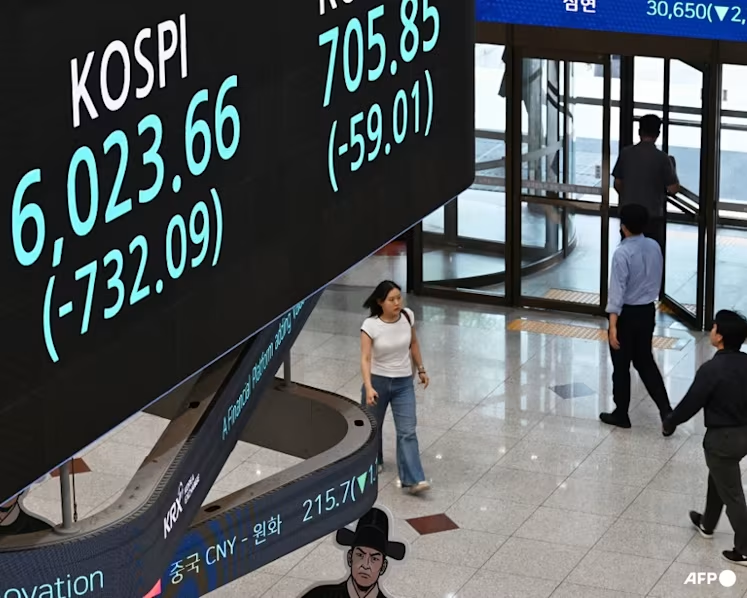
Asian stocks moved lower on Tuesday as rising oil prices and higher bond yields revived concerns about inflation. Japan and South Korea led the declines after several sessions of strong gains.
Investor sentiment weakened further after the U.S.-Iran ceasefire expired and expectations for a rapid diplomatic resolution faded.
Brent crude climbed above $91 per barrel, while the U.S. 30-year Treasury yield reached its highest level since 2007. The combination added fresh pressure on global risk assets.
The MSCI AC Asia Pacific Index fell around 0.8%. Meanwhile, Nasdaq 100 futures dropped 0.7% and S&P 500 futures declined 0.4%.
Rising Bond Yields Pressure Technology Stocks
Higher long-term bond yields are creating additional pressure for technology shares, which had been among the main drivers of Asia’s recent market rebound.
Japan’s 10-year government bond yield climbed close to 2.95%, reaching its highest level in around three decades.
The increase reflected stronger expectations for further Bank of Japan policy tightening, as well as growing concerns about Japan’s fiscal outlook.
Nikkei and KOSPI Lead Asian Market Losses
Japan’s Nikkei 225 fell about 2.5%, ending a five-session winning streak. The broader TOPIX index declined around 1.1%.
Technology and semiconductor stocks were among the biggest contributors to the Nikkei’s losses as rising yields and higher energy prices weighed on growth-sensitive shares.
Kioxia Holdings dropped 7.6%, while Murata Manufacturing fell 9.6%. TDK declined 3.7%, and Sony lost around 1.2%.
South Korea’s KOSPI fell around 1.6% after initially gaining more than 3% following Monday’s market holiday.
South Korean Chip Stocks Come Under Pressure
South Korean semiconductor stocks also traded lower.
Samsung Electronics declined around 1.4%, while LG Innotek fell approximately 1.3%. SK Hynix moved against the broader trend, gaining around 1.4%.
The weakness came despite continued investment in artificial intelligence infrastructure.
Nvidia has agreed to support up to $105 billion in financing for a major OpenAI data-center campus in Ohio, highlighting the enormous level of capital being directed toward the global AI infrastructure expansion.
However, rising yields, oil prices and geopolitical risks appeared to outweigh enthusiasm surrounding AI investment during Tuesday’s session.
AI Boom Still Supports Broader Market Sentiment
DBS analysts indicated that the broader environment for equities remains relatively supportive.
Strong corporate earnings, continued artificial intelligence investment and expectations for a less hawkish Federal Reserve continue to provide support for risk assets.
However, analysts warned that risks could increase if the AI rally loses momentum, geopolitical tensions worsen or the Federal Reserve is forced to tighten monetary policy again.
China and Hong Kong Stocks Move Lower
Chinese markets also weakened as momentum in technology shares faded.
The CSI 300 declined around 0.8%, while the Shanghai Composite lost approximately 0.4%. Hong Kong’s Hang Seng Index fell around 0.7%.
Technology stocks in mainland China and Hong Kong were among the weaker performers.
Foxconn Industrial Internet dropped 3.1%, Luxshare Precision declined 2.3% and Semiconductor Manufacturing International Corp slipped around 0.5%.
Among major Hong Kong-listed technology companies, JD.com fell 2.7%, Meituan dropped 3.4% and Tencent declined 1.8%.
Energy Stocks Gain as Oil Prices Climb
Energy companies moved higher as rising crude prices improved the outlook for oil producers.
Japan’s Inpex gained around 2.7%, while Eneos rose approximately 2.2%. In Hong Kong, CNOOC advanced close to 2%.
The gains followed renewed concerns about oil supply disruptions in the Middle East after the U.S.-Iran ceasefire expired.
Iran has signaled that it could adopt a more aggressive posture, while U.S. President Donald Trump has taken a tougher position in negotiations.
The escalation has renewed uncertainty surrounding the Strait of Hormuz, a critical shipping route for global oil supplies.
Mixed Performance Across Other Asian Markets
Elsewhere in the region, market performance was mixed.
Australia’s S&P/ASX 200 edged around 0.2% higher, while Singapore’s FTSE Straits Times Index fell approximately 1.3%.
India’s Nifty 50 slipped around 0.3%, while Indonesia’s IDX Composite gained about 1.3%.
Australian economic data also provided some positive signals.
The Westpac-Melbourne Institute Consumer Sentiment Index rose 6% to 88.9 in August, recording its second consecutive monthly improvement.
Bank Indonesia Decision in Focus
Investors are now turning their attention to Wednesday’s Bank Indonesia interest rate decision.
Market expectations currently point toward the central bank keeping monetary policy unchanged after maintaining its policy rate at 5.75% in July.
The decision will be closely watched as Asian markets continue to balance higher oil prices, rising bond yields, geopolitical risks and changing expectations for global monetary policy.