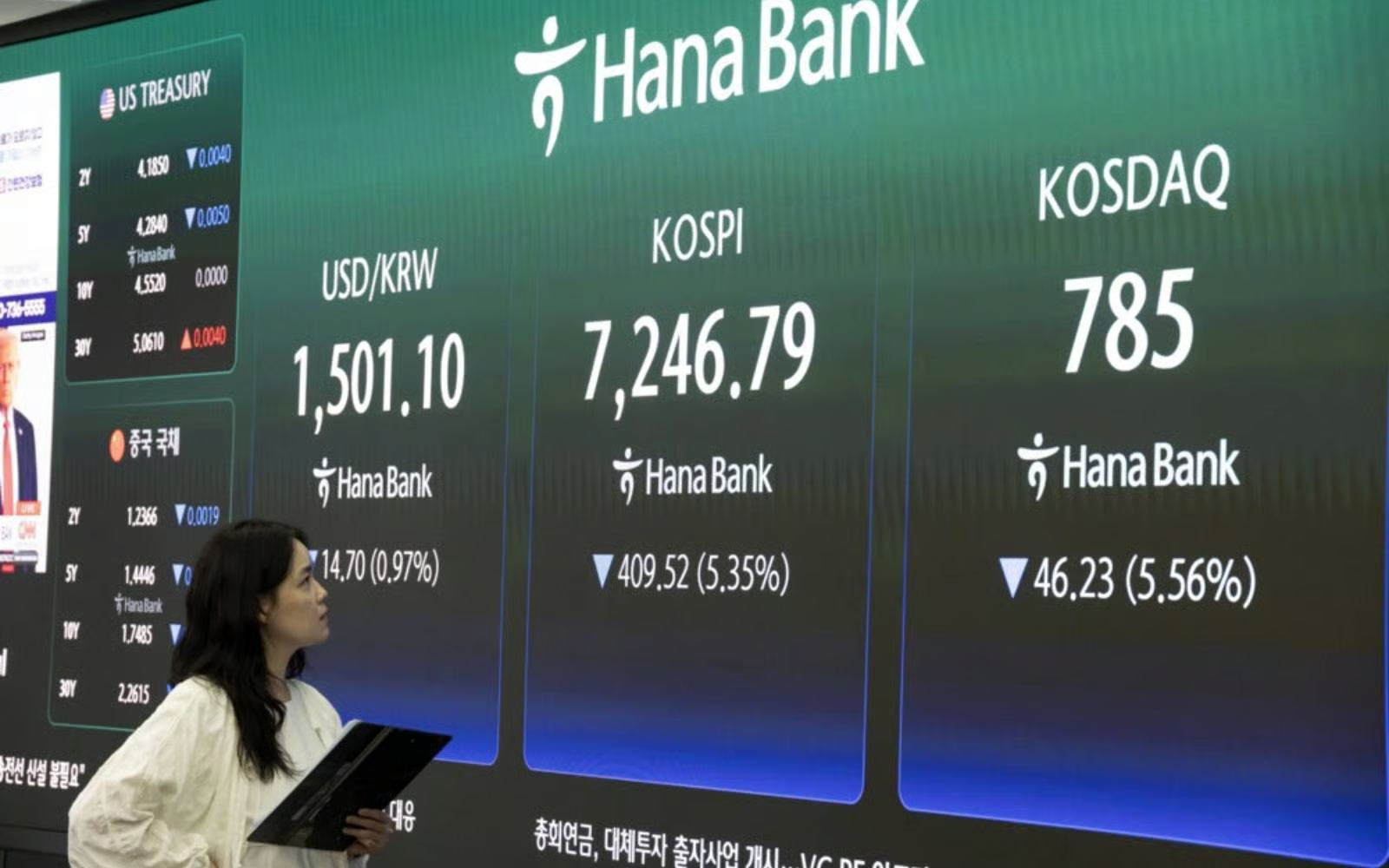
Asian stocks rebounded on Friday as investors returned to semiconductor and technology shares following a sharp market selloff fueled by concerns over artificial intelligence investments and increasing competition from China.
South Korea and Japan led the regional recovery, with the KOSPI climbing 3.3% and Japan’s Nikkei 225 advancing 1.7%. Both indexes recovered part of their previous session’s heavy losses as investors bought technology stocks at lower valuations.
The broader MSCI Asia Pacific Index gained 1.1%, reflecting improved sentiment across regional equity markets.
However, Indonesia experienced a dramatically different trading session. The Jakarta Composite Index plunged more than 11% after MSCI proposed downgrading the country’s stock market classification, triggering its steepest daily decline since January 1998.
Asian Stocks Recover as Semiconductor Shares Rebound
South Korean semiconductor companies were among the strongest performers as investors returned to stocks that had suffered significant losses during Thursday’s market rout.
Samsung Electronics advanced 2.9%, while memory chip manufacturer SK Hynix gained 2.22%.
The recovery followed a particularly difficult session for South Korean equities, during which the KOSPI plunged nearly 8% and triggered a circuit breaker amid heavy selling pressure.
Japanese technology stocks also participated in the rebound.
Memory chip producer Kioxia climbed 3.3%, while electronics giant Sony gained 2.9%.
Meanwhile, Taiwan’s technology sector delivered mixed results. Foxconn advanced 1.3%, although optical component manufacturer Largan declined 5.7%.
The renewed buying interest helped stabilize Asian stock markets following concerns about stretched technology valuations and the financial sustainability of the artificial intelligence boom.
Nevertheless, investors remained cautious about whether the recovery could develop into a sustained market rally.
AI Investment Concerns Continue to Pressure Technology Stocks
Despite Friday’s rebound, concerns surrounding the enormous costs of artificial intelligence infrastructure development continued to influence global financial markets.
Investors have become increasingly worried about the substantial debt accumulated by companies financing large-scale AI projects.
Cloud computing provider CoreWeave has emerged as a particular focus of these concerns.
The company’s shares suffered a sharp selloff after reports suggested that yields on some of its bonds had reached levels associated with financially distressed debt.
CoreWeave shares plunged 15.5% on Wednesday and extended their losses early Thursday before recovering part of the decline.
The developments raised questions about whether companies investing billions of dollars in AI infrastructure can generate sufficient revenue to justify their borrowing costs.
Higher financing expenses could also create additional challenges for technology businesses that depend heavily on external capital.
These concerns contributed to broader selling across semiconductor manufacturers, cloud computing companies and other AI-related stocks.
Chinese Chipmakers Increase Competition With Samsung and SK Hynix
Growing competition from Chinese semiconductor manufacturers has added another challenge for established technology companies.
ChangXin Memory Technologies (CXMT) recently reported progress in developing a next-generation dynamic random-access memory architecture.
The technological development could potentially strengthen China’s position in the global memory chip industry.
It may also increase competitive pressure on major South Korean manufacturers, including Samsung Electronics and SK Hynix.
However, CXMT shares rebounded nearly 5% during Friday’s trading session as investors reassessed the semiconductor sector’s outlook.
Elsewhere in China, equity markets recorded broad gains.
Hong Kong’s Hang Seng Index advanced 1.2%, while China’s CSI 300 gained 0.9%. The Shanghai Composite also climbed 1.1%.
Taiwan’s benchmark stock index increased 0.7%, although Taiwan Semiconductor Manufacturing Company (TSMC) slipped 0.4%.
The decline came despite TSMC reporting record quarterly profits and providing an optimistic revenue outlook.
The mixed performance highlighted continued uncertainty surrounding semiconductor valuations, even as demand for advanced computing technology remains an important driver of industry growth.
Indonesia Stock Market Crashes 11% Following MSCI Downgrade Proposal
Indonesia’s stock market suffered one of its most severe trading sessions in nearly three decades, sharply contrasting with the recovery across other Asian markets.
The Jakarta Composite Index plunged more than 11% after MSCI announced a proposal to reclassify Indonesia from emerging-market status to standalone-market status.
The decline represented the benchmark’s largest single-day fall since January 1998.
MSCI expressed concerns about the transparency and overall functioning of Indonesia’s equity market.
The index provider highlighted opaque ownership arrangements, suspected coordinated trading activities and insufficient progress in implementing market reforms.
These issues have raised questions about whether Indonesian stocks continue to meet the requirements for inclusion in major emerging-market benchmarks.
A downgrade could have significant consequences for international investment flows.
Funds tracking MSCI emerging-market indexes might be required to reduce or eliminate their exposure to Indonesian equities if the reclassification proceeds.
Such adjustments could place additional selling pressure on the country’s stock market and reduce demand from international institutional investors.
MSCI Sets June 2027 Deadline for Indonesia Market Decision
MSCI has launched a consultation process to assess whether Indonesia should lose its emerging-market classification.
The index provider will collect feedback from market participants until April 30, 2027, with a final decision expected by June 30, 2027.
An existing freeze on certain Indonesian securities’ index additions and related adjustments will remain in place during the review period.
Indonesian authorities have introduced measures aimed at improving market transparency and addressing concerns surrounding shareholder structures.
However, MSCI indicated that investors have yet to observe sufficient evidence of consistent improvements.
Indonesia Stock Exchange chief executive Jeffrey Hendrik has sought additional clarification regarding the proposed downgrade.
The latest developments add to an already challenging year for Indonesian equities.
The Jakarta Composite has lost more than 30% of its value this year, making it one of the weakest-performing major stock markets globally.
Foreign investors have also withdrawn substantial capital, with net equity sales reaching approximately $4.7 billion.
The possibility of an MSCI downgrade could intensify these pressures unless meaningful reforms restore investor confidence.
Australia, Singapore and India Join Asian Market Recovery
Outside the region’s major technology markets, several Asia-Pacific indexes also recorded gains.
Singapore’s Straits Times Index advanced 0.6%, supported by the broader improvement in investor sentiment.
Australia’s S&P/ASX 200 climbed 0.9%, recovering alongside other regional equity benchmarks.
In India, Nifty 50 futures increased 1.5%, suggesting a positive trading outlook for domestic equities.
However, New Zealand’s NZX 50 declined 0.6%, making it one of the region’s weaker performers.
Meanwhile, U.S. equity futures remained relatively stable.
Nasdaq 100 and S&P 500 futures showed limited movement after Wall Street’s major indexes registered modest gains during Thursday’s session.
The subdued performance suggested that investors remained cautious despite the rebound in Asian technology stocks.
U.S. Inflation and Federal Reserve Rate Expectations Remain in Focus
Persistent inflation in the United States continued to create uncertainty for global financial markets.
Recent consumer and producer inflation reports exceeded economists’ expectations, while stronger retail sales highlighted the resilience of American consumer spending.
These developments raised concerns that inflationary pressures could remain elevated, complicating the Federal Reserve’s monetary policy decisions.
Investors initially increased expectations for additional interest rate hikes before reducing the probability of an October increase.
Attention has increasingly shifted toward the possibility of further monetary tightening in December.
Chicago Federal Reserve President Austan Goolsbee suggested that some inflationary pressures may prove temporary.
However, he also indicated that persistent demand, including substantial spending on AI data centers, could require a stronger monetary policy response.
Investors are now closely monitoring remarks from Federal Reserve Chair Kevin Warsh at an event in Bangkok for additional guidance on the interest rate outlook.
Higher U.S. borrowing costs could create further challenges for Asian stock markets, particularly technology companies with elevated valuations or substantial financing needs.
Geopolitical Tensions Add to Asian Stock Market Uncertainty
Beyond inflation and monetary policy, geopolitical developments continued to influence investor sentiment.
Escalating tensions between Saudi Arabia and Yemen’s Houthi forces, alongside attacks on commercial shipping, have increased concerns about disruptions to global energy supplies.
These risks remain particularly important for Asian economies that depend heavily on imported crude oil.
Meanwhile, reports suggested that Washington was considering easing restrictions on certain oil tankers to reduce shipping costs and help stabilize fuel prices.
Trade relations between China and the European Union also remained in focus.
The EU is reportedly preparing additional trade measures targeting China, potentially introducing new challenges for Asian exporters and international supply chains.
Asian Stock Market Outlook: Recovery Faces Continued Risks
Friday’s rebound suggests that investors remain willing to return to semiconductor and technology stocks following periods of heavy selling.
However, uncertainty surrounding AI financing, rising Chinese competition and persistent U.S. inflation could continue to generate volatility.
Indonesia faces additional challenges as investors assess the potential consequences of MSCI’s proposed market downgrade.
Looking ahead, Asian equity markets are likely to remain sensitive to Federal Reserve policy expectations, global technology valuations and geopolitical developments.
While the recovery in semiconductor stocks has provided temporary relief, a sustained advance may depend on improving confidence in AI investment returns and greater stability across international financial markets.