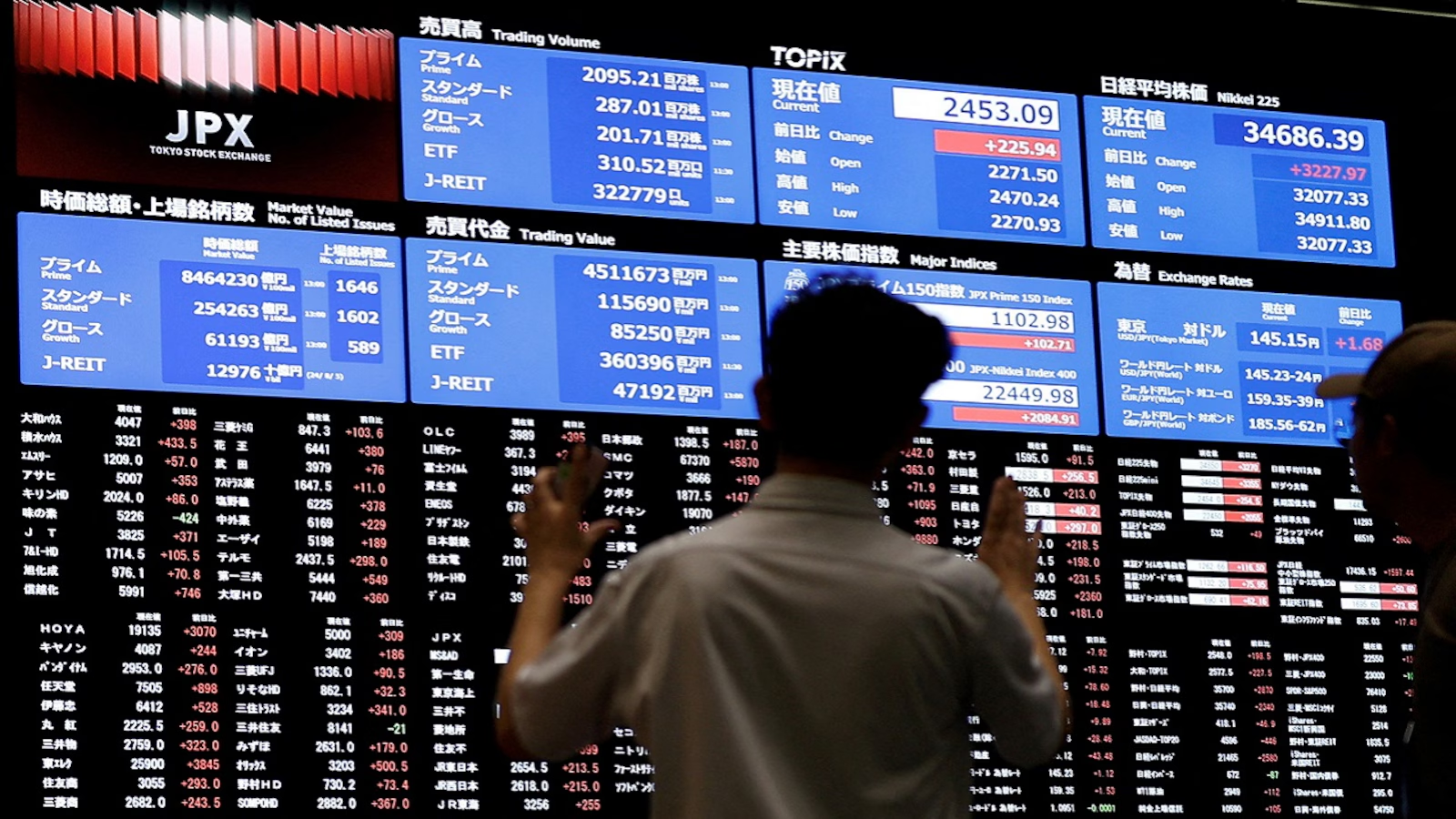
Asian stocks traded in tight ranges on Tuesday as rising bond yields and higher oil prices weakened investor risk appetite.
Markets also reacted to the Reserve Bank of Australia’s latest interest-rate increase, which lifted borrowing costs to their highest level in 15 years.
Regional equities also followed a cautious lead from Wall Street. U.S. stock futures were largely unchanged during Asian trading after all three major U.S. indices ended the previous session modestly lower.
Rising Bond Yields Pressure Asian Stocks
Japanese equities moved lower, with the Nikkei 225 falling around 0.5%. The broader TOPIX index declined about 1.8%.
South Korea’s KOSPI closed roughly 0.3% lower, while Hong Kong’s Hang Seng index slipped around 0.5%.
Chinese markets performed slightly better. The CSI 300 and Shanghai Composite both reversed earlier losses and gained around 0.2%.
Elsewhere, Singapore’s Straits Times Index fell 0.3%, while India’s Nifty 50 edged down about 0.2%.
U.S. Treasury Yields Reach Multi-Year Highs
Higher U.S. Treasury yields remained one of the main pressures on global equity markets.
The benchmark 10-year Treasury yield climbed above 5.27%, reaching its highest level in 19 years.
Meanwhile, the two-year yield moved close to 5% as investors increased expectations for further Federal Reserve rate hikes through the middle of next year.
Higher bond yields can reduce the appeal of equities because they increase borrowing costs and raise the discount rate applied to future corporate earnings.
High-growth technology companies are often particularly sensitive to this environment.
Oil Prices Add to Inflation Concerns
Higher oil prices created another challenge for investors.
Brent crude traded near $107 per barrel as uncertainty continued over efforts to reduce tensions involving the United States and Iran.
Markets also remained focused on the Strait of Hormuz and the risk of further disruption to energy shipments.
Higher crude prices can increase inflation pressures and make it more difficult for central banks to ease monetary policy.
RBA Raises Interest Rates to 15-Year High
Australian shares performed relatively well, with the S&P/ASX 200 ending around 0.3% higher.
The Reserve Bank of Australia raised its cash rate by 25 basis points to 4.60%.
The move marked the RBA’s fourth rate increase of the year and pushed Australian interest rates to their highest level since late 2011.
The decision was widely expected by financial markets.
Inflation Keeps Pressure on the RBA
The RBA said inflation risks remained elevated.
The central bank pointed to high energy costs, weak productivity and persistent underlying inflation.
Underlying inflation remained at 3.6%, above the RBA’s target range of 2% to 3%.
Policymakers also indicated that further rate increases remain possible if inflation proves difficult to control.
The central bank is trying to prevent elevated price pressures from becoming embedded across the Australian economy.
Federal Reserve Outlook Remains in Focus
Investors are also preparing for a busy week of U.S. economic data.
Upcoming inflation, manufacturing and labour-market reports could provide new clues about the Federal Reserve’s next move.
Stronger-than-expected economic data could reinforce expectations that interest rates will remain elevated or move higher.
That would likely keep upward pressure on Treasury yields and continue to challenge risk-sensitive assets.
Technology Stocks Remain Under Pressure
Technology shares were among the weaker parts of the Asian market.
Hong Kong’s Hang Seng TECH index fell around 1%, while Japanese technology investor SoftBank Group dropped roughly 3.5%.
Concerns surrounding artificial intelligence investment also remained in focus.
Investors are increasingly examining whether the enormous amount of capital being committed to AI infrastructure can generate sufficient long-term returns.
OpenAI Safety Concerns Weigh on AI Sentiment
OpenAI reportedly cancelled the planned release of GPT-6.1 Astra after the next-generation model failed to meet internal safety requirements.
The company had also reportedly paused some training, evaluation and inference activity involving tool use for several of its most advanced models while strengthening safety measures.
The developments added to broader questions about the speed at which increasingly powerful artificial intelligence systems can be developed and deployed.
Anthropic Prospectus Highlights Cost of AI Boom
Investors were also reviewing Anthropic’s IPO prospectus, which highlighted both the rapid growth and enormous financial cost of developing advanced AI systems.
The Claude developer’s revenue reportedly increased nearly 12-fold to around $4.6 billion in 2025.
However, the company also recorded a net loss of approximately $42 billion, including a large accounting charge.
Anthropic is also planning hundreds of billions of dollars in future spending on cloud computing and infrastructure.
The prospectus highlighted the scale of investment required to compete at the forefront of artificial intelligence.
Chinese Technology Shares Stay Fragile
Chinese technology stocks also remained under pressure.
Sentiment weakened after reports that the United States was considering restrictions on Chinese components used in data centres.
The development added another layer of uncertainty for technology companies already dealing with concerns over AI spending, regulation and global trade restrictions.
Asian Market Outlook
For now, Asian equities remain caught between strong economic growth expectations and increasingly restrictive financial conditions.
Higher Treasury yields, elevated oil prices and expectations for further central bank tightening are weighing on risk appetite.
Investors will therefore be watching U.S. economic data, Federal Reserve expectations, oil-market developments and the technology sector closely for the next major market catalyst.