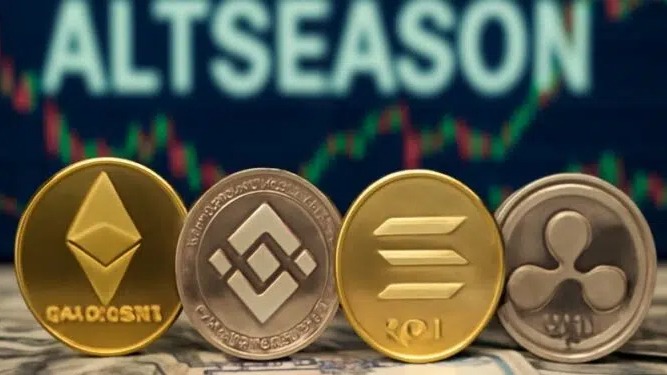
Altseason may be getting closer, but this cycle is already showing signs of behaving differently.
Rather than rotating blindly into every altcoin, traders appear to be becoming more selective. Capital is increasingly moving toward protocols with revenue, real utility and exposure to strong market narratives.
Altcoins Begin to Outperform
Several altcoins have posted major gains over the past month.
Memecoin launchpad PONS surged more than 350%, while Uniswap’s UNI gained over 110%. Arbitrum’s ARB climbed more than 150%, and AI-focused NEAR advanced roughly 180%.
Privacy token Zcash also reached a record high above $1,600 last week.
Meanwhile, Bitcoin Layer-2 token LIT and memecoin launchpad token PUMP ranked among the strongest performers over the same period.
The gains stretch across very different parts of the crypto market. That makes it difficult to identify one dominant theme.
However, the broader trend suggests traders are increasingly looking for projects with stronger business models and clearer use cases.
Revenue-Generating Crypto Projects Attract Attention
Bankless podcast host David Hoffman highlighted the strong performance of tokens such as ARB, UNI, Jupiter’s JUP and Ondo’s ONDO.
According to Hoffman, one important feature connects many of these projects: they generate revenue.
That could suggest the current rally is being driven partly by fundamentals and utility rather than pure speculation.
Among the 20 largest gainers last week, only two were memecoins. More recently, Pudgy Penguins was the only memecoin to appear among the biggest performers.
Memecoins Still Remain Part of the Altseason Story
Fundamentals are not the only force driving the market.
1inch co-founder Sergej Kunz said memecoins recorded some of the strongest buyer growth over the past 30 days.
At the same time, DeFi protocols, privacy coins, artificial intelligence projects and tokenized assets are also attracting capital.
Kunz described the current pattern as one of “breadth before depth.”
In other words, more crypto wallets are purchasing a wider selection of tokens, but individual position sizes remain relatively limited.
That behavior suggests traders are participating in the rally while remaining cautious.
Is Altseason Officially Here Yet?
Despite the recent surge in altcoins, the market has not officially entered altcoin season according to CoinMarketCap’s Altcoin Season Index.
The index currently stands at 64 out of 100.
That is a significant increase from 48 a week earlier, but it remains below the 75 level typically used to identify an official altseason.
This suggests momentum is improving, although Bitcoin has not yet been broadly overtaken by the wider altcoin market.
Capital Is Concentrating in Fewer Altcoins
Another major difference this cycle is the concentration of capital.
Data from trading firm Talos shows that the 10 largest altcoins now account for roughly 80% of total altcoin market capitalization.
That compares with around 70% at the end of 2024.
Samar Sen, head of international markets at Talos, said this indicates that capital is increasingly clustering around a smaller group of assets rather than spreading evenly across the entire altcoin market.
Talos also recorded a strong buying bias during September.
Buying activity dominated on most trading days, which contrasts with late 2024 when buying and selling flows were more balanced.
The previous post-election rally also produced broader gains across assets such as Dogecoin, Cardano and Hedera.
Which Altcoins Are Traders Buying?
According to Talos, the strongest activity is currently concentrated around several specific narratives.
Revenue-generating protocols, onchain perpetual trading platforms and DeFi projects have attracted considerable interest.
Tokens including HYPE, LIT, UNI and MORPHO are among the projects benefiting from those trends.
Privacy-focused assets are also performing strongly.
Zcash, NEAR and Monero have attracted increased attention, while AI-related tokens such as VVV and TAO have also gained momentum.
Memecoin Launchpads Continue to Grow
Memecoin activity has not disappeared.
Talos has observed strong trading interest around launchpad tokens including PUMP and PONS.
The Robinhood ecosystem has also attracted attention, alongside speculative assets such as the USELESS memecoin.
PONS has been one of the strongest performers over the past 30 days.
The bigger trend, however, is that investors appear to be focusing on individual narratives rather than treating all altcoins as one broad market.
Tokenized Assets Add Another Crypto Narrative
Tokenized assets are also gaining momentum.
Tokenized gold and tokenized stocks have attracted more buyers, while AI-related tokens continue to see increased participation from a relatively small base.
The growing overlap between different crypto sectors is creating unusual new trading opportunities.
For example, unconventional trading pairs involving tokenized stocks and memecoins have appeared on Robinhood.
Pairs such as BONER/HIMS and SPACEHOOD/SPCX demonstrate how traditional assets, tokenization and speculative crypto markets are beginning to merge.
One such market reportedly generated more than $425 million in trading volume within 24 hours during early September.
Could Fundamentals Drive the Next Altseason?
Michael Egorov, founder of Curve Finance and Yield Basis, believes this cycle is showing greater interest in genuine use cases and institutional demand.
According to Egorov, investors are paying more attention to protocols that provide useful services, connect cryptocurrency with traditional financial activity and demonstrate real-world functionality.
Stablecoins are one example.
Their growing role in onchain foreign exchange markets and fintech applications could help connect crypto infrastructure with the wider economy.
Egorov believes this integration could become one of the strongest long-term drivers of demand.
If adoption continues growing, the next altseason could receive support from actual crypto usage rather than speculation alone.
Retail Traders May Be Playing a Larger Role
The structure of altcoin trading has also changed.
Talos data shows that dealer participation in altcoin markets fell from around 65% at the end of 2024 to approximately 32% in September.
That decline occurred even as overall trading flows continued to show a strong buying bias.
According to Sen, this represents a significant difference from the previous altcoin rally.
Liquidity providers and market makers appear to have played a smaller role in the latest move.
Crypto Trading Is Becoming More Accessible
At the same time, access to altcoins has become easier for retail investors.
Assets that previously required traders to use decentralized exchanges such as Raydium or Orca can increasingly be accessed through mainstream platforms.
This reduces barriers for less experienced investors and could expand retail participation.
Professional traders also have more sophisticated tools available this cycle.
Wallet tracking, onchain analytics and copy trading can help investors identify where capital is moving across chains, wallets and protocols.
This combination of easier retail access and more advanced professional trading tools could make the next altseason very different from previous cycles.
The Next Altseason Could Have Fewer Winners
The current market does not yet suggest a simple rotation from speculation toward fundamentals.
Instead, several competing narratives are developing at the same time.
DeFi, privacy coins, AI tokens, memecoins, tokenized assets and revenue-generating protocols are all attracting capital.
However, traders appear to be increasingly selective about where they allocate funds.
If that trend continues, the next altseason may produce strong gains without lifting every altcoin equally.
Rather than a broad market-wide rally, this cycle could reward a smaller group of projects that combine strong narratives, liquidity, revenue and genuine utility.