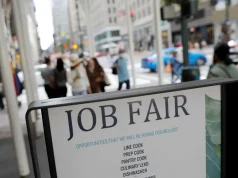
Private-sector hiring in the United States weakened during July, according to the latest ADP employment report.
US businesses added 44,000 jobs during the month. This was well below the revised increase of 95,000 recorded in June.
Economists had expected private payrolls to rise by approximately 70,000. The weaker result suggests that companies are becoming more cautious about expanding their workforces.
Education and Healthcare Lead Job Creation
The education and health services sector generated most of July’s employment gains.
Businesses within the sector added 36,000 positions, making it the strongest contributor to overall private-sector hiring.
However, employment trends were considerably weaker across several other industries.
The leisure and hospitality sector lost 11,000 jobs. Employment also declined in trade, transportation and utilities, as well as in natural resources and mining.
Manufacturing and Construction Add Few Jobs
Professional and business services reported only limited employment growth during July.
The financial activities sector also recorded modest gains.
Manufacturing payrolls increased by 2,000 positions, while construction companies added just 1,000 jobs.
These figures suggest that hiring remained subdued across many major areas of the US economy.
Higher Costs and AI May Be Affecting Hiring
Samuel Tombs, chief US economist at Pantheon Macroeconomics, said companies may be reducing hiring because of rising operating costs.
Higher energy prices have increased financial pressure on businesses. At the same time, artificial intelligence is improving the productivity of existing employees.
As companies adopt more AI tools, they may find it more difficult to estimate how many additional workers they will need over the medium term.
This uncertainty could encourage employers to delay recruitment decisions.
ADP Data Comes Before Official Jobs Report
The ADP employment report is produced in partnership with the Stanford Digital Economy Lab.
It was released ahead of the Bureau of Labor Statistics’ more comprehensive employment report, which is due on Friday.
Investors closely follow the official report because it includes nonfarm payroll growth, unemployment figures and wage data.
However, ADP figures have often differed significantly from the Bureau of Labor Statistics’ estimate of private payroll growth. Therefore, the latest report may not provide a reliable preview of Friday’s numbers.
US Labour Market Shows Signs of Cooling
Separate government data showed that there were 1.04 job vacancies for every unemployed person in June.
This figure was largely unchanged from May, suggesting that demand for workers remains relatively stable but is no longer exceptionally strong.
Economists expect the official report to show that private payrolls increased by 78,000 in July, following a gain of 49,000 in June.
Total nonfarm payrolls are forecast to rise by 80,000 after increasing by 57,000 during the previous month.
Unemployment Rate Expected to Remain at 4.2%
The US unemployment rate is currently expected to remain unchanged at 4.2%.
However, there is a possibility that the jobless rate could move slightly higher.
A recent Conference Board survey showed that the percentage of consumers describing jobs as plentiful fell in July to its lowest level since February 2021.
This decline may indicate that workers are becoming less confident about employment opportunities.
Federal Reserve Implications
Signs of slower hiring could influence expectations surrounding Federal Reserve interest-rate policy.
A weaker labour market may reduce the need for further rate increases, particularly if wage pressures and inflation continue to ease.
However, stronger-than-expected figures in Friday’s official employment report could challenge that outlook and support a more restrictive monetary policy stance.
For now, the ADP report suggests that private-sector hiring is losing momentum as businesses respond to higher costs, economic uncertainty and changing staffing requirements.