Asian currencies traded within tight ranges on Friday as investors remained cautious ahead of the latest U.S. jobs report. At the same time, uncertainty over a possible Iran peace agreement continued to support demand for the U.S. dollar as a safe-haven currency.
The U.S. Dollar Index rose around 0.1% to 99.97, extending its recovery after gaining 0.3% in the previous session. The move helped the index rebound further from recent seven-month lows.
Japanese Yen Gives Back Some Intervention Gains
Most Asian currencies were relatively stable after weakening during the previous trading session.
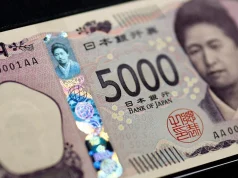
The Japanese yen was little changed, with USD/JPY trading near 158.4 after rising roughly 0.4% a day earlier.
The yen has surrendered part of the strong gains triggered by last week’s rare coordinated intervention by Japan and the United States. The operation marked the first joint effort by the two countries to support the Japanese currency since 1998.
Following the intervention, the yen strengthened to around 155 per dollar. That recovery came after the currency had previously fallen to nearly 164 per dollar in late July, close to its weakest level in almost four decades.
US Jobs Data Takes Center Stage
Investors are now closely watching the latest U.S. nonfarm payrolls report for further clues about the Federal Reserve’s monetary policy outlook.
Recent economic indicators from the United States have provided mixed signals. As a result, the employment report could play an important role in shaping expectations for the Fed’s next moves.
A stronger-than-expected jobs report could reinforce expectations that policymakers will maintain a relatively hawkish stance. On the other hand, weaker employment figures could increase speculation that the Fed may adopt a more cautious approach in the months ahead.
Iran Uncertainty Supports the US Dollar
Geopolitical developments also remained an important driver of currency markets.
The dollar benefited from higher U.S. Treasury yields and ongoing uncertainty surrounding negotiations involving Iran and shipping through the Strait of Hormuz.
Media reports indicated that an Iranian parliamentary committee was considering legislation that could restrict U.S. and Israeli vessels from passing through the strategic waterway. The proposal could also introduce penalties for ships that violate those restrictions.
The Strait of Hormuz is a major route for global energy shipments, making any disruption particularly important for oil and financial markets.
Oil Prices Rise as Inflation Concerns Return
Oil prices extended their recent gains during Asian trading on Friday as investors reacted to the latest geopolitical developments.
Higher energy prices have also renewed concerns about inflation. Persistent oil price gains could add to broader price pressures and influence expectations surrounding future Federal Reserve policy.
These developments helped push U.S. Treasury yields higher, providing additional support for the dollar.
China Trade Surplus Beats Expectations
The Chinese yuan was broadly stable, with both the onshore USD/CNY and offshore USD/CNH exchange rates showing little movement.
China reported a larger-than-expected trade surplus for July as export growth remained strong.
Exports increased 24% compared with the same period a year earlier. Although growth slowed from June, the figure still exceeded market expectations and pointed to resilient overseas demand.
Imports, meanwhile, increased 28% year-on-year, suggesting that domestic demand also remained relatively steady.
Other Asian Currencies Remain Mixed
Currency movements across the rest of Asia were relatively limited.
The South Korean won strengthened slightly, with USD/KRW falling around 0.2%. The Singapore dollar also gained modestly as USD/SGD slipped approximately 0.1%.
Meanwhile, the Indian rupee weakened, with USD/INR rising about 0.2%.
The Australian dollar was broadly unchanged against the U.S. currency, with AUD/USD trading close to flat.
Overall, Asian forex markets remained cautious as traders balanced geopolitical uncertainty, higher oil prices and expectations surrounding the U.S. jobs report.