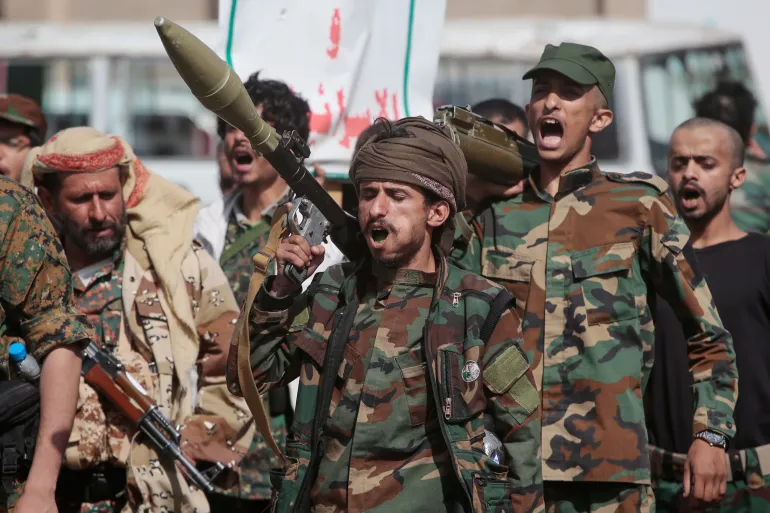
Iran-backed Houthi militants launched a deadly missile attack on a government military camp in southern Yemen on Monday, killing at least 20 soldiers and injuring dozens more, according to the Associated Press (AP).
The Houthi attack in Yemen targeted the al-Alam military camp in Shabwa province, where government forces had been training police officers and security personnel.
Citing Yemeni military officials, the AP reported that the militants fired three ballistic missiles at the facility. At least 20 soldiers were killed, while approximately two dozen others sustained injuries.
Yemen Government Vows Strong Response to Houthi Attack
The head of Yemen’s Presidential Leadership Council condemned the assault, confirming that newly recruited personnel from different parts of the country were among the casualties.
Furthermore, he pledged a decisive response to the deadly strikes, signaling the possibility of further military escalation.
Meanwhile, a Houthi-affiliated news agency acknowledged the operation, claiming that dozens of government fighters had been killed or wounded. However, the outlet did not provide additional details.
The targeted military installation sits along an important supply route used by Yemeni government forces in Shabwa province.
Yemen Conflict Intensifies as Saudi-Backed Forces Advance
The latest attack comes amid escalating fighting between Houthi militants and Saudi-aligned government forces.
In recent weeks, coalition-backed troops have intensified efforts to reclaim territories controlled by the Houthis. These operations include strategically important areas overlooking alternative Saudi oil shipping routes through the Bab el-Mandeb Strait.
Additionally, the conflict has extended beyond Yemen’s borders, with Houthi forces claiming responsibility for attacks targeting infrastructure in neighboring Saudi Arabia.
On Sunday, an airstrike linked to the Saudi-led coalition reportedly killed at least nine people in Saada, a Houthi-controlled province in northern Yemen.
According to the AP, Saudi authorities had not immediately commented on the incident.
Middle East Tensions Threaten Global Oil Shipping Routes
The renewed violence in Yemen represents another dangerous development in the broader Middle East conflict.
Regional hostilities have intensified since the joint US-Israeli military offensive against Iran began in late February, adding further instability to an already volatile geopolitical environment.
Of particular concern are two critical maritime chokepoints: the Bab el-Mandeb Strait and the Strait of Hormuz.
Both waterways play essential roles in international energy transportation, making them strategically important for global oil supplies.
As military tensions increase, disruptions to shipping activity through these routes have heightened concerns about energy supply security.
Consequently, restrictions on maritime traffic and the possibility of further attacks have contributed to upward pressure on global oil prices.
Continued instability in Yemen could therefore amplify uncertainty across international energy markets, particularly if the conflict threatens additional shipping infrastructure or oil transportation routes.