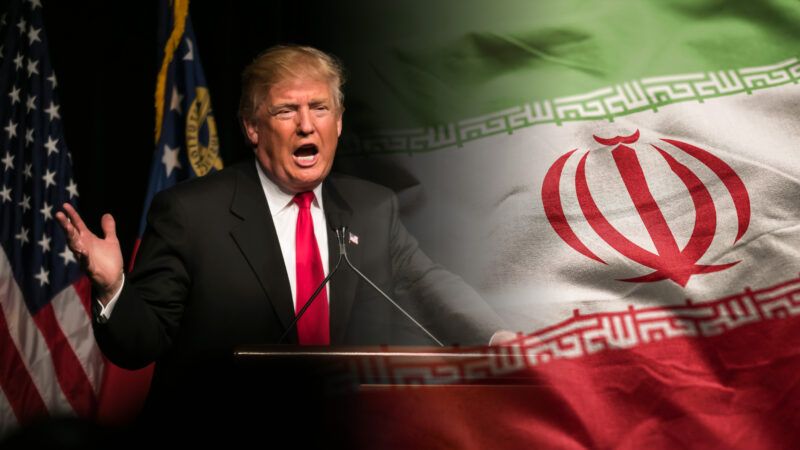
U.S. President Donald Trump has raised the possibility of additional military strikes against Iran, suggesting that Washington could target more of Tehran’s nuclear facilities as tensions between the two countries remain elevated.
During an interview with Newsmax host Rob Finnerty on Thursday, Trump identified Pickaxe Mountain, a suspected underground Iranian nuclear installation, as a potential target for future U.S. military operations.
The president indicated that American forces could move quickly against the facility if further action became necessary. However, he also suggested that deploying U.S. ground troops into Iran would not be required.
His comments followed reports that the Pentagon was evaluating new military options against Iranian nuclear and energy infrastructure, potentially including the use of one of America’s most powerful conventional weapons.
Trump Considers New Strikes on Iran’s Nuclear Facilities
Trump’s latest remarks have intensified concerns about a possible escalation in the ongoing U.S.-Iran conflict.
Speaking about Iran’s nuclear capabilities, the president specifically mentioned Pickaxe Mountain, a suspected heavily fortified underground facility believed to be associated with Tehran’s nuclear program.
He suggested that Washington was examining the site as a possible target and expressed confidence that American forces could strike it rapidly if necessary.
Nevertheless, Trump stopped short of announcing a new military operation or providing a specific timetable for additional attacks.
He also downplayed the possibility of an American ground offensive, indicating that U.S. military objectives could be pursued without deploying troops inside Iranian territory.
The statements come as diplomatic efforts to resolve the conflict have struggled to produce a lasting agreement.
Pentagon Reportedly Weighs Using the ‘Mother of All Bombs’
According to CNN, U.S. military planners have developed potential strike options involving the GBU-43/B Massive Ordnance Air Blast bomb, commonly known as the Mother of All Bombs (MOAB).
The powerful conventional weapon could reportedly be considered for operations targeting Iranian energy infrastructure and nuclear installations.
Sources familiar with the planning indicated that the military options could be presented to Trump if he decides to resume combat operations, either before or after the November 3 midterm elections.
However, the existence of contingency plans does not mean that the president has authorized their implementation.
When questioned about the reports, Trump emphasized that the MOAB is a conventional weapon rather than a nuclear bomb.
He did not directly confirm or deny whether the U.S. military was preparing to deploy it against Iran.
The possibility of using such a powerful weapon has nevertheless raised questions about the potential consequences of further American military action.
Could the MOAB Destroy Iran’s Underground Nuclear Sites?
The GBU-43/B is among the most powerful conventional weapons developed by the United States military.
Unlike nuclear weapons, it relies on conventional explosives to generate an extremely powerful blast across a large area.
However, military analysts have questioned whether the bomb would be effective against deeply buried Iranian nuclear installations.
The MOAB is primarily designed to generate extensive blast effects rather than penetrate heavily reinforced underground structures.
Consequently, its ability to destroy facilities protected beneath substantial layers of rock and reinforced construction remains uncertain.
These limitations are particularly relevant to Pickaxe Mountain, where suspected nuclear infrastructure is believed to be located deep underground.
Although the weapon could cause considerable destruction above ground, its effectiveness against such fortified targets has been questioned.
The potential use of the MOAB would also represent a significant military escalation, increasing the risk of Iranian retaliation and further regional instability.
Strait of Hormuz Tensions Complicate U.S.-Iran Peace Efforts
The renewed discussion of military action comes as Washington and Tehran remain divided over security and maritime operations in the Strait of Hormuz.
The strategically important waterway plays a crucial role in international energy transportation, making developments in the region particularly significant for global oil markets.
Recent attempts to negotiate an agreement between the United States and Iran have made limited progress, leaving the possibility of further military confrontation unresolved.
Continued tensions around the Strait of Hormuz have also heightened concerns about potential disruptions to oil shipments and regional energy infrastructure.
Any additional military escalation could further complicate maritime trade and increase uncertainty across international commodity markets.
For investors, developments involving Iran remain an important geopolitical risk, particularly given their potential implications for crude oil prices, inflation and global economic stability.
November Midterm Elections Could Influence Trump’s Military Decision
Domestic political considerations may also play an important role in determining the timing of any additional U.S. military action.
Trump has appeared reluctant to launch another major offensive against Iran ahead of the November 3, 2026, midterm elections.
The administration faces growing public concern about elevated energy prices, with the conflict contributing to uncertainty surrounding global petroleum supplies.
Higher gasoline and diesel costs have become politically sensitive as American voters assess the economic consequences of the ongoing confrontation.
Reports have suggested that Washington could consider resuming more extensive military operations after the elections, while Iranian authorities are also reportedly preparing for the possibility of renewed attacks.
However, the timing of any operation remains uncertain, and no final decision on additional strikes has been publicly confirmed.
U.S.-Iran Conflict Outlook Remains Uncertain
Trump’s comments suggest that further military action against Iran remains under consideration, particularly concerning suspected nuclear facilities that Washington views as strategically important.
At the same time, the Pentagon’s reported evaluation of powerful conventional weapons highlights the range of military options being examined.
Nevertheless, considerable uncertainty surrounds the effectiveness of potential strikes, the likelihood of Iranian retaliation and the prospects for a diplomatic resolution.
The coming weeks could prove important as the United States approaches its midterm elections and both sides reassess their military and diplomatic positions.
For now, the possibility of renewed U.S. strikes on Iran continues to create geopolitical uncertainty, with potentially significant consequences for Middle Eastern stability and global energy markets.