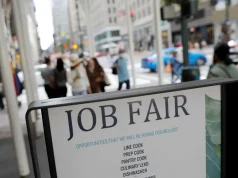
UK unemployment remained at 4.9% in the three months to July, coming in below the 5% forecast. However, payroll employment continued to weaken, with some of the largest annual declines recorded in the retail and hospitality sectors.
The Office for National Statistics said the UK labour market remained broadly stable overall. Employment and unemployment rates showed little change during the latest reporting period.
At the same time, payroll numbers continued to edge lower, highlighting signs of underlying weakness in parts of the economy.
UK Payroll Employment Continues to Decline
The number of payrolled employees fell by 101,000, or 0.3%, in the year to July.
Between June and July alone, payroll employment declined by 19,000, equivalent to a 0.1% fall.
The figures are based on data collected from HM Revenue and Customs records.
Retail and hospitality experienced some of the sharpest reductions in payroll employment over the past year.
UK Employment Rate Remains Broadly Stable
The employment rate for people aged between 16 and 64 stood at 75.1%.
That was 0.1 percentage point lower compared with the previous year, although the figure was largely unchanged from the previous quarter.
Meanwhile, the economic inactivity rate stood at 20.9%. This was 0.1 percentage point lower on both an annual and quarterly basis.
The Claimant Count also increased during August, reaching an estimated 1.692 million.
However, the ONS warned that the latest Claimant Count figure remains provisional and could be revised.
UK Job Vacancies Fall to Decade Lows
UK job vacancies continued to decline during the three months to August.
Vacancies fell by 8,000, or 1.1%, to 702,000.
According to the ONS Vacancy Survey, higher labour costs may be discouraging smaller businesses from hiring additional workers.
Vacancy levels are now among the lowest seen outside the pandemic period in more than a decade.
The last comparable level was recorded between August and October 2014, when there were around 701,000 vacancies.
This continued decline suggests that demand for workers is cooling even though the UK unemployment rate remains relatively stable.
UK Wage Growth Slows
Annual growth in total pay, including bonuses, eased to 3.9% in the three months to July.
That was down from 4.2% in the previous period.
Total wage growth was last lower between September and November 2020, when it stood at 3.7%.
Regular pay growth, excluding bonuses, remained at 3.5%. The figure has been relatively stable across the past five three-month reporting periods.
The ONS noted that regular wage growth has changed little in recent months. However, total pay growth has continued to slow.
Public and Private Sector Pay Growth Diverge
A significant gap remains between wage growth in the public and private sectors.
Regular pay in the public sector increased by 6.3%, while private sector regular pay rose by 2.9%.
The ONS said public sector figures continue to be affected by the timing of NHS pay awards during the year.
After adjusting for inflation using the CPIH measure, regular pay increased by 0.6% in real terms.
Total pay rose by 0.9% after taking inflation into account.
UK Workforce Jobs Edge Lower
The total number of workforce jobs stood at 36.7 million in June.
That represented a decline of 48,000 jobs, or 0.1%, compared with March.
The fall was largely driven by self-employment, where the number of jobs dropped by 43,000, or 1%.
Meanwhile, public sector employment increased slightly.
Public sector jobs reached 6.21 million in June, up by 11,000, or 0.2%, compared with March.
Overall, the latest UK labour market data presents a mixed picture. Unemployment remains below forecasts and employment levels are broadly stable. However, falling vacancies, declining payroll numbers, and slower wage growth suggest that conditions in the labour market are gradually cooling.