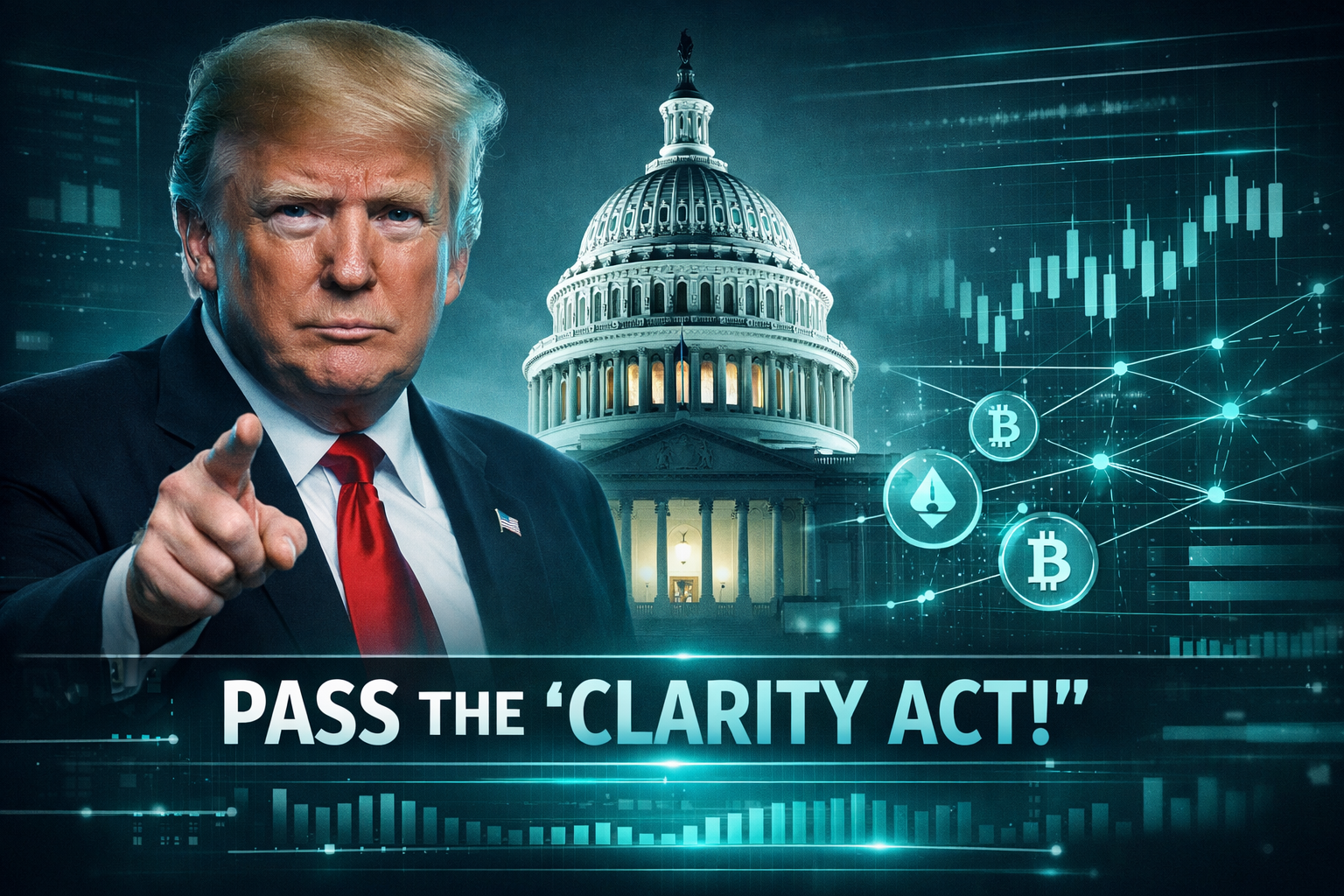
U.S. President Donald Trump renewed his call for Congress to pass the Digital Asset Market Clarity (CLARITY) Act, arguing that the legislation is necessary to keep the United States competitive with China in the rapidly evolving cryptocurrency sector.
Speaking at the White House alongside prominent crypto industry executives, Trump urged lawmakers to approve what he described as a fair version of the market structure bill.
Crypto Leaders Join Trump at White House
The event included several major figures from the digital asset industry, including Coinbase CEO Brian Armstrong and Gemini co-founders Cameron and Tyler Winklevoss.
Trump said the United States needs clear and lasting crypto regulations to remain ahead of global competitors, particularly China.
The CLARITY Act is designed to establish a clearer regulatory framework for digital assets and define how different cryptocurrencies should be supervised in the United States.
CLARITY Act Remains Stalled in the Senate
The CLARITY Act passed the House of Representatives in July 2025, but progress in the Senate has been slow.
Lawmakers have raised concerns about several areas of the legislation, including tokenized equities, stablecoin rewards, and possible conflicts of interest involving the Trump family’s activities in the crypto industry.
The Senate is currently in recess, meaning further legislative progress is expected only after lawmakers return.
Coinbase CEO Sees Bipartisan Support
Brian Armstrong said the legislation could provide the U.S. crypto industry with a more stable regulatory environment for decades.
According to Armstrong, the bill could eventually secure more than 60 votes in the Senate once lawmakers move forward with procedural steps expected in September.
Trump also emphasized the bipartisan nature of the legislation, saying that several Democratic lawmakers support the measure.
A strong bipartisan vote could improve the chances of the CLARITY Act clearing the Senate and reaching the president’s desk.
Trump Calls for Passage Following Lindsey Graham’s Death
Trump previously urged Congress to approve the CLARITY Act following the death of Senator Lindsey Graham, whom he described as a strong supporter of the legislation.
The president encouraged Senate lawmakers to advance the bill in Graham’s honor.
Trump has increasingly positioned his administration as supportive of the digital asset industry, with cryptocurrency regulation becoming a significant part of his broader economic agenda.
White House Continues Engagement With Crypto Industry
The latest meeting is not the first time the Trump administration has brought crypto executives to the White House.
Industry leaders previously attended a White House crypto summit in March 2025, where regulatory issues were discussed.
Trump also hosted crypto representatives during the signing of the GENIUS stablecoin legislation in July 2025.
These meetings reflect the administration’s broader effort to establish a more defined regulatory environment for digital assets in the United States.
Senator Ruben Gallego Raises Ethics Concerns
Not all lawmakers agree with Trump’s approach to the CLARITY Act.
Senator Ruben Gallego raised concerns about the ethics provisions included in the legislation, arguing that Congress, rather than the president, should determine the appropriate regulatory restrictions.
Gallego’s comments highlight one of the major disagreements surrounding the bill: how to address potential conflicts of interest while still creating a regulatory framework that encourages crypto innovation.
SEC and CFTC Move Ahead Without CLARITY
While Congress continues debating the legislation, U.S. financial regulators are moving forward with their own cryptocurrency policies.
The Commodity Futures Trading Commission (CFTC) is preparing to discuss additional crypto regulations through its Innovation Advisory Committee.
CFTC leadership has indicated that the agency may continue developing rules while waiting for Congress to return and potentially advance the CLARITY Act.
SEC Proposes New Crypto Rules
The Securities and Exchange Commission (SEC) has also proposed new measures affecting digital asset companies.
The proposals include a possible safe harbor that could prevent certain crypto tokens from automatically being treated as investment contracts.
The SEC is also considering exemptions related to token issuance, potentially giving crypto companies greater regulatory flexibility.
These developments show that U.S. regulators are attempting to establish clearer crypto rules even without final passage of the CLARITY Act.
U.S. Crypto Regulation Enters Critical Phase
The debate surrounding the CLARITY Act could become a major turning point for cryptocurrency regulation in the United States.
Supporters argue that clearer market structure rules would encourage investment, provide regulatory certainty, and help the U.S. compete with other major economies.
However, disagreements over ethics, stablecoins, tokenized assets, and regulatory authority could continue to delay final approval.
For now, investors and crypto companies will closely watch the Senate, SEC, CFTC, and White House for signs of how quickly the U.S. digital asset regulatory framework will develop.