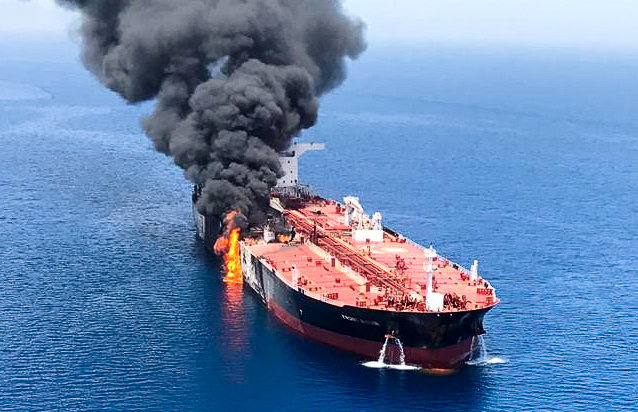
An oil tanker was struck by an unidentified projectile in the Strait of Hormuz, causing a fire on board, according to the United Kingdom Maritime Trade Operations agency.
The incident adds to growing concerns over the safety of commercial shipping through one of the world’s most important energy routes.
Tanker Hit Between Oman and Iran
Local authorities reported that the vessel was struck on Tuesday while traveling through the Strait of Hormuz, between Oman and Iran.
The crew was reported safe, while no environmental damage was identified following the attack.
The identity of those responsible remains unknown.
Strait of Hormuz Remains a Major Global Risk
The latest incident highlights the continuing dangers facing ships attempting to move through the Strait of Hormuz.
The waterway has been severely disrupted since the start of the U.S. and Israeli military campaign against Iran earlier this year.
Before the conflict began, roughly 20% of global oil and liquefied natural gas shipments passed through the strait, making it one of the most important energy chokepoints in the world.
Any prolonged disruption can therefore have major consequences for oil prices, global trade and inflation.
Oil Prices Face Pressure From Shipping Disruptions
Iran’s restrictions on traffic through the Strait of Hormuz have already contributed to higher energy prices.
Reduced access to the route has raised concerns about oil and LNG supplies reaching international markets.
Higher energy costs can also increase inflationary pressure globally, potentially forcing central banks to reconsider their interest-rate strategies.
A prolonged disruption could therefore affect not only the energy market but also monetary policy and broader economic growth.
Iran Has Not Claimed Responsibility
Iran has not claimed responsibility for Tuesday’s tanker attack.
The United States has also conducted operations against vessels in the region as Washington attempts to enforce a tighter naval blockade around Iranian ports.
The continued military activity has created a highly uncertain environment for commercial shipping and energy markets.
Diplomacy Over Strait of Hormuz Gains Momentum
Despite the ongoing hostilities, there have been signs of progress in diplomatic efforts aimed at reducing tensions.
Iran and Oman are reportedly working toward an agreement concerning the management of commercial shipping through the Strait of Hormuz.
However, Iranian officials have warned that any agreement would not necessarily result in the immediate reopening of the waterway.
The negotiations remain important because even a partial restoration of shipping could reduce some of the pressure on global energy markets.
Qatar Pushes for Temporary Shipping Corridor
Qatar has also stepped up diplomatic efforts.
Qatari Prime Minister Sheikh Mohammed bin Abdulrahman Al Thani recently traveled to Iran as part of an attempt to restart negotiations and reduce regional tensions.
According to Qatar’s foreign ministry, discussions included a phased proposal that could establish a temporary commercial shipping corridor through the Strait of Hormuz.
The framework could also include efforts to clear mines from the waterway, potentially making commercial transit safer.
U.S. Sanctions Add to Iran Tensions
The diplomatic push comes as the United States prepares additional sanctions against Iran.
Washington has sought to increase economic pressure on Tehran, while Iranian officials have strongly criticized the strategy.
Iran has described the latest U.S. measures as an intensified form of economic warfare.
The combination of military confrontation, sanctions and shipping restrictions continues to complicate efforts to reach a broader agreement.
Pakistan Also Attempts to Revive Ceasefire Talks
Pakistan has joined Qatar in trying to reduce tensions between Iran and the United States.
Field Marshal Asim Munir recently visited Tehran in an effort to revive an interim ceasefire agreement that has since expired.
Pakistan has frequently acted as an intermediary between Washington and Tehran and could continue playing a role in future negotiations.
Iran War Timeline Remains Uncertain
Despite diplomatic activity, there is still no clear timeline for ending the conflict.
U.S. President Donald Trump said in an interview with Al Jazeera that he had “no time schedule” for concluding the war.
The conflict is approaching its six-month mark, while uncertainty surrounding the Strait of Hormuz remains one of the most important risks for global energy markets.
For now, traders are likely to continue monitoring oil prices, shipping conditions and diplomatic negotiations for signs that the situation is either stabilizing or moving toward further escalation.