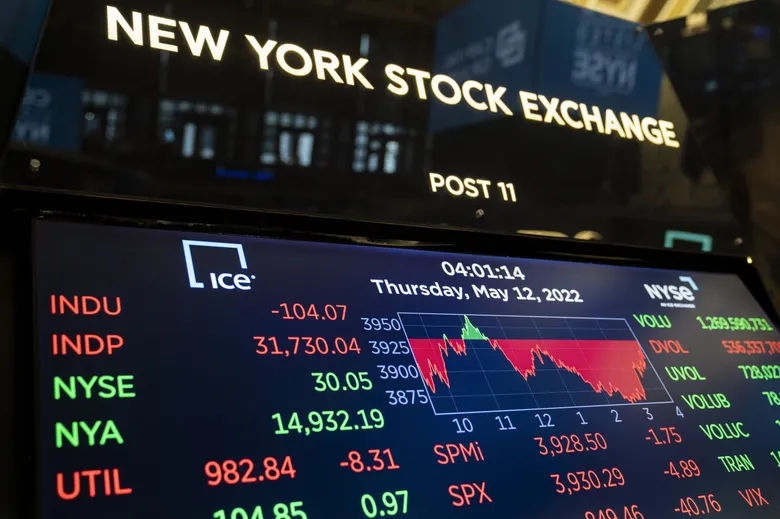
The Nasdaq Composite suffered its worst weekly performance since late June as concerns surrounding artificial intelligence investments triggered a broad sell-off across technology stocks.
Wall Street ended Friday sharply lower, with investors increasingly questioning the sustainability of the AI spending boom, elevated technology valuations, and rising corporate debt levels.
Higher oil prices and uncertainty surrounding Federal Reserve interest rate policy added further pressure to market sentiment. Meanwhile, investors turned their attention toward the upcoming wave of third-quarter corporate earnings reports.
Nasdaq Plunges 4.5% as Wall Street Stocks Slide
Major US stock indices ended Friday’s session in negative territory, with technology shares leading the declines.
The S&P 500 dropped 1.1% to close at 7,659.11 points, while the Dow Jones Industrial Average reversed earlier gains and fell 0.6% to 52,001.52 points.
The Nasdaq Composite experienced the steepest decline, sinking 2.2% to finish at 26,140.03 points.
For the week, the Nasdaq lost approximately 4.5%, marking its weakest performance since late June.
The S&P 500 declined 2% over the same period, while the Dow managed to gain 0.7%.
The sharp divergence highlighted the growing pressure on technology companies, particularly those associated with artificial intelligence infrastructure and semiconductor production.
AI Investment Concerns Weigh on Technology Stocks
The artificial intelligence investment boom, previously a major driver of US stock market gains, has become a source of increasing uncertainty.
Investors are questioning whether companies can generate sufficient returns from the enormous amounts of capital being committed to AI infrastructure.
Concerns have intensified around rising debt issuance, aggressive data center expansion, and increasing competition from Chinese technology companies.
The combination has encouraged investors to reduce exposure to AI-related stocks, particularly businesses with high valuations and substantial financing requirements.
Michael O’Rourke, chief market strategist at Jones Trading, warned that corporate earnings growth could reach a peak in 2026.
According to O’Rourke, Nvidia, Micron Technology, and Google’s parent company Alphabet are expected to account for approximately one-third of this year’s earnings growth.
This concentration raises concerns about the broader market’s dependence on a relatively small number of technology companies.
Meanwhile, persistent inflation and expectations of elevated interest rates have encouraged investors to adopt more defensive positions.
Semiconductor Stocks Record Steep Weekly Losses
Semiconductor manufacturers were among the biggest casualties of the latest technology sell-off.
The declines accelerated after reports highlighted technological advances by Chinese memory chip producer ChangXin Memory Technologies.
These developments raised concerns about increasing competition and potential pressure on memory chip prices.
Micron Technology shares fell approximately 14.6% during the week.
South Korea’s Samsung Electronics and SK Hynix recorded even steeper declines of 17.8% and 24.3%, respectively.
The broader semiconductor sector also experienced heavy selling pressure.
The Philadelphia Semiconductor Index plunged 11.4% for the week, recording its weakest performance since early April 2025.
The losses reflected growing uncertainty about future profitability across an industry that has benefited enormously from the expansion of artificial intelligence.
CoreWeave and Nebius Hit by AI Financing Fears
Companies specializing in cloud computing infrastructure for artificial intelligence also faced significant selling pressure.
These businesses, often referred to as neocloud providers, offer access to powerful graphics processing units used for AI training and inference.
However, their business models frequently require substantial investment in expensive computing equipment and data center infrastructure.
Concerns about the sector intensified following a Gartner report predicting that 80% of neocloud providers could cease operating independently by 2030.
The forecast raised questions about industry consolidation and the long-term viability of smaller infrastructure providers.
CoreWeave attracted particular attention after some of its bonds dropped to new lows in secondary trading.
The decline suggested growing investor concern about the company’s financing obligations and credit risk.
Nvidia CEO Jensen Huang subsequently expressed confidence in CoreWeave’s financial position, indicating that the company did not require additional financial support from Nvidia.
Nevertheless, CoreWeave and rival Nebius each suffered weekly share price declines of approximately 25.2%.
The losses highlighted the growing sensitivity of AI infrastructure companies to financing conditions and investor confidence.
Anthropic IPO Valuation Expectations Come Under Pressure
Concerns about the artificial intelligence sector extended beyond publicly traded technology companies.
According to a Reuters report cited in the original coverage, some investors in Anthropic reduced their valuation expectations for the company’s potential initial public offering.
The reported valuation estimate declined to approximately $1.5 trillion from an earlier $2 trillion.
The development suggested that investors were becoming more cautious about assigning exceptionally high valuations to AI companies.
Anthropic, the developer of the Claude AI models, reportedly told investors that third-quarter revenue had increased 45% to $16.8 billion.
Although the figures indicated strong demand for its artificial intelligence products, analysts highlighted a sequential slowdown in revenue growth.
The combination of slowing growth rates and elevated valuation expectations added to concerns about whether AI companies can sustain their rapid expansion.
Federal Reserve Rate Hike Expectations Decline
Away from technology stocks, investors closely monitored developments in US monetary policy.
Stronger-than-expected consumer and producer inflation reports earlier in the week initially increased expectations of another Federal Reserve interest rate hike.
Rising energy prices contributed significantly to inflationary pressures, reinforcing concerns about the persistence of elevated consumer costs.
However, expectations shifted following remarks from Federal Reserve Chair Kevin Warsh at a forum in Bangkok.
Speaking during the annual meetings of the International Monetary Fund and World Bank, Warsh acknowledged ongoing inflation challenges while highlighting the resilience of the global economy.
He also discussed the potential productivity benefits associated with the surge in artificial intelligence investment.
Nevertheless, Warsh avoided providing specific guidance about the Federal Reserve’s next monetary policy decision.
His comments suggested that policymakers would continue evaluating economic conditions rather than committing to an immediate rate increase.
October Fed Rate Hike Probability Falls to 17%
Financial markets interpreted Warsh’s remarks as less hawkish than initially feared.
According to CME Group’s FedWatch Tool, the probability of a 25-basis-point rate hike at the October 27–28 meeting declined to approximately 17%.
That compared with nearly 28% the previous day.
Deutsche Bank strategist Jim Reid highlighted the importance of Warsh’s decision not to challenge prevailing market expectations.
Despite stronger inflation data, the Fed chair refrained from signaling an urgent need for further tightening.
The shift provided some relief for rate-sensitive assets, although concerns about corporate borrowing costs and technology valuations remained elevated.
Investors will now focus on upcoming economic releases and central bank communications for additional clues about the interest rate outlook.
Tesla Falls Despite New Roadster Demonstration
Tesla was another notable casualty of Friday’s technology sector weakness.
The electric vehicle manufacturer unveiled a new Roadster featuring rocket-style boosters during a widely watched demonstration.
The vehicle reportedly performed a controlled landing after jumping from a ramp, attracting considerable attention to the company’s latest technological ambitions.
Tesla shares initially moved higher following the presentation.
However, the broader market sell-off eventually overwhelmed the positive reaction, sending the stock down approximately 2.1% by the close.
Elsewhere, corporate earnings produced some positive developments.
Alcoa shares advanced 2.6% after the aluminum producer reported better-than-expected third-quarter profits.
Truist Financial also gained ground following quarterly earnings that exceeded market expectations.
These results highlighted the importance of company-specific earnings performance even as broader market sentiment deteriorated.
Oil Prices Surge Amid Middle East Supply Concerns
Geopolitical tensions provided another major source of uncertainty for financial markets.
Crude oil prices were heading toward substantial weekly gains as investors assessed supply risks in the Middle East.
Brent crude futures rose approximately 4.7% over the week, while US West Texas Intermediate crude gained 10.7%.
The rally came despite indications that overall Middle Eastern crude exports had recovered toward pre-war levels.
Continued attacks on commercial vessels near the Strait of Hormuz maintained concerns about the security of global energy shipments.
Meanwhile, escalating fighting in Yemen between Iran-backed Houthi forces and the Saudi-backed government raised additional fears about disruptions near the Bab el-Mandeb Strait.
Both waterways play important roles in international energy transportation.
Further interruptions to shipping could increase freight costs and tighten available oil supplies.
US-Russia Diesel Deal Faces Political Opposition
Rising diesel prices also remained in focus as disruptions to energy infrastructure complicated global fuel supplies.
President Donald Trump announced a major diesel supply agreement with Russian President Vladimir Putin, aimed at easing pressure on international fuel markets.
The announcement followed renewed concerns about Ukrainian attacks on Russian energy facilities.
Ukraine indicated that it intended to resume targeting Russian energy infrastructure despite efforts by Washington to negotiate an energy ceasefire.
However, the diesel agreement faced opposition from lawmakers in the United States.
A bipartisan group of 18 representatives, including 17 Democrats and one Republican, introduced legislation seeking to block the arrangement.
The political dispute added further uncertainty to the outlook for diesel supplies and international energy prices.
Higher fuel costs could also reinforce inflationary pressures, complicating the Federal Reserve’s efforts to balance price stability with economic growth.
Wall Street Turns Attention to Third-Quarter Earnings
Following the Nasdaq’s sharp weekly decline, investors are preparing for a busy period of corporate earnings announcements.
Strong earnings growth has been one of the principal factors supporting US equity markets throughout 2026.
However, concerns are emerging that the pace of profit expansion could slow, particularly among the technology companies responsible for a substantial portion of market gains.
Investors will pay close attention to revenue growth, profit margins, capital expenditure plans, and management guidance.
Results from major technology companies could prove especially influential in determining whether confidence in the AI investment boom begins to recover.
Meanwhile, inflation data, Treasury yields, and geopolitical developments will remain important drivers of market sentiment.
What Comes Next for the Nasdaq and US Stock Market?
The Nasdaq’s 4.5% weekly decline represents a significant setback for technology stocks following an extended period of AI-driven market enthusiasm.
Growing concerns about semiconductor competition, corporate debt, and the profitability of AI infrastructure investments have encouraged investors to reconsider their exposure to the sector.
Nevertheless, lower expectations of an immediate Federal Reserve rate hike could provide some support to equities.
Strong third-quarter earnings may also help restore confidence if companies demonstrate that revenue and profit growth remain resilient.
Conversely, disappointing earnings guidance or additional stress in AI-related credit markets could extend the selling pressure.
For now, the Nasdaq faces a challenging market environment, with technology valuations, Federal Reserve policy expectations, and rising energy costs all influencing investor sentiment.
The upcoming earnings season could play a decisive role in determining whether the latest technology sell-off develops into a broader correction or creates the conditions for a market recovery.