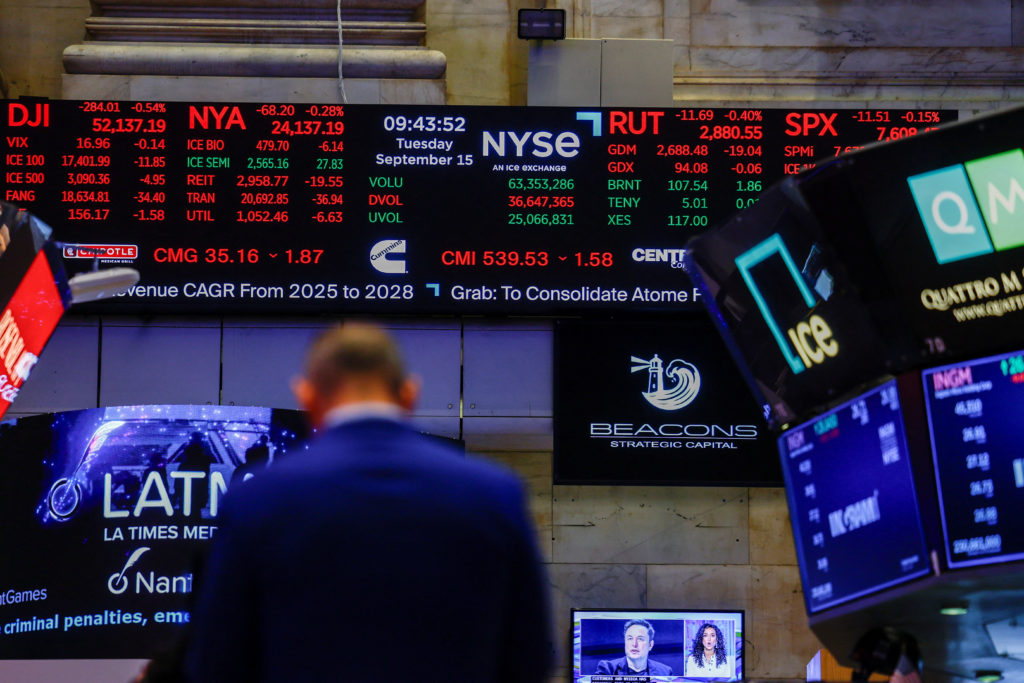
Wall Street moved lower on Wednesday as a sell-off in the U.S. bond market pressured technology stocks.
At the same time, oil prices rebounded after five consecutive sessions of losses as investors assessed mixed diplomatic signals between the United States and Iran.
Markets were also preparing for Chinese President Xi Jinping’s visit to Washington, which begins on Wednesday.
Nasdaq Leads Wall Street Lower
At 12:05 ET, the S&P 500 was down 0.7% at 7,714.31 points.
The Dow Jones Industrial Average fell 0.6% to 51,532.56, while the tech-heavy Nasdaq Composite dropped 1.1% to 26,958.03.
Rising U.S. Treasury yields placed particular pressure on technology stocks, which tend to be more sensitive to changes in long-term interest rates.
Higher bond yields can reduce the relative appeal of growth stocks by increasing the discount rate applied to future earnings.
Oil Prices Rebound as Iran Talks Remain in Focus
Energy markets remained an important driver of investor sentiment.
President Donald Trump used strong language toward Iran during a speech at the United Nations General Assembly on Tuesday.
However, he later said his team had held productive discussions with Iranian representatives on the sidelines of the event.
The conflicting signals left traders closely watching the conflict for clues about future oil supply, inflation and interest rates.
Brent crude futures were last up 3.5% at $102.71 per barrel.
Daniela Hathorn, Senior Market Analyst at Capital.com, said lower oil prices can reduce near-term inflation concerns, ease pressure on bond yields and improve conditions for corporate margins and household spending.
Meta’s Muse AI Agent Draws Market Attention
Investor attention also shifted back toward artificial intelligence.
Meta Platforms’ new AI agent, Muse, has attracted strong consumer interest since its launch.
A sharp rise in downloads has boosted enthusiasm around companies connected to the AI infrastructure supporting the service.
That momentum had previously helped lift technology shares and contributed to record levels in the Nasdaq Composite.
Muse Raises Questions for Financial Services
The rapid adoption of Muse has also revived concerns about possible disruption across the financial services sector.
Meta’s AI platform has partnered with companies including PayPal and fintech provider Plaid to expand into areas such as payments and financial planning.
That development has increased investor concerns about how artificial intelligence could reshape traditional financial services.
The S&P 500 financial sector fell around 2% on Tuesday.
Shares of major banks and financial firms, including JPMorgan Chase and Bank of America, came under pressure.
Brokerages such as Raymond James and Ameriprise Financial also declined, while Charles Schwab and LPL Financial both fell by more than 6%.
Travel Stocks Face AI Disruption Fears
Travel-related shares also came under pressure.
Investors are increasingly considering how AI tools such as Muse could affect trip planning, bookings and other travel services.
The ability of AI agents to automate these tasks could create new competitive challenges for traditional travel platforms.
Meta Shares Surge After Muse Launch
Meta CEO Mark Zuckerberg is expected to address investors and the broader technology industry at a company event on Wednesday.
Since Muse launched on September 8, Meta shares have gained more than 20%.
That rise has added more than $200 billion to the company’s market capitalization and allowed Meta to outperform several other major U.S. technology stocks.
The strong early performance of Muse is likely to remain a major focus during Zuckerberg’s appearance.
AI Safety Debate Continues
The rapid development of advanced AI systems has also intensified debate around safety and regulation.
Some researchers and technology executives have warned about the long-term risks associated with increasingly powerful AI systems.
These concerns have contributed to calls for stronger safeguards and greater oversight.
Zuckerberg has taken a more optimistic view, arguing that competition and legal liability already give AI companies strong incentives to build safer systems.
Nvidia CEO Jensen Huang has also pushed back against extreme AI-risk scenarios.
Meanwhile, Trump has argued that the United States should accelerate its AI development in order to remain competitive with China.
Trump-Xi Meeting Could Shape AI and Trade Policy
Artificial intelligence is expected to be one of several major topics discussed during Xi Jinping’s visit to Washington.
The United States and China are competing for leadership in AI, making technology policy an increasingly important part of their broader economic relationship.
Earlier this week, U.S. Treasury Secretary Scott Bessent said he had discussed a possible AI safety notification system with Chinese Vice Premier He Lifeng.
Whether Washington and Beijing can reach meaningful agreements on AI remains uncertain.
U.S.-China Trade Talks Also in Focus
Trade will be another key topic during the Trump-Xi meeting.
The White House is expected to seek confirmation that Beijing will continue honoring the tariff truce agreed earlier this year.
That agreement is scheduled to expire in November.
Without an extension, the risk of renewed trade tensions between the world’s two largest economies could increase.
Trump and Xi are also expected to discuss Chinese rare-earth exports and agricultural purchase commitments.
Markets Balance Yields, AI and Geopolitics
Investors are currently navigating several major market drivers at once.
Rising Treasury yields are weighing on technology stocks, while oil prices remain highly sensitive to developments involving Iran.
At the same time, AI-related optimism continues to support selected technology companies even as concerns grow about disruption across financial services and travel.
The Trump-Xi meeting now adds another important variable, with trade, artificial intelligence and strategic economic issues all likely to influence market sentiment.