Most Asian stock markets moved lower on Thursday as rising global bond yields pressured risk assets.
Investors were also focused on a high-profile meeting between U.S. President Donald Trump and Chinese President Xi Jinping.
Japanese equities were a notable exception, advancing as markets reopened after a three-day holiday.
U.S. stock index futures also edged lower during Asian trading after Wall Street declined overnight amid higher Treasury yields and elevated oil prices.
Rising Bond Yields Pressure Asian Stocks
A sharp increase in government bond yields remained one of the main drivers of market sentiment.
Japan’s Nikkei 225 gained around 1.1%, while the broader TOPIX rose 0.1% as investors returned from the holiday break.
The gains partly reflected catch-up trading following earlier advances on Wall Street.
However, the rally was limited by rising bond yields in both Japan and the United States.
Japan’s 10-year government bond yield climbed to its highest level in approximately 30 years.
U.S. Treasury Yields Reach Multi-Year Highs
The moves in Asia followed a sharp selloff in the U.S. Treasury market.
The benchmark U.S. 10-year Treasury yield climbed above 5% and traded around 5.11%, reaching its highest level since 2007.
The two-year yield approached 4.9%, while the 30-year yield moved above 5.4%.
Higher yields have increased concerns that central banks may need to keep interest rates elevated for longer to control persistent inflation.
Oil Prices Add to Inflation Concerns
Energy prices also remained an important factor for global markets.
Oil prices edged lower on Thursday after strong gains in the previous session.
However, crude remained elevated as tensions between the United States and Iran continued despite hopes for diplomatic progress.
High oil prices can add to inflationary pressures, potentially complicating the outlook for central-bank policy.
Rising bond yields also increase the discount rate applied to future corporate earnings, which can weigh heavily on technology and other growth-focused stocks.
Chinese Stocks Fall Ahead of Trump-Xi Talks
Chinese equities moved lower as investors awaited the meeting between Trump and Xi.
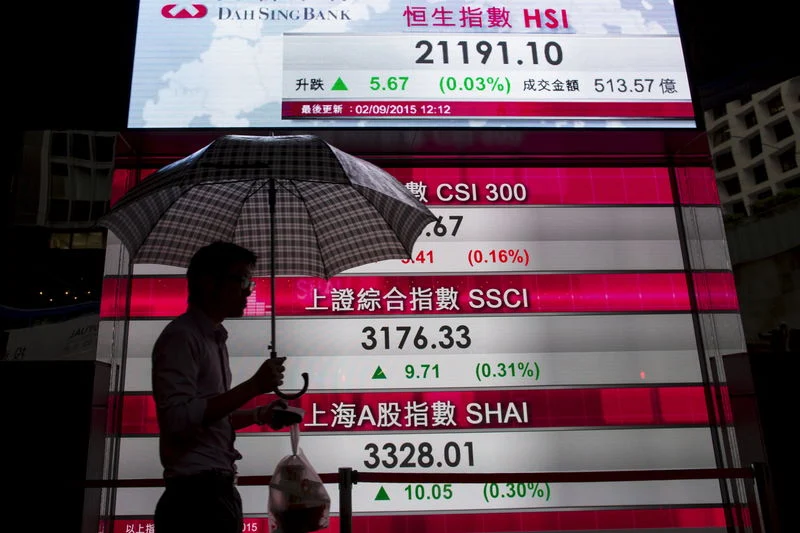
The Shanghai Composite fell nearly 1%, while the blue-chip CSI 300 declined about 1.5%.
Hong Kong’s Hang Seng Index dropped around 0.7%, with technology companies and semiconductor stocks among the weakest performers.
Markets were focused on the Trump-Xi meeting in Washington on Thursday.
Trade, artificial intelligence, technology and Taiwan were among the issues expected to feature in discussions.
U.S. Treasury Secretary Scott Bessent also said Washington and Beijing had agreed to extend their existing trade truce by two months.
Australia Stocks Fall as Unemployment Rises
Australia’s S&P/ASX 200 declined around 0.8%.
Fresh employment data showed that job growth exceeded expectations.
However, the unemployment rate climbed to its highest level in five years as more people entered the labour force.
The figures arrived ahead of the Reserve Bank of Australia’s September 29 policy meeting.
Expectations for a possible interest-rate increase remained firm following the latest labour-market data.
Other Asian Markets Trade Lower
Elsewhere in the region, Singapore’s Straits Times Index was little changed.
India’s Nifty 50 fell around 1%.
South Korean financial markets remained closed for a public holiday.
Overall, Asian equities remained under pressure from rising global yields, elevated energy prices and uncertainty surrounding major U.S.-China talks.