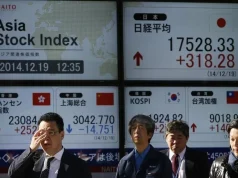
Asian stock markets declined sharply on Wednesday as heavy selling in technology shares continued for a second consecutive session.
South Korea led the regional losses, while investors remained cautious ahead of major U.S. technology earnings and the Federal Reserve’s latest interest rate decision.
Market sentiment also weakened after Iran launched fresh missile attacks targeting U.S. forces. The renewed hostilities disrupted recent ceasefire hopes, pushed oil prices higher and revived concerns about global inflation.
Wall Street Weakness Pressures Asian Markets
Asian markets followed a mixed session on Wall Street.
The Dow Jones recorded gains, but the technology-heavy Nasdaq declined as investors reduced their exposure to artificial intelligence and semiconductor stocks.
During Asian trading, Nasdaq 100 futures fell by around 0.6%, while S&P 500 futures slipped approximately 0.1%.
The MSCI Asia Pacific Index excluding Japan declined by about 3.5%, reflecting broad weakness across regional markets.
KOSPI Drops 6% as Technology Selloff Deepens
South Korea’s KOSPI fell by more than 6% after briefly dropping over 12% earlier in the session.
The decline extended Tuesday’s historic selloff, when the index recorded its largest one-day loss in nearly five months.
The KOSPI has now fallen approximately 34% from its recent peak. As a result, analysts are debating whether the correction could tighten domestic financial conditions and eventually influence South Korean monetary policy.
Nomura analysts said the scale of the decline could become increasingly important for the country’s economic and interest rate outlook.
SK Hynix and Samsung Shares Slide
South Korean semiconductor companies suffered some of the region’s steepest losses.
SK Hynix fell by more than 12%, despite reporting record quarterly profit. Strong demand for high-bandwidth memory chips used in artificial intelligence servers supported the company’s earnings.
However, the results failed to satisfy investors’ high expectations. SK Hynix had fallen by more than 20% earlier in the session before recovering part of its losses.
Samsung Electronics declined by more than 8%, while LG Innotek dropped almost 13%.
The losses showed that strong earnings were no longer enough to support AI-related stocks after their rapid rise in recent months.
Investors Question AI Stock Valuations
The technology selloff reflected growing concerns about high artificial intelligence valuations.
Investors are also questioning the large amounts of capital that technology companies are spending on AI infrastructure.
At the same time, competition across the semiconductor industry continues to increase. China’s rapidly expanding chip sector could place additional pressure on established manufacturers in South Korea, Japan and Taiwan.
These concerns have encouraged investors to reduce positions in some of the region’s strongest-performing technology stocks.
Japan Stocks Fall as Chipmakers Tumble
Japan’s Nikkei 225 declined by approximately 1.3%, with technology and electronics companies leading the losses.
Kioxia Holdings and Murata Manufacturing both fell by more than 15%.
Japanese markets also faced uncertainty after a powerful earthquake struck off the country’s eastern coast.
Authorities issued tsunami warnings across several areas. However, there were no immediate reports of major damage to industrial facilities, while officials continued to monitor the situation.
Chinese Stocks Outperform Regional Markets
Chinese equities performed better than most other Asian markets.
Hong Kong’s Hang Seng Index climbed by around 1.5%, while the Shanghai Shenzhen CSI 300 gained approximately 0.5%.
The Shanghai Composite also edged 0.2% higher.
Investors appeared to rotate into Chinese domestic shares following recent underperformance across technology markets in other parts of Asia.
The stronger performance also suggested that some investors viewed Chinese stocks as relatively less expensive after previous declines.
Taiwan Market Extends Semiconductor Losses
Taiwan’s technology-heavy stock market remained under pressure.
The Taiwan Weighted Index fell by nearly 4% as investors continued selling semiconductor shares.
Taiwanese companies are heavily exposed to the global chip industry. Therefore, concerns about AI valuations, capital spending and rising competition weighed heavily on the market.
Australian Stocks Rise After Softer Inflation
Australia was one of the region’s strongest-performing markets.
The S&P/ASX 200 climbed to its highest level since early April after inflation data came in below expectations.
The softer figures encouraged traders to reduce expectations for another interest rate increase from the Reserve Bank of Australia.
Mining company Rio Tinto gained approximately 4.8% after reporting earnings that exceeded analyst forecasts.
The company’s shares reached their highest level since July 7.
Singapore Gains While India Trades Flat
Elsewhere in Asia, Singapore’s Straits Times Index advanced by around 0.5%.
Financial stocks helped support the market.
India’s Nifty 50 remained broadly unchanged as investors avoided taking large positions before the Federal Reserve’s announcement.
Middle East Conflict Pushes Oil Prices Higher
Oil prices remained elevated as tensions in the Middle East intensified.
The United States and Saudi Arabia carried out attacks against Iran-backed groups in Iraq. The strikes followed drone attacks targeting Saudi oil facilities.
U.S. Central Command also said it intercepted several ballistic missiles launched by Iran toward American forces in the region.
The latest escalation increased concerns about potential disruptions to energy supplies.
Higher oil prices could also add to inflation by raising transportation and production costs across the global economy.
Federal Reserve Decision in Focus
Investors are now waiting for the Federal Reserve’s policy announcement.
The central bank is widely expected to leave interest rates unchanged. However, markets continue to price in roughly a 33% possibility of another rate increase.
A more hawkish Fed message could place further pressure on technology shares and other risk-sensitive investments.
Meanwhile, a less aggressive policy outlook could provide some relief to global stock markets.
Investors will also closely monitor earnings reports from Microsoft and Meta Platforms. Their results may provide further insight into artificial intelligence spending and the outlook for the technology sector.
Asian Markets Remain Under Pressure
Asian markets remain vulnerable to several major risks.
The ongoing AI stock correction, rising semiconductor competition, Middle East tensions and uncertainty surrounding U.S. interest rates have all weakened investor confidence.
The Federal Reserve’s guidance and upcoming technology earnings could now determine whether the regional selloff continues or begins to stabilize.