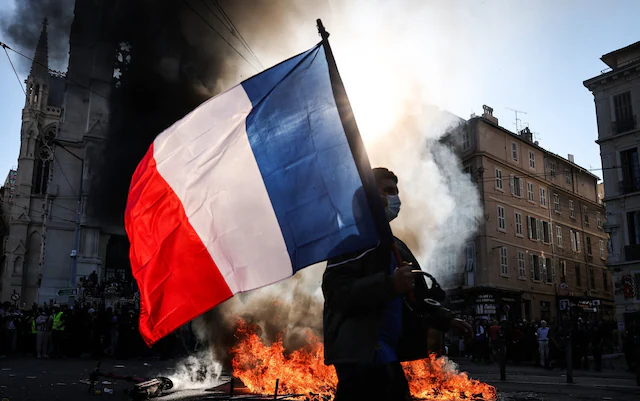
France introduced partial curfews in Paris and several other cities on Monday, October 19, following a weekend of violent riots, widespread looting and anti-government demonstrations.
Authorities imposed restrictions in Paris, Lille, Nice and other locations as criticism intensified over the government’s handling of public security. The unrest has also raised concerns about France’s political stability, economic outlook and financial markets.
Prime Minister Sébastien Lecornu rejected the possibility of a citywide curfew in Paris. Instead, he supported targeted restrictions while keeping the option of a state of emergency open.
France Imposes Curfews in Paris and Major Cities
French authorities announced several security measures aimed at preventing further violence and restoring public order.
In Paris, police prohibited demonstrations in selected areas beginning at 8 p.m. local time. Additional overnight curfews were introduced around Place de la République and Les Halles, starting at 11 p.m. and remaining in effect until 6 a.m. on Tuesday.
Security forces were deployed to enforce the restrictions and prevent further disturbances.
Meanwhile, authorities introduced curfews for minors in Lille, Douai, Wattignies and Denain. The measures were scheduled to operate between 8 p.m. and 6 a.m. over two nights.
Nice Mayor Eric Ciotti also announced overnight restrictions for minors in the city centre.
In Marseille, officials prohibited public gatherings and demonstrations as part of wider efforts to contain the unrest.
Nationwide Riots Leave Thousands Arrested and Police Injured
The violence followed weeks of student-led demonstrations and growing public dissatisfaction with living costs and public services.
Hundreds of thousands of people participated in protests over the weekend. Although many demonstrations remained peaceful, some developed into violent confrontations, vandalism and looting.
According to France’s Interior Ministry, approximately 2,400 people were arrested during the unrest.
Nearly 1,000 police officers were injured, while one demonstrator died after suffering cardiac arrest on Saturday.
The government had deployed around 60,000 police officers and other security personnel. However, Interior Minister Laurent Nuñez acknowledged that the deployment was insufficient to control the most violent incidents.
The unrest comes approximately six months before France’s next presidential election, increasing political pressure on President Emmanuel Macron’s administration.
Nearly 3,000 French Shops Affected by Riots and Looting
Businesses across France suffered extensive damage during the weekend’s disturbances.
The Federation of Trade and Retail estimated that almost 3,000 stores were affected by the violence.
Retailers reported broken windows, stolen merchandise and significant property damage. Business representatives called for tax relief and social security assistance to support affected companies.
In central Paris, several luxury shopping districts experienced vandalism.
At Place Vendôme, numerous high-end boutiques remained closed on Monday, with security personnel stationed outside their entrances.
A Dior store suffered damage to its entrance, while other luxury retailers, including Rolex, Louis Vuitton, Ralph Lauren and Gucci, reported damaged windows.
Marseille also experienced extensive looting. Olympique de Marseille confirmed that its official merchandise store had been targeted, while a town hall elsewhere in central France was set on fire.
Local shop owners criticised the limited police presence during the violence, describing substantial damage to their businesses.
The government announced plans to introduce furlough support for affected workers and businesses beginning Tuesday.
Additionally, digital platforms were instructed to remove advertisements involving stolen merchandise and cooperate with authorities investigating illegal resales.
French Government Faces Criticism Over Security Failures
Prime Minister Lecornu accused far-left groups of contributing to the violence and attempting to destabilise the country before the presidential election.
However, opposition politician Jean-Luc Mélenchon challenged those accusations and demanded evidence to support the government’s claims.
President Macron also faced growing pressure over the authorities’ response.
Interior Minister Laurent Nuñez reportedly offered his resignation following criticism of the security operation. Macron rejected the offer and instructed him to strengthen enforcement while addressing failures in intelligence gathering and planning.
The mayors of Paris, Marseille and Lyon also criticised the response.
In a joint opinion article published in Libération, the three mayors expressed concern that significant areas of their cities had been inadequately protected during the disturbances.
Their criticism added to the political challenges facing the government as it attempts to restore confidence in public security.
France’s Financial Markets Face Growing Political Risks
The unrest has also created additional uncertainty for investors already concerned about France’s economic outlook.
French financial assets underperformed broader European markets on Monday, although the declines remained relatively contained compared with previous episodes of political instability.
The benchmark CAC 40 index fell approximately 0.23% during the October 19 session.
Investors are closely watching the government’s ability to maintain political stability while advancing its budget legislation.
France faces significant fiscal challenges, including elevated public debt and pressure to improve government finances.
A prolonged period of political disruption could complicate budget negotiations and weaken investor confidence.
Furthermore, continued curfews and demonstrations could negatively affect several sectors of the French economy.
Retail businesses, luxury goods companies, hospitality operators and tourism-related services may face reduced activity if security restrictions remain in place.
For government bond investors, uncertainty surrounding fiscal policy and political stability could also influence perceptions of French sovereign debt risk.
More Protests and Nationwide Strikes Expected
Despite the restrictions, further demonstrations remain possible.
French labour unions have called for another round of nationwide strikes and rallies on November 5.
The beginning of school holidays could temporarily reduce student participation. However, additional gatherings and blockades have already been reported near prominent locations, including the Louvre and Sciences Po university in Paris.
Authorities confirmed that the Champions League football match between Paris Saint-Germain and Barcelona would proceed as scheduled on Tuesday evening.
Meanwhile, several European governments advised travellers visiting France to exercise caution and avoid large crowds.
Demonstrations driven by rising living costs have also affected other European countries, including Italy, Belgium and Albania.
Macron Seeks Energy Supplies as France Confronts Economic Pressure
While French authorities worked to restore order, President Macron travelled to Kuwait as part of a broader diplomatic visit to the Gulf region.
The trip focused partly on securing additional petrol and diesel supplies to help ease pressure on domestic fuel prices.
Higher living costs, dissatisfaction with public services and broader economic uncertainty have contributed to growing public frustration.
The combination of political unrest, fiscal pressures and security concerns presents a difficult challenge for the French government.
Although targeted curfews may help contain further violence, the longer-term consequences will depend on whether authorities can restore stability and address the economic grievances driving public dissatisfaction.