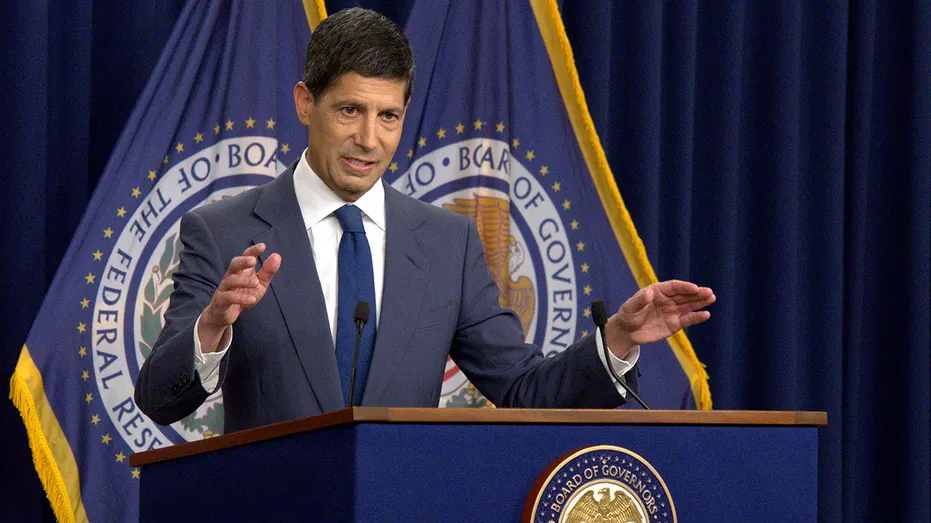
Federal Reserve Chairman Kevin Warsh has avoided giving clear guidance on the future path of U.S. interest rates. However, the combination of persistent inflation, oil prices above $100 per barrel and rising bond yields is increasing pressure on the Fed to act.
Markets now strongly expect the Federal Reserve to raise interest rates at its upcoming policy meeting.
Fed Rate Hike Expectations Rise
The Federal Reserve will announce its latest monetary policy decision on Wednesday after completing a two-day meeting.
Financial markets are heavily pricing in a 25-basis-point rate hike. That would lift the federal funds target range to 3.75%-4.00%.
Investors are also watching for signs that further tightening could follow later this year.
Warsh Faces His First Major Policy Test
The decision represents a major test for Warsh, who has led the Federal Reserve’s rate-setting committee since taking office in May.
President Donald Trump selected Warsh with the expectation that interest rates would eventually move lower.
However, inflation and financial market conditions have made that outcome increasingly difficult.
A rate increase could also prove politically sensitive ahead of November’s elections, particularly as voters remain concerned about affordability and borrowing costs.
Treasury Yields Add Pressure on the Fed
Bond markets are sending a strong signal as well.
The benchmark 10-year U.S. Treasury yield reached 5% on Monday, reflecting expectations for higher interest rates, elevated oil prices and persistent inflation.
Bank of America analysts argued that the Fed faces a difficult choice: raise rates or risk a further surge in bond yields.
A sharp rise in yields could create broader financial market instability and tighten borrowing conditions across the economy.
Warsh May Have to Address Future Rate Hikes
A rate hike would also make it harder for Warsh to avoid discussing the future direction of monetary policy.
If Fed officials also project another increase later this year, markets will likely demand greater clarity.
TD Securities economist Oscar Munoz said Warsh will need to carefully balance his preference for limited forward guidance with growing questions about whether additional tightening is coming.
If the Fed raises rates now, investors may interpret that as the beginning of a broader tightening phase.
Economists Shift Toward a Rate Hike
Economists have become significantly more hawkish in recent days.
A fresh Reuters poll shows that economists now expect the Federal Reserve to raise interest rates on Wednesday.
Only a week earlier, many had expected the central bank to keep rates unchanged.
The shift follows stronger-than-expected inflation data.
Inflation Data Changes the Fed Outlook
Earlier this month, several Federal Reserve officials argued that policymakers should remain patient.
Fed Governor Christopher Waller had pointed to softer inflation readings in June and July as evidence that price pressures were gradually moving toward the Fed’s 2% target.
New York Fed President John Williams had also favored waiting for more economic data.
However, the latest inflation report has complicated that outlook.
Core Inflation Remains Too High
U.S. consumer prices excluding food and energy rose 0.3% month over month in August.
That pace remains above levels consistent with the Federal Reserve’s 2% inflation target.
The stronger inflation reading has reinforced concerns that price pressures are not cooling quickly enough.
Several Fed officials had already indicated that they would support higher rates if inflation failed to improve.
Oil Above $100 Adds Another Inflation Risk
Energy prices are creating additional uncertainty.
Oil prices have surged above $100 per barrel amid renewed geopolitical tensions in the Middle East.
Higher energy prices can feed directly into transportation, manufacturing and consumer costs.
This creates a fresh inflationary risk at a time when underlying price pressures remain elevated.
Warsh has previously emphasized that inflation must move toward the Fed’s target both clearly and quickly.
Fed Credibility Could Be at Stake
Some economists believe the Fed may now need to act to maintain its credibility.
JPMorgan economist Michael Feroli expects a rate hike, although he believes the decision is closer than the roughly 90% probability currently reflected in futures markets.
He argued that Warsh’s repeated warnings about inflation could lose credibility if they are not followed by policy action.
Markets May Have Boxed the Fed In
Other analysts believe market expectations themselves are increasing pressure on policymakers.
Scotiabank economist Derek Holt said Warsh’s emphasis on financial market signals may have limited the Fed’s flexibility.
With a rate hike already heavily priced in, holding rates steady could trigger a sharp market reaction.
That could push Treasury yields even higher and create renewed volatility across bonds, equities and currencies.
Fed Officials Could Still Choose to Hold
A rate increase is not guaranteed.
Some economists argue that Warsh could still persuade a majority of policymakers to leave rates unchanged.
However, recent inflation data, higher oil prices and the Fed chairman’s own emphasis on price stability make that option less likely.
Several officials may conclude that the current pace of disinflation is too slow.
First Warsh-Era Rate Hike Looks Increasingly Likely
The Federal Reserve now faces a difficult balance between inflation risks, financial market stability and political pressure.
Persistent core inflation, oil above $100 and Treasury yields near major psychological levels have all strengthened the case for tighter monetary policy.
Unless the Fed delivers a surprise, markets increasingly expect Wednesday’s meeting to produce the first interest rate hike under Chairman Kevin Warsh.