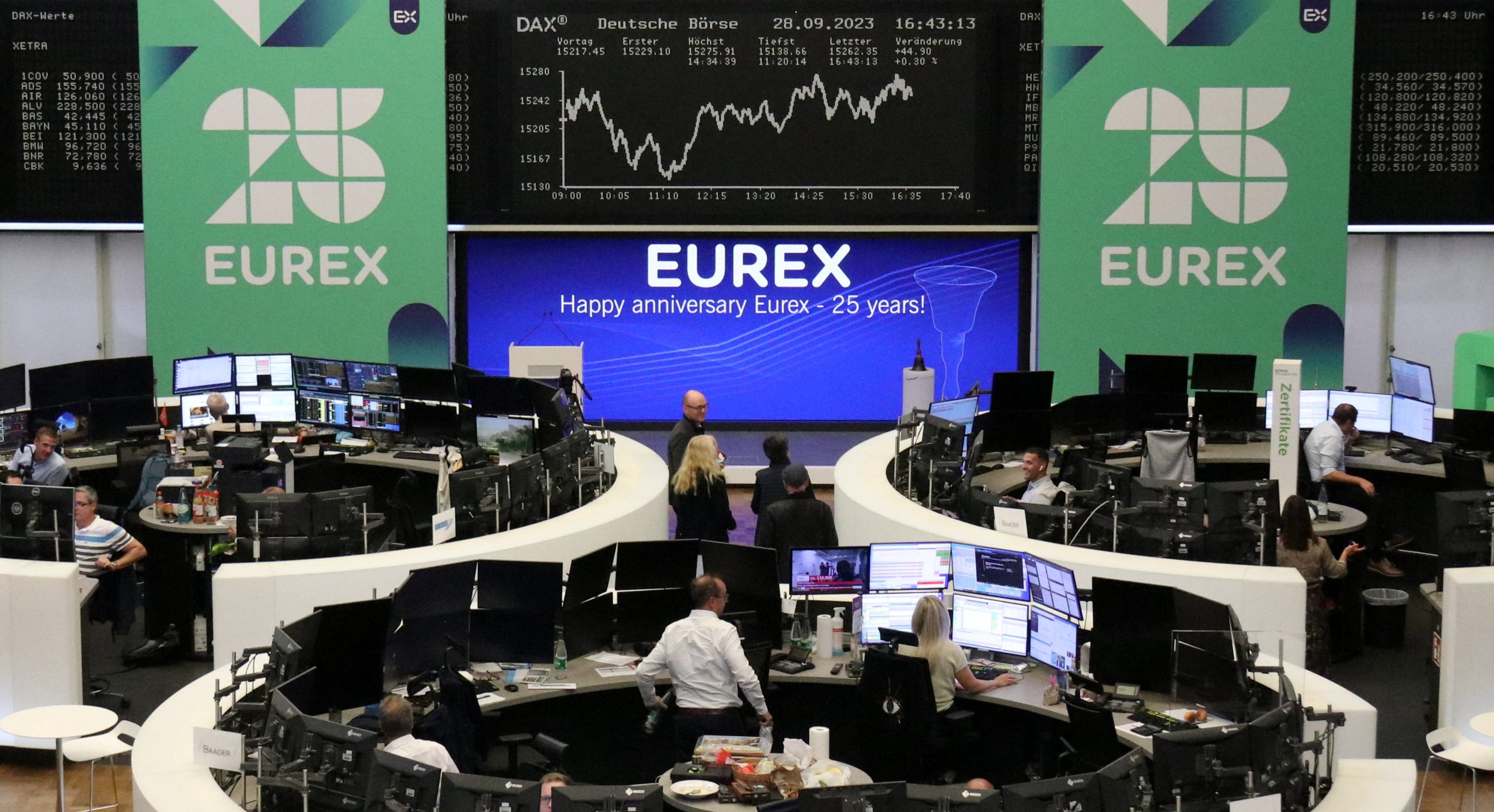
European stocks dropped to their lowest levels in nearly four months on Thursday as rising bond yields, concerns over France’s public debt and escalating Middle East tensions weighed on investor sentiment.
The pan-European STOXX 600 index declined 1%, reaching its weakest level since June 11. The selloff followed Wednesday’s session, which ended a three-day winning streak for European equities.
Major stock market indices across the region recorded losses. Germany’s DAX fell 1%, while France’s CAC 40 declined 0.9%. London’s FTSE 100 slipped 0.7%, and Italy’s FTSE MIB led the losses with a 1.3% drop.
Although European markets attempted a modest recovery earlier in the week, growing concerns about global borrowing costs, energy prices and fiscal instability have continued to limit investor appetite for risk.
European Stocks Fall as US Tech Giants Plan Massive Debt Issuance
European financial markets faced additional pressure following reports that major American technology companies are preparing substantial new borrowing programs.
US technology giants, including SpaceX and Broadcom, are reportedly planning debt financing that could total approximately $80 billion.
The potential surge in corporate bond issuance has raised concerns about increased competition for institutional investment capital.
Large borrowing programs can absorb investor demand that might otherwise support government bonds or other corporate debt securities.
Consequently, the additional supply could contribute to rising borrowing costs and wider credit spreads across international fixed-income markets.
Higher bond yields generally create challenges for stock markets because they increase financing costs and make interest-bearing investments more attractive relative to equities.
European Technology Stocks Slide Amid Global Bond Market Pressure
Although European stock markets have less direct exposure to major US artificial intelligence companies, they remain closely connected to the global technology supply chain.
Several leading European semiconductor manufacturers and industrial businesses supply components, equipment and services to American technology firms.
As a result, uncertainty surrounding technology-sector financing and investment spending can influence European corporate valuations.
German semiconductor manufacturer Infineon fell 2.7%, while Dutch chipmaking equipment giant ASML declined 2.3%.
BE Semiconductor Industries and STMicroelectronics also recorded substantial losses, with both companies dropping approximately 2.6%.
The declines highlighted growing investor caution toward technology stocks as global bond yields continued rising.
Middle East Conflict Pushes Oil and Natural Gas Prices Higher
Escalating geopolitical tensions in the Middle East added another source of pressure to European stock markets.
Crude oil and European natural gas futures climbed sharply following renewed attacks on commercial shipping and energy infrastructure across the Persian Gulf and Red Sea.
Reports of additional drone and missile strikes raised concerns about the security of major international energy transportation routes.
The renewed instability increased the geopolitical risk premium in energy markets, reversing some of the price declines recorded in previous sessions.
Higher oil and gas prices represent a particular challenge for European economies because many industries depend heavily on imported energy.
Rising Energy Costs Increase Inflation and Economic Growth Risks
European manufacturers and other energy-intensive businesses face the prospect of higher operating expenses as fuel and electricity costs increase.
The timing is particularly challenging as Northwestern Europe approaches the winter heating season, when natural gas and electricity demand typically rises.
A prolonged increase in energy prices could squeeze corporate profit margins while reducing household purchasing power.
Furthermore, elevated energy costs may keep inflation above central bank targets, making it more difficult for policymakers to lower interest rates.
This combination of persistent inflation and weaker economic growth has revived concerns about stagflation across European markets.
As a result, investors remain cautious about sectors particularly exposed to energy costs, borrowing expenses and changes in consumer demand.
Hawkish Federal Reserve Minutes Add Pressure to European Markets
The latest Federal Reserve meeting minutes also contributed to the negative mood across European financial markets.
Minutes from the Federal Open Market Committee’s September meeting, released Wednesday, indicated that most policymakers considered another interest rate increase appropriate before the end of the year.
The hawkish outlook weakened expectations that the US central bank would soon shift toward easier monetary policy.
Higher American interest rates can influence global financial conditions by increasing US Treasury yields and supporting the dollar.
These developments may also place upward pressure on borrowing costs in other major economies, including those in Europe.
For European equities, tighter global financial conditions can reduce investment demand and create additional challenges for companies relying on debt financing.
The prospect of further monetary tightening therefore added to existing concerns about energy inflation and the stability of government bond markets.
French Debt Concerns Deepen as Bank of France Warns of Fiscal Risks
France’s deteriorating fiscal outlook emerged as another major concern for European investors.
Bank of France Governor Emmanuel Moulin warned Wednesday that the country’s economic and financial situation remained serious amid widening budget deficits and persistent political uncertainty.
Rising government borrowing costs have intensified concerns about France’s ability to stabilize its public finances.
However, Moulin rejected suggestions that the European Central Bank should intervene to support French government bonds.
He emphasized that France must address its fiscal challenges through domestic budget reforms rather than relying on external monetary assistance.
The comments reinforced the importance of credible fiscal measures as investors reassess the risks associated with French sovereign debt.
CAC 40 Struggles as French Banks Face Heavy Selling
France’s CAC 40 remained under significant pressure, trading near its weakest levels since March.
The benchmark index was also heading toward a second consecutive weekly decline as uncertainty surrounding the country’s budget negotiations continued to undermine investor confidence.
French government bond yields have risen as investors demand higher returns to compensate for growing fiscal and political risks.
The resulting bond market volatility has also affected French financial institutions, many of which maintain substantial holdings of domestic sovereign debt.
When government bond prices decline, banks holding those securities can face valuation losses and increased concerns about their balance sheets.
Shares of major French lenders Societe Generale and BNP Paribas both dropped more than 2% during the session.
The banking sector’s weakness reflected broader concerns about France’s fiscal outlook and the potential consequences of prolonged instability in sovereign debt markets.
European Stock Market Outlook: Bond Yields and French Debt Remain Key Risks
The near-term direction of European stocks will likely depend on developments in global bond markets, Middle East energy supplies and France’s efforts to address its fiscal challenges.
Further increases in US Treasury yields could maintain upward pressure on European borrowing costs, particularly if large American corporate debt offerings compete with government securities for investor capital.
Meanwhile, continued geopolitical instability could keep oil and natural gas prices elevated, increasing inflation risks and threatening economic growth.
France’s budget negotiations will also remain an important focus as investors assess whether policymakers can restore confidence in the country’s public finances.
A stabilization in bond yields, easing energy prices or progress toward credible fiscal reforms could help European equities recover.
However, continued uncertainty may keep investors cautious, particularly toward banks, semiconductor companies and other sectors sensitive to financing conditions.
For now, the STOXX 600’s decline to a nearly four-month low reflects the multiple challenges facing European financial markets as debt concerns, geopolitical risks and restrictive monetary policy combine to pressure investor sentiment.