Wall Street surged on Wednesday as US stocks rallied following the Democratic Party’s decisive victory in the midterm elections. Investors welcomed the removal of political uncertainty, pushing the Dow Jones, S&P 500, and Nasdaq sharply higher despite concerns about potential changes to government policy.
The stock market initially reacted negatively to the election results. However, sentiment quickly improved as investors considered the possibility that divided government could reduce the likelihood of major economic policy changes.
Wall Street Rally Sends Dow Jones, S&P 500 and Nasdaq Higher
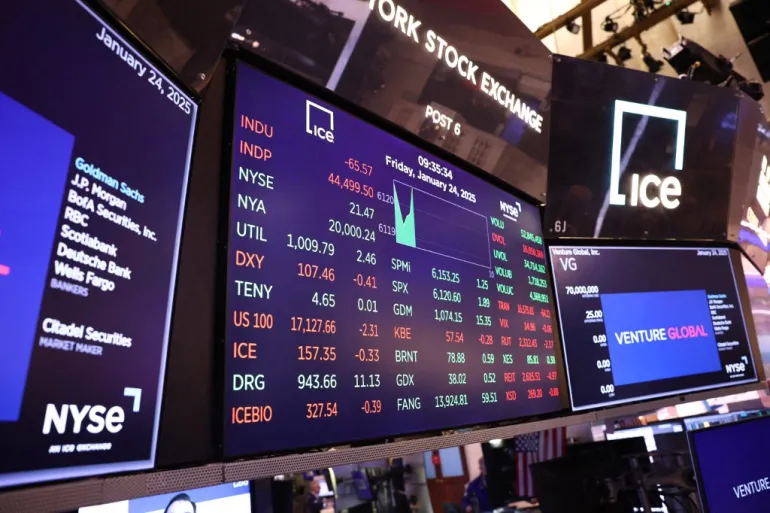
Major US stock indexes recorded substantial gains during Wednesday’s trading session as buying activity accelerated across Wall Street.
At 12:36 p.m. Eastern Time, the S&P 500 climbed 1.8% to 7,704.76 points, while the Dow Jones Industrial Average jumped 2.9% to 53,275.30 points.
The technology-heavy Nasdaq Composite also advanced 2%, reaching 25,881.55 points.
The rally followed an initial decline in stock index futures as the scale of the Democratic victory became apparent overnight.
However, investors quickly shifted their attention toward the benefits of reduced election uncertainty and the potential for greater stability in Washington.
US Midterm Elections Remove Major Market Uncertainty
Peter Tuz, president of Chase Investment Counsel, suggested that the market’s positive reaction reflected relief that the election outcome was no longer uncertain.
According to Tuz, investors had been concerned about the possibility of contested results or prolonged political disputes.
The Democrats’ decisive victory removed much of that uncertainty, encouraging investors to return to equities.
Historical market patterns also suggest that US stocks have frequently performed well following midterm elections, regardless of which political party emerges victorious.
Nevertheless, the new congressional balance could significantly influence government priorities.
Tuz suggested that Democratic control might lead to slower growth in defense spending, greater federal involvement in healthcare and energy, and renewed discussions about tax increases.
Despite these potential policy changes, the immediate market reaction reflected optimism that the election-related uncertainty had largely passed.
Democrats Secure Control of Both Chambers of Congress
The Democratic Party achieved a sweeping victory in Tuesday’s US midterm elections, gaining control of both the Senate and House of Representatives.
According to Associated Press projections cited during Wednesday’s session, Democrats had secured 54 seats in the 100-member Senate, with two races still undecided.
In the House, the party had won at least 228 seats, comfortably exceeding the 218 seats required for a majority.
The results included significant Democratic victories in traditionally Republican-leaning states.
James Talarico won the Senate race in Texas, while Abdul El-Sayed secured victory in Michigan.
Overall, Democrats flipped at least seven Senate seats previously held by Republicans.
The election results represented a major political setback for President Donald Trump, whose party had controlled both congressional chambers during the first two years of his second term.
Trump Faces Congressional Opposition After Republican Defeat
Democratic control of Congress could complicate President Trump’s legislative agenda during the remainder of his presidency.
Beginning in January, major legislation will generally require cooperation between the Republican administration and Democratic lawmakers.
However, Trump will retain his presidential veto authority, potentially limiting the scope of Democratic legislative initiatives.
The election outcome followed growing voter dissatisfaction with economic conditions and the administration’s handling of the Iran war.
Higher gasoline prices, persistent inflation, and concerns about the cost of living were important issues throughout the campaign.
Trump acknowledged the election results but argued that the Republican Party’s losses were partly attributable to his absence from the ballot.
Vice President JD Vance also identified the Iran conflict as a major factor behind the Republican defeat.
For investors, the new political environment raises questions about federal spending, taxation, defense policy, and future regulatory changes.
AI Data Center Stocks Slide Despite Broad Wall Street Rally
Although the broader US stock market moved sharply higher, artificial intelligence infrastructure companies experienced significant selling pressure.
Investors became concerned that Democratic control of Congress could introduce stricter regulations affecting data center construction and AI development.
Nebius shares fell approximately 5.8%, while CoreWeave declined 8.9%.
IREN suffered an even larger drop, losing around 9.9% during the session.
The declines reflected growing uncertainty about the future expansion of AI infrastructure across the United States.
Public concerns surrounding electricity consumption, environmental impacts, and potential employment disruptions have increased scrutiny of the rapidly growing industry.
Although substantial federal legislation would face obstacles under a Republican White House, state and local authorities could still impose additional requirements on new data center projects.
AI Investment Concerns Continue to Pressure Technology Stocks
The election-related selloff added to existing concerns about the enormous capital investments required to develop artificial intelligence infrastructure.
Technology companies have committed substantial financial resources to building data centers, purchasing advanced processors, and expanding computing capacity.
Some investors have questioned whether these investments will generate sufficient returns to justify their costs.
The possibility of tighter regulations has introduced another potential challenge for companies dependent on large-scale AI infrastructure development.
Justin Buell, chief investment officer at Continuity Group, suggested that the midterm elections could help stabilize the broader stock market by reducing political uncertainty.
However, he acknowledged that AI and technology shares could experience additional volatility as investors evaluate potential regulatory changes.
Buell also pointed to the historically favorable seasonal performance of US equities during November and December.
Nevertheless, historical market patterns do not guarantee future gains, particularly when interest rates, corporate earnings, and geopolitical developments remain uncertain.
Defense Stocks Fall as Investors Anticipate Spending Changes
Defense contractors were among the notable losers following the Democratic election victory.
Shares of Lockheed Martin, Northrop Grumman, and RTX declined between approximately 3.2% and 6.8%.
The weakness reflected concerns that Democratic lawmakers could challenge some of the Trump administration’s defense spending priorities.
Investors also considered whether congressional opposition could influence future military procurement programs and government contracts.
However, any significant reduction in defense spending would depend on legislative negotiations and broader national security considerations.
For major defense companies, federal budget decisions remain a key factor affecting revenue expectations and long-term profitability.
Solar Energy Stocks Surge on Prospects of Renewed Support
Renewable energy companies moved in the opposite direction as investors anticipated a potentially more favorable policy environment.
Enphase Energy shares gained approximately 6.4%, while First Solar advanced 6.8%.
The rally reflected expectations that Democratic lawmakers could support policies encouraging renewable energy investment and domestic clean energy manufacturing.
Potential incentives and regulatory changes could benefit companies operating in the solar energy sector.
However, the extent of any policy changes remains uncertain because President Trump retains the ability to veto legislation.
Despite these limitations, the election results encouraged renewed investor interest in clean energy stocks.
Semiconductor Stocks Decline Despite Strong AMD Earnings
Semiconductor stocks also struggled during Wednesday’s session, even as the broader technology market recovered.
The Philadelphia Semiconductor Index fell approximately 2.7%, reflecting continued concerns about the sustainability of artificial intelligence investment.
Advanced Micro Devices (AMD) reported stronger-than-expected quarterly earnings and issued an optimistic revenue outlook.
However, AMD shares gained just 0.5% during the session, surrendering much of their earlier premarket advance of more than 7%.
Chief Executive Officer Lisa Su told analysts that AMD expects revenue growth exceeding 80% in 2027, compared with market expectations of approximately 77%.
The company anticipates that data center processors will become the primary drivers of its future revenue and earnings expansion.
Nevertheless, AMD’s quarterly profitability was affected by a non-cash accounting charge exceeding $1 billion.
The expense was associated with stock warrants granted to OpenAI and Meta Platforms as part of commercial agreements involving future AMD chip purchases.
The market reaction highlighted the continuing tension between strong AI-related earnings growth and investor concerns about valuations and capital spending.
CVS Health Stock Plunges on Plans to Split Company
Elsewhere, CVS Health attracted significant attention after announcing plans to separate its operations into two independent publicly traded companies.
Shares of the healthcare giant dropped nearly 12% as investors assessed the potential consequences of the restructuring.
The planned separation would create one company focused on healthcare services and another dedicated to retail pharmacy operations.
The healthcare solutions business, provisionally retaining the CVS Health name, would include Aetna, CVS Caremark, CVS Specialty, Oak Street Health, and Signify Health.
The second business, CVS Pharmacy, would operate approximately 9,000 retail pharmacies alongside mail-order pharmacy services, MinuteClinic locations, virtual care, and Health100 technology services.
The company expects to complete the separation during the first half of 2028, subject to the necessary approvals and other conditions.
Analysts Warn CVS Breakup Carries Operational Risks
The proposed restructuring represents a significant change in CVS Health’s business strategy.
For years, the company pursued an integrated healthcare model combining insurance, pharmacy benefit management, and retail pharmacy services.
Separating these operations could allow each business to focus more closely on its individual priorities.
However, the decision also introduces operational and financial uncertainties.
Rajiv Leventhal, senior analyst at Emarketer, warned that separating the retail pharmacy business from insurance and pharmacy benefit management could weaken some of the benefits associated with the integrated business model.
CVS pharmacies currently benefit from connections with Aetna insurance members and Caremark customers.
Operating independently could make it more difficult for the retail division to maintain those advantages.
The financial challenges experienced by other pharmacy chains, including Walgreens and Rite Aid, also highlight the risks facing standalone pharmacy businesses.
Investors will therefore be watching how CVS manages the transition and whether the proposed separation can create sustainable shareholder value.
Wall Street Outlook: Can the Post-Election Rally Continue?
Wednesday’s stock market rally highlighted investor relief following the US midterm elections and the removal of a significant source of political uncertainty.
The strong gains in the Dow Jones, S&P 500, and Nasdaq suggested that investors were increasingly comfortable with the prospect of divided government.
However, the mixed performance across individual sectors demonstrated that the election results could have different implications for different industries.
AI infrastructure and defense companies faced selling pressure, while renewable energy stocks benefited from expectations of potential policy support.
Meanwhile, semiconductor stocks continued to struggle with concerns about AI investment spending, and CVS Health experienced company-specific volatility following its restructuring announcement.
Looking ahead, investors will focus on corporate earnings, Federal Reserve monetary policy, inflation trends, and developments surrounding the Iran conflict.
Although the removal of election uncertainty has supported market sentiment, the longer-term direction of US stocks will depend on economic fundamentals and the ability of companies to deliver sustainable earnings growth.