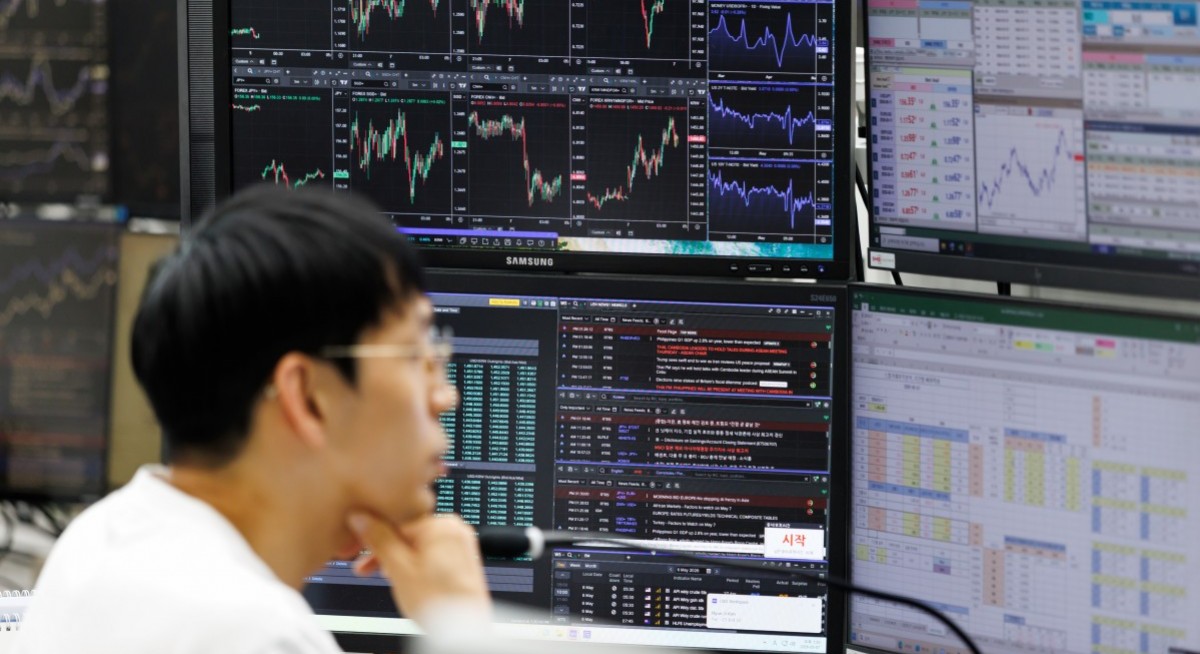
Asian stocks declined sharply on Tuesday as a deepening semiconductor selloff rattled regional markets. Heavy losses in Samsung Electronics and SK Hynix reflected growing concerns about Chinese competition, extending the technology sector’s weakness from Wall Street into Asia.
Chinese automakers also faced selling pressure following disappointing September vehicle sales and renewed concerns over European Union trade restrictions.
Meanwhile, investors remained cautious ahead of important US inflation figures and the beginning of the third-quarter corporate earnings season. Elevated oil prices and geopolitical uncertainty added to the negative market sentiment.
Asian Stock Markets Fall as Technology Shares Extend Losses
South Korea’s KOSPI suffered one of the region’s steepest declines, falling 5.8% after briefly plunging more than 7% earlier in the session.
Japan’s Nikkei 225 dropped 1.9%, while Hong Kong’s Hang Seng Index slipped 0.09%.
Mainland Chinese equities performed relatively better. The CSI 300 edged up 0.03%, while the Shanghai Composite gained 0.25%.
The weakness followed losses across Wall Street’s technology sector on Monday. The Nasdaq Composite declined 0.5%, while the Philadelphia Semiconductor Index tumbled 2.7%, reaching its lowest level since mid-September.
US stock futures also pointed lower during Asian trading. Nasdaq 100 futures fell 0.7%, while S&P 500 futures declined 0.1%.
Samsung and SK Hynix Plunge Amid Rising Chinese Chip Competition
South Korean semiconductor companies led the regional technology selloff as investors reassessed the competitive outlook for memory-chip manufacturers.
SK Hynix shares plunged 8.9%, while Samsung Electronics dropped 8%. Electronics component manufacturer LG Innotek also declined 8.9%.
The losses followed reports that Chinese memory-chip producer CXMT is making progress on a higher-density 4F² DRAM architecture.
The company is reportedly targeting the introduction of next-generation server memory products before the end of the year.
These developments have raised concerns that Chinese manufacturers could challenge established semiconductor companies more aggressively, potentially increasing supply and pressuring prices.
Despite the technological progress, CXMT shares also weakened, falling 2.4%.
South Korean markets faced additional pressure from monetary policy uncertainty.
President Lee Jae Myung indicated that South Korea might need to increase interest rates to narrow the gap with US borrowing costs and remain aligned with global monetary tightening.
South Korea’s benchmark interest rate currently stands at 3.00%, compared with the Federal Reserve’s 3.75%–4.00% target range.
However, higher borrowing costs could create additional challenges for the domestic economy, particularly given elevated household debt and concerns about loan defaults.
Semiconductor Selloff Spreads Across Taiwan and Japan
The downturn extended beyond South Korea, affecting major technology manufacturers throughout Asia’s semiconductor supply chain.
In Taiwan, Taiwan Semiconductor Manufacturing Company (TSMC) declined 1.6%, while electronics manufacturing giant Foxconn lost 2.1%. Optical lens producer Largan Precision slipped 0.6%.
Japanese technology stocks also recorded substantial losses.
Memory-chip manufacturer Kioxia plunged 12.4%, while electronic component suppliers TDK and Murata Manufacturing declined 6.2% and 6.9%, respectively.
The widespread weakness highlighted growing uncertainty surrounding semiconductor valuations, artificial intelligence investment expectations, and competition from emerging Chinese manufacturers.
Chinese Automakers Slide as EU Trade Curbs Add Pressure
Chinese automotive stocks also struggled after fresh industry data revealed a sharp deterioration in domestic vehicle demand.
Passenger-car retail sales dropped 28% year-on-year in September to 1.618 million vehicles, marking the industry’s 12th consecutive monthly decline.
The disappointing figures added to concerns about slowing consumer demand and growing competitive pressures within China’s automotive market.
Meanwhile, an agreement between the European Union and China aimed at restricting Chinese hybrid vehicle imports raised additional questions about export growth.
The proposed measures could significantly reduce hybrid vehicle shipments to European markets, although specific implementation details have yet to be finalized.
Several major Chinese automakers traded lower following these developments.
Great Wall Motor declined 2%, BYD fell 1.9%, and SAIC Motor lost 0.7%. Leapmotor slipped 0.9%, while XPeng and NIO dropped 2.1% and 1.6%, respectively.
However, some manufacturers managed to post gains despite the broader sector weakness.
Geely advanced 1.8%, Chery gained 0.2%, and Li Auto rose 0.5%.
Oil Prices and Geopolitical Tensions Keep Investors Cautious
Elevated energy prices remained another important concern for Asian stock markets.
Brent crude traded near $105.50 per barrel as investors assessed potential supply disruptions linked to escalating geopolitical tensions.
Reports of Houthi attacks targeting Saudi Arabia, including a strike on Riyadh’s main airport over the weekend, heightened concerns about a wider regional conflict.
At the same time, markets considered the possibility of increased Russian diesel exports.
US President Donald Trump suggested that Russia could expand diesel shipments and referred to a potential energy-related truce between Russia and Ukraine.
However, the proposed arrangement remained unconfirmed, while legal concerns surrounding the diesel export proposal emerged from both major US political parties.
These developments left investors balancing the risks of further energy supply disruptions against the possibility of additional fuel entering global markets.
US Inflation Data and Federal Reserve Outlook Take Center Stage
Investors are now turning their attention to Wednesday’s US Consumer Price Index (CPI) report for fresh indications about the Federal Reserve’s future interest rate decisions.
Additional economic releases, including producer price inflation and retail sales figures, are scheduled later in the week.
Stronger-than-expected inflation readings could increase expectations of further monetary tightening, potentially pushing long-term Treasury yields higher.
Such an outcome could place renewed pressure on technology stocks and other interest-rate-sensitive assets.
Meanwhile, Japan’s producer price inflation slowed to 6.8% in September from 7.6% in August, falling below market expectations.
Nevertheless, a 24.5% increase in yen-denominated import prices, driven by currency weakness and elevated raw material costs, could maintain pressure on the Bank of Japan to consider additional monetary tightening.
Investors will closely monitor the central bank’s upcoming October 29–30 policy meeting.
RBA Signals Persistent Inflation Risks
In Australia, minutes from the Reserve Bank of Australia’s September meeting revealed that policymakers unanimously approved a 25-basis-point interest rate increase, bringing the benchmark rate to 4.60%.
The decision reflected ongoing concerns about inflationary pressures stemming from higher energy costs, artificial intelligence-related demand, and constraints on productive capacity.
However, the central bank also acknowledged signs of slowing economic activity.
Weaker household spending, moderating output growth, and gradually improving labor market supply conditions highlighted the challenges facing policymakers as they attempt to contain inflation without excessively restricting economic growth.
Wall Street Earnings Season Could Shape Market Direction
Beyond economic data, investors are preparing for the beginning of the third-quarter earnings season among major US financial institutions.
JPMorgan Chase, Goldman Sachs, Citigroup, and Wells Fargo are scheduled to release their quarterly results on Tuesday.
Bank of America and Morgan Stanley will follow on Wednesday.
The reports could provide valuable insight into corporate profitability, lending activity, consumer financial conditions, and the broader US economic outlook.
With Asian stocks already under pressure from semiconductor weakness and trade uncertainty, upcoming inflation data and corporate earnings could play a significant role in determining whether global equity markets stabilize or face further selling.