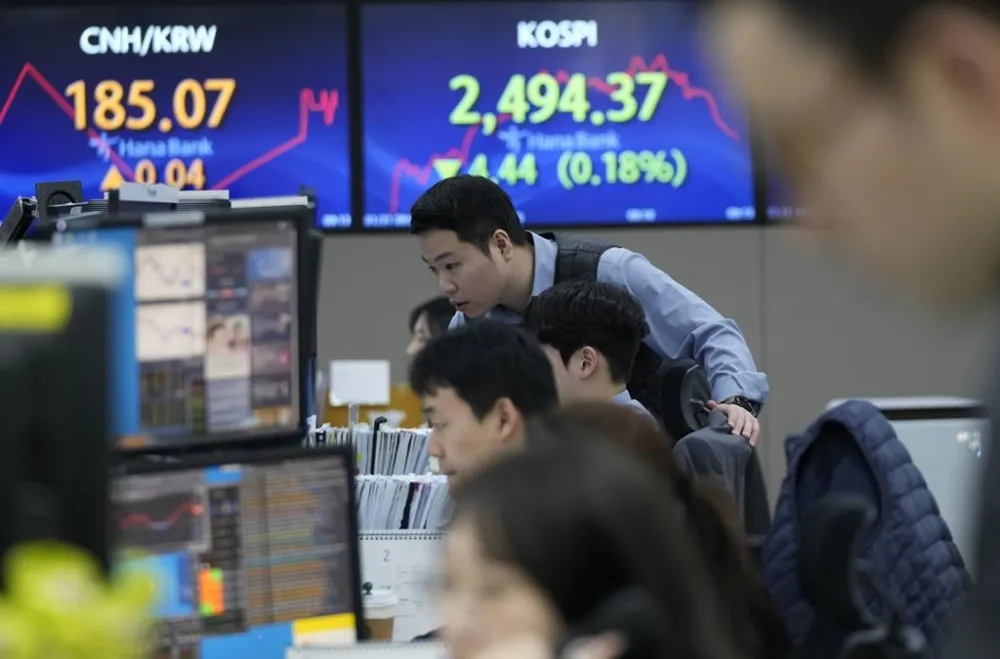
Asian stocks moved mostly higher on Thursday, led by strong gains in Japanese semiconductor shares. Sentiment improved after Micron Technology delivered an upbeat outlook, while softer U.S. inflation data reduced expectations for another Federal Reserve rate hike this month.
U.S. stock index futures also advanced during Asian trading, with Nasdaq futures leading gains. Wall Street had closed mixed in the previous session.
Nikkei Surges as Chip Stocks Rally
Japan’s Nikkei 225 jumped around 3.3%, outperforming the region as semiconductor-related shares rallied sharply.
The broader TOPIX index gained about 0.7%.
Advantest shares climbed more than 8%, while Kioxia Holdings gained around 5%. Tokyo Electron also advanced roughly 6%.
The rally followed strong guidance from U.S. chipmaker Micron Technology, which forecast first-quarter revenue above analyst expectations.
Micron’s outlook reinforced confidence that strong demand linked to artificial intelligence will continue to support memory-chip sales.
TSMC, Samsung and SK Hynix Gain
Semiconductor stocks also performed well elsewhere in Asia.
Taiwan’s benchmark stock index rose about 0.9%, while Taiwan Semiconductor Manufacturing Company (TSMC) gained approximately 1.3%.
South Korea’s KOSPI advanced around 1.6%.
Samsung Electronics climbed roughly 2.5%, while SK Hynix gained about 3%.
South Korean Exports Jump
Investor sentiment in South Korea was also supported by strong trade data.
Exports surged 83.5% from a year earlier, beating market expectations.
Semiconductor exports reached a record high as continued global investment in artificial intelligence supported demand for advanced chips.
The figures added to optimism surrounding Asia’s semiconductor industry.
Other Asian Markets Trade Mixed
Performance across the rest of Asia was more mixed.
India’s Nifty 50 slipped around 0.2%, while Singapore’s Straits Times Index gained about 0.4%.
Mainland Chinese markets were closed for the National Day holiday. Hong Kong markets were also shut on Thursday.
Chinese exchanges are scheduled to remain closed through October 7 before reopening on October 8.
Australian Stocks Fall as Trade Surplus Shrinks
Australia moved against the broader regional trend.
The S&P/ASX 200 closed nearly 2% lower after new data showed a sharp decline in the country’s trade surplus.
Australia’s goods trade surplus fell to A$495 million in August, down from a revised A$1.351 billion in July.
The figure also came in well below economists’ expectations of around A$2 billion.
Exports increased 3.7% from the previous month, while imports rose 5.8%.
Australian Inflation Keeps RBA in Focus
The latest trade figures followed stronger inflation data from Australia.
The monthly inflation indicator accelerated to 4.0% in August, compared with 3.5% in July.
Meanwhile, trimmed-mean inflation held at 3.6%.
The figures have kept investor attention firmly on the Reserve Bank of Australia after its latest interest rate increase.
Softer U.S. Inflation Eases Fed Rate Hike Fears
Asian markets also received support from softer U.S. inflation data.
The PCE price index rose 0.3% in August, below the 0.4% increase expected by economists.
Annual PCE inflation stood at 2.6%, while core inflation increased 0.2% from the previous month.
The softer figures reduced pressure on the Federal Reserve to raise interest rates again in October.
High Bond Yields and Oil Prices Limit Gains
Despite the positive tone, gains across Asian stocks were partly limited by elevated bond yields and high oil prices.
Brent crude remained close to $100 per barrel as geopolitical uncertainty continued to raise concerns over possible Middle East supply disruptions.
For now, Asian equity markets remain supported by strong semiconductor demand and easing expectations for further U.S. monetary tightening.