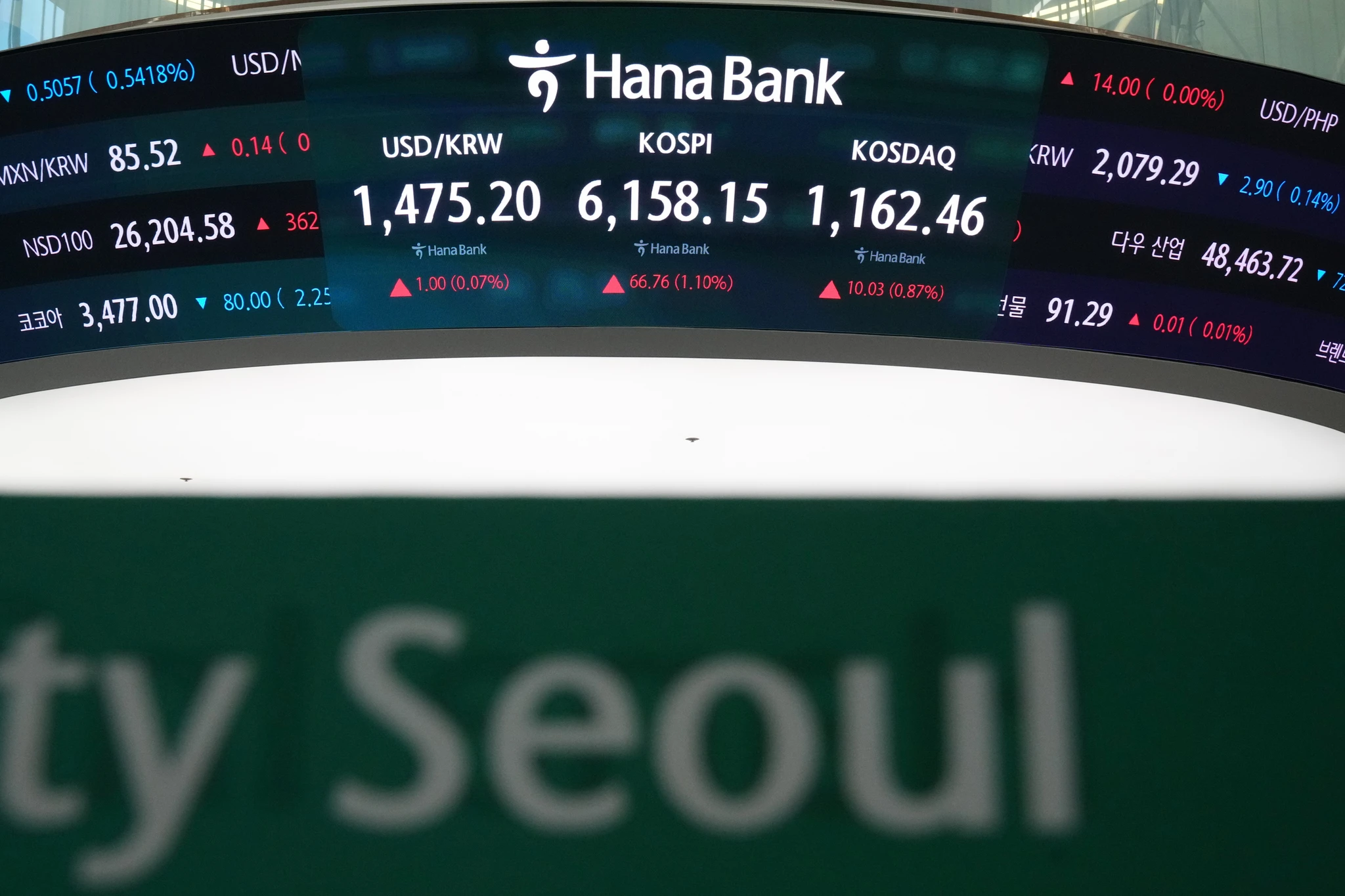
Asian stocks posted modest gains on Wednesday as semiconductor shares recovered from their recent selloff. However, rising oil prices and uncertainty ahead of crucial US inflation data prevented a broader market rally.
Stronger-than-expected Chinese trade figures helped improve investor sentiment across the region. Nevertheless, subdued consumer inflation in China highlighted ongoing challenges facing the world’s second-largest economy.
The MSCI Asia-Pacific Index excluding Japan advanced 0.5%, reflecting cautious optimism across regional equity markets.
Asian Stock Markets Rise as Investors Remain Cautious
South Korea’s KOSPI led regional gains, climbing 1.6%, while Japan’s Nikkei 225 advanced 0.6%. Hong Kong’s Hang Seng Index increased 0.3%.
Chinese equities delivered mixed results. The CSI 300 declined 0.2%, while the Shanghai Composite edged 0.1% higher.
Meanwhile, Australia’s S&P/ASX 200 dropped 0.7%. New Zealand’s NZX 50 remained relatively unchanged, and Singapore’s Straits Times Index gained 0.1%.
US equity futures also moved higher during Asian trading hours. Nasdaq 100 futures advanced 0.3%, while S&P 500 futures rose 0.1%.
The gains followed a mixed session on Wall Street, where banking shares weakened after quarterly earnings reports from major US financial institutions.
Technology stocks also faced selling pressure, with the Philadelphia Semiconductor Index falling 2.7% to its lowest level since mid-September.
Semiconductor Stocks Rebound Following AI-Related Selloff
Semiconductor companies helped support Asian stocks as investors returned to the sector following Tuesday’s sharp declines.
In South Korea, Samsung Electronics shares jumped 2.8%, while memory chip manufacturer SK Hynix gained 2%.
Both companies had suffered losses in the previous session amid growing concerns about competition from Chinese semiconductor manufacturers.
In Taiwan, Taiwan Semiconductor Manufacturing Company (TSMC) climbed 1.4%, while electronics manufacturer Foxconn advanced 2.6%. However, Largan Precision declined 3.9%.
Japan’s Kioxia also remained under pressure, falling 1.8%.
The earlier semiconductor selloff was partly driven by concerns that China’s ChangXin Memory Technologies is narrowing the technological gap with established memory chip producers.
Investors are increasingly questioning whether major technology companies can sustain their substantial investments in artificial intelligence infrastructure.
Consequently, upcoming US corporate earnings could provide important insights into the profitability and long-term outlook of the AI industry.
The earnings season began with reports from JPMorgan Chase, Goldman Sachs, Citigroup and Wells Fargo. Bank of America and Morgan Stanley are scheduled to release their results later on Wednesday.
Rising Oil Prices Add Pressure to Global Markets
Elevated energy prices continued to weigh on investor confidence as geopolitical tensions in the Middle East intensified.
Recent missile and drone attacks by Houthi forces against Saudi Arabia raised concerns about potential disruptions to global oil supplies.
Brent crude futures climbed 1.2% to approximately $106.86 per barrel. Meanwhile, US crude oil advanced 0.8% to $94.96.
Higher energy costs could complicate the global inflation outlook, potentially forcing central banks to maintain restrictive monetary policies for longer.
New York Federal Reserve President John Williams recently indicated that another interest rate increase might be necessary this year to contain inflation.
However, he suggested that additional tightening may not be required in 2027.
Financial markets currently assign a 22% probability to a Federal Reserve rate hike in October.
Meanwhile, the US Dollar Index eased to 102.17 after reaching an 18-month high during the previous session. The euro remained broadly stable at $1.1202.
China Exports Surge as Inflation Reveals Economic Weakness
China’s latest economic indicators delivered mixed signals, with stronger international trade contrasting sharply with subdued domestic consumer demand.
Exports surged 36.3% year-on-year in September, significantly exceeding economists’ forecasts of 25.5%.
Imports also outperformed expectations, climbing 31% compared with the anticipated 24.5% increase.
The figures highlighted resilient trade activity, providing some reassurance to investors concerned about the country’s economic momentum.
However, inflation data painted a less encouraging picture.
China’s Consumer Price Index (CPI) increased 0.9% year-on-year in September, up slightly from August’s 0.8% reading but below expectations of 1%.
Monthly consumer inflation rose just 0.2%, while core inflation remained at 1%.
In contrast, the Producer Price Index (PPI) accelerated sharply to 5%, compared with 3.8% in the previous month. The increase exceeded market expectations of 4.5%.
Higher energy and commodity costs contributed to rising factory-gate prices, while relatively weak underlying consumer inflation pointed to continued pressure on household demand.
The contrasting figures suggest that China’s industrial sector is experiencing stronger price pressures even as domestic consumption struggles to gain momentum.
Singapore GDP Beats Forecasts as Regional Growth Moderates
Elsewhere in Asia, Singapore reported stronger-than-expected economic growth for the third quarter.
The city-state’s GDP expanded 5.4% year-on-year, exceeding the consensus forecast of 5.1%.
Nevertheless, growth slowed from the previous quarter’s 6.2% expansion, suggesting some moderation in regional economic activity.
India also attracted investor attention following comments from Finance Minister Nirmala Sitharaman.
She expressed willingness to consider discussions regarding the transaction tax imposed on share trading, as authorities seek to encourage additional capital inflows.
India’s Nifty 50 Index gained 1.6% on Tuesday, while Nifty 50 futures advanced 2.1%.
US CPI Inflation Report Could Determine Market Direction
Investors are now turning their attention to Wednesday’s US Consumer Price Index report, which could significantly influence expectations for Federal Reserve monetary policy.
Economists forecast annual headline inflation to accelerate to 3.6%.
On a monthly basis, consumer prices are expected to increase 0.6%, following August’s 0.4% rise.
Core CPI, which excludes volatile food and energy prices, is projected to advance 0.2% month-on-month.
A stronger-than-expected inflation reading could increase expectations of further interest rate hikes, potentially putting pressure on equity markets.
Conversely, softer inflation could ease monetary tightening concerns and provide additional support for Asian stocks and global technology shares.
For now, the combination of recovering semiconductor stocks, stronger Chinese trade figures and elevated oil prices leaves regional markets balancing improving growth signals against persistent inflation risks.