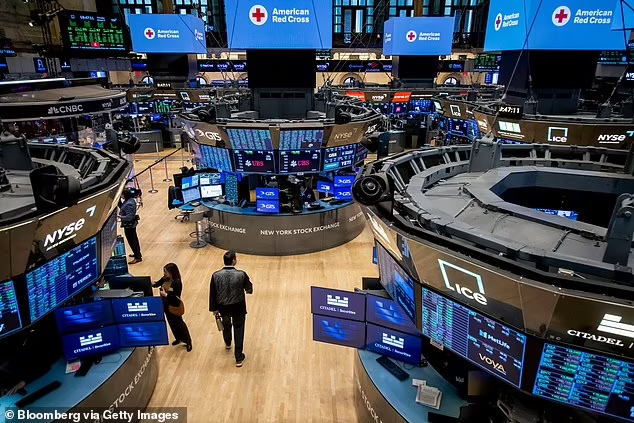
US stocks traded slightly lower on Tuesday as weakness in technology shares and mixed corporate earnings weighed on Wall Street sentiment. The Dow Jones Industrial Average slipped into negative territory, while concerns about growing Chinese competition in artificial intelligence added pressure to semiconductor stocks.
Investors also assessed quarterly results from major US banks, including JPMorgan, Citigroup, Wells Fargo, and Goldman Sachs. Meanwhile, Treasury yields and oil prices showed mixed movements ahead of key US inflation data.
At 13:53 ET (17:53 GMT), the S&P 500 declined 0.2% to 7,793.66 points, while the Nasdaq Composite fell 0.3% to 27,164.40 points.
The Dow Jones Industrial Average dropped 0.5% to 51,594.35 points as several blue-chip companies faced selling pressure following their earnings announcements.
Technology Stocks Weaken Amid Growing Chinese AI Competition
Technology stocks remained under pressure as investors questioned whether Chinese companies were narrowing the competitive gap with leading US artificial intelligence and semiconductor businesses.
The S&P 500 technology sector recovered some earlier losses but remained down approximately 0.2%.
Micron Technology extended its recent decline and was heading toward a fourth consecutive losing session.
The weakness partly reflected reports of technological advances by China’s ChangXin Memory Technologies (CXMT), raising concerns about future competition in the global memory chip market.
Similar worries affected Asian equities earlier in the session.
South Korea’s KOSPI index, which has significant exposure to semiconductor and technology companies, plunged 5.5%.
The sharp decline highlighted growing investor concerns about AI-related valuations, competition, and the sustainability of technology sector growth.
Intel and Broadcom Executives Question AI Investment Economics
Comments from leading semiconductor executives added to uncertainty surrounding artificial intelligence investments.
Speaking at the DBS Asia Future Forward Conference on Monday, Intel CEO Lip-Bu Tan highlighted China’s competitive advantage in AI operating costs.
Tan explained that Chinese frontier AI models can generate tokens at substantially lower costs than comparable US systems.
He suggested that these lower costs could accelerate AI adoption in China while creating challenges for American companies facing expensive computing requirements.
At the same conference, Broadcom CEO Hock Tan raised concerns about the financial returns companies are generating from AI investments.
He argued that many businesses continue spending heavily on AI technology without demonstrating clear returns.
Tan also warned that some investors may have unrealistic expectations about the profitability of AI-related opportunities.
The comments reinforced broader questions about whether the substantial capital flowing into artificial intelligence infrastructure can generate sustainable financial returns.
JPMorgan Earnings Disappoint as Wall Street Banks Report Q3 Results
Bank earnings dominated Tuesday’s financial calendar, with four of the five largest US lenders by consolidated assets announcing quarterly results.
JPMorgan Chase reported weaker-than-expected third-quarter profits, largely due to disappointing fixed-income trading revenue.
The bank experienced its first decline in fixed-income markets revenue since the first quarter of 2024.
However, JPMorgan raised its 2026 net interest income guidance to approximately $106.2 billion, compared with its previous forecast of $105.5 billion.
The improved outlook initially helped its shares recover from earlier losses. Nevertheless, JPMorgan stock later reversed course and traded approximately 0.1% lower.
CEO Jamie Dimon said the US economy continued to benefit from solid corporate investment and consumer spending.
However, he also highlighted persistent inflation, growing fiscal deficits, elevated asset prices, rising interest rates, and geopolitical uncertainty as potential economic risks.
Citigroup and Wells Fargo Shares Decline Despite Positive Results
Citigroup reported stronger-than-expected quarterly earnings and revenue, with net income increasing 40% year over year to $5.25 billion.
CEO Jane Fraser highlighted that the bank achieved its strongest third-quarter revenue performance in a decade.
Despite the earnings beat, Citigroup shares declined 4.1%.
Meanwhile, Wells Fargo reported a 5% annual increase in quarterly net interest income, supported by growth in loan balances and investment securities holdings.
However, the bank’s shares fell approximately 2.1%.
Wells Fargo CEO Charlie Scharf maintained that consumer and business customers remained financially resilient.
He pointed to continued consumer spending, relatively low loan delinquencies, and expanding deposit and investment balances.
Scharf also acknowledged risks from higher interest rates, elevated energy prices, and persistent inflation.
Nevertheless, he suggested that AI infrastructure investments, strong employment levels, and wage growth continued to provide important support for the US economy.
Goldman Sachs Beats Earnings Expectations
Goldman Sachs delivered better-than-expected quarterly earnings and revenue, supported by stronger trading and investment banking operations.
The positive results helped the bank’s shares outperform several competitors during the session.
However, Goldman Sachs stock reduced some of its earlier gains and was trading approximately 0.2% higher.
The mixed performance across major banks suggested that investors were closely examining individual business results rather than responding solely to headline earnings figures.
UnitedHealth and Johnson & Johnson Weigh on the Dow Jones
Healthcare stocks also attracted considerable attention following quarterly earnings announcements from UnitedHealth Group and Johnson & Johnson.
UnitedHealth initially gained after reporting improved medical cost trends and increasing its full-year adjusted earnings guidance.
The health insurer’s medical care ratio, which measures the proportion of insurance premiums spent on patient care, declined compared with the previous year.
However, UnitedHealth shares subsequently reversed their gains and traded approximately 0.2% lower.
Johnson & Johnson experienced a sharper decline, with its stock falling around 6%.
Although the pharmaceutical and medical technology company exceeded Wall Street’s earnings and revenue estimates, investors were disappointed by weaker-than-expected sales growth in its medical devices business.
The company acknowledged that MedTech growth fell short of management’s expectations.
Elsewhere, Domino’s Pizza shares declined 3.4% after the restaurant chain reported a modest 0.3% increase in US same-store sales.
US Treasury Yields Show Mixed Performance
Beyond corporate earnings, investors monitored developments in the US bond market following the Columbus Day holiday.
Treasury yields moved in different directions as traders assessed inflation expectations and the Federal Reserve’s monetary policy outlook.
The benchmark 10-year Treasury yield declined 2.5 basis points to 5.221%, extending losses from the previous week.
Meanwhile, the 30-year yield fell 3.2 basis points to 5.567%.
However, the more interest-rate-sensitive two-year Treasury yield increased 1.9 basis points to 4.810%.
These movements reflected uncertainty surrounding future borrowing costs and the direction of US monetary policy.
The bond market remains an important consideration for stock investors because higher yields can increase financing costs and reduce the relative appeal of equity investments.
Oil Prices Mixed as Middle East Tensions Persist
Oil markets also experienced mixed trading conditions as investors weighed potential increases in Russian fuel supplies against ongoing geopolitical risks.
Brent crude futures declined 0.8% to $105.86 per barrel.
Meanwhile, US West Texas Intermediate crude futures gained 0.4% to $94.14 per barrel.
The movements followed Russian statements suggesting that diesel exports could exceed the volumes previously announced under a supply agreement with the United States.
Expectations of additional fuel availability helped ease some concerns about global energy shortages.
However, tensions in the Middle East continued to threaten oil supply routes.
Fresh attacks on Saudi Arabian infrastructure by Houthi forces in Yemen contributed to Monday’s surge in crude prices.
A prolonged increase in energy costs could intensify inflationary pressures and complicate the Federal Reserve’s efforts to maintain price stability.
US Inflation Data Could Determine Wall Street’s Next Move
Investors are now looking ahead to Wednesday’s release of September’s US Consumer Price Index (CPI).
The inflation report could provide important information about consumer price pressures and influence expectations surrounding the Federal Reserve’s next interest-rate decision.
The central bank increased borrowing costs in September for the first time since 2023.
However, financial markets currently expect policymakers to leave interest rates unchanged at their upcoming October meeting.
A stronger-than-expected inflation reading could reinforce concerns about prolonged restrictive monetary policy.
Conversely, signs of easing inflation could provide support for equities by reducing expectations of additional rate increases.
US Stock Market Outlook: Earnings and Inflation Remain Key Drivers
Looking ahead, the US stock market faces several important developments that could influence investor sentiment.
The ongoing corporate earnings season will test whether American companies can sustain profit growth despite elevated borrowing costs and geopolitical uncertainty.
Technology stocks may remain particularly sensitive to competition from Chinese AI companies and concerns about the profitability of artificial intelligence investments.
Meanwhile, bank earnings could provide further insight into consumer financial conditions, corporate borrowing demand, and the broader economic outlook.
Movements in Treasury yields and crude oil prices will also remain important factors, particularly as markets assess the potential for persistent inflation.
Although the S&P 500, Nasdaq Composite, and Dow Jones recorded relatively modest declines on Tuesday, the combination of technology sector weakness and mixed earnings results suggests investors are becoming increasingly selective.
Ultimately, the upcoming US inflation report and continued corporate earnings announcements could help determine whether Wall Street resumes its upward momentum or experiences further short-term volatility.