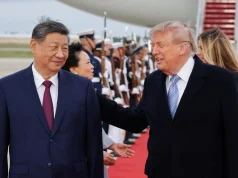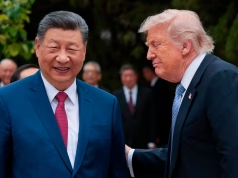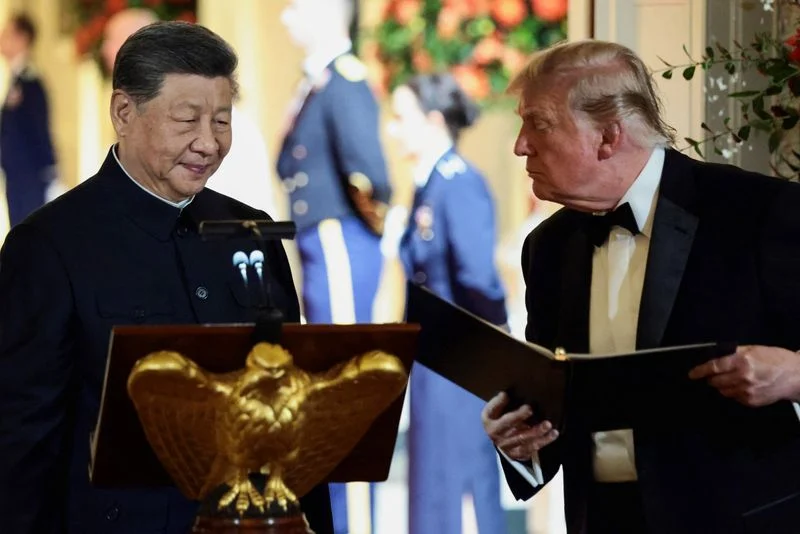
US President Donald Trump is set to conclude Chinese President Xi Jinping’s visit to Washington with a tour of the US National Archives on Friday, following their high-profile summit at the White House.
The visit is expected to highlight the history of US-China relations while offering both leaders another opportunity to emphasize their respective views on the future of ties between the world’s two largest economies.
Thursday’s state summit featured extensive ceremony and symbolism. However, it produced few signs of major breakthroughs on the most difficult issues dividing Washington and Beijing.
Trade and Artificial Intelligence Remain on the Agenda
Despite the absence of a major agreement, Trump pointed to progress through an existing bilateral trade mechanism.
The US president highlighted improved market access for American farmers and ranchers. Meanwhile, both governments identified artificial intelligence as an area where further cooperation could be possible.
Trade, AI and geopolitical tensions have remained central to discussions between Washington and Beijing during Xi’s visit.
Leaders to View Key US Historical Documents
Trump said the National Archives visit would give Xi an opportunity to see some of the most significant documents in American history.
These include the Declaration of Independence, US Constitution and Bill of Rights.
The leaders are also expected to view historical material documenting relations and cultural exchanges between China and the United States.
Trump presented the visit as a reflection of the long history of trade and interaction between the two countries.
Taiwan Remains a Major Issue in US-China Relations
However, the National Archives visit comes as Taiwan remains one of the most sensitive issues in relations between Washington and Beijing.
China considers democratically governed Taiwan part of its territory and opposes US military support and arms sales to the island.
The United States does not maintain formal diplomatic relations with Taiwan. However, Washington maintains unofficial relations with Taipei and, under US law, is committed to providing Taiwan with the means to maintain sufficient self-defense capabilities.
Analysts have suggested that Xi could take particular interest in historical records surrounding Washington’s 1979 decision to establish formal diplomatic relations with the People’s Republic of China.
Xi Raises Taiwan During Trump Meeting
Xi raised the Taiwan issue during Thursday’s talks with Trump.
According to Chinese state reporting cited by Reuters, Xi called on Washington to approach the issue cautiously and reiterated Beijing’s opposition to Taiwanese independence.
Beijing has also repeatedly pushed the United States to reduce or end arms sales to Taiwan.
The wording used by Washington on Taiwan remains closely watched. The United States follows its “one China” policy, under which it acknowledges Beijing’s position regarding Taiwan without endorsing China’s sovereignty claim over the island.
US allies across Asia are therefore likely to pay close attention to any changes in how Trump describes Washington’s Taiwan policy following his meetings with Xi.
Taiwan Arms Sales Under Scrutiny
The Trump administration approved an approximately $11 billion arms package for Taiwan in December 2025.
A separate package worth roughly $14 billion has remained on hold. Following his May meeting with Xi, Trump described the second package as a potentially useful negotiating tool.
The issue has become an important part of negotiations between Beijing and Washington.
Craig Singleton of the Foundation for Defense of Democracies said Beijing may increasingly view the current pause in some Taiwan arms sales as a new starting point for negotiations rather than a temporary measure.
His assessment suggests China could seek to incorporate its Taiwan-related concerns more firmly into the broader framework governing US-China relations.
Democrats Criticize Outcome of Trump-Xi Summit
Senate Democrats criticized the White House summit on Thursday, arguing that Trump had not obtained significant concessions from Beijing on several major issues.
Their criticism focused on areas including trade, national security, artificial intelligence and human rights.
They also criticized the president for not publicly addressing Chinese military pressure on Taiwan during the summit and called for previously approved US military assistance and weapons deliveries to move forward.
The disagreement highlights the continuing domestic debate in Washington over how the United States should balance diplomatic engagement with China against economic and security concerns.
US-China Relations Remain in Focus
The Trump-Xi summit has demonstrated that both governments are seeking areas where cooperation remains possible, particularly in trade and emerging technologies.
However, major strategic differences remain unresolved.
Taiwan, arms sales, trade policy and technological competition are likely to remain important sources of tension as Washington and Beijing attempt to manage their broader relationship.
The National Archives visit will provide a symbolic conclusion to Xi’s Washington trip, but the longer-term direction of US-China relations will depend on how both governments handle those unresolved disputes.