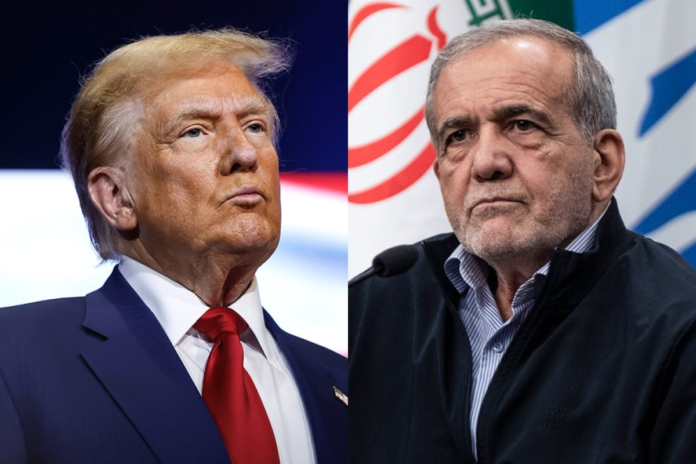
U.S. President Donald Trump said he would be open to meeting Iranian President Masoud Pezeshkian during this week’s United Nations General Assembly in New York.
However, the possibility of diplomacy comes as tensions between Washington and Tehran remain high, with both sides exchanging fresh warnings over the weekend.
Trump Leaves Door Open to Pezeshkian Meeting
Trump made the comments during a phone interview with Fox News correspondent Trey Yingst.
According to Yingst, Trump said he was open to meeting Pezeshkian while the Iranian president attends the UN General Assembly.
Pezeshkian is expected in New York this week as world leaders gather for the annual UN meeting.
Trump Also Increases Pressure on Iran
Despite signaling possible talks, Trump also issued strong warnings toward Tehran.
According to Fox’s account of the interview, the U.S. president said Iran needed to reach an agreement with Washington or face severe economic and military consequences.
Iran responded with warnings of its own.
Iran’s military said any renewed U.S. attack could trigger sustained retaliation against American military bases and other regional interests. Iranian officials also claimed they had information suggesting another attack could be under preparation, although they did not publicly provide supporting details.
U.S.-Iran Conflict Remains Unresolved
Relations between Washington and Tehran have remained deeply strained since U.S. and Israeli strikes on Iran began on February 28.
The conflict has since expanded across the region and disrupted important energy and shipping routes, including the Strait of Hormuz.
Diplomatic efforts have so far failed to produce a lasting settlement, leaving markets and regional governments focused on whether this week’s UN meetings could create another opportunity for negotiations.
Houthi Offensive Adds New Regional Risk
Tensions have also intensified in Yemen, where the Iran-aligned Houthi movement has expanded military operations against Saudi Arabia.
The Houthis have launched missile and drone attacks toward Saudi territory while making territorial gains along Yemen’s Red Sea coast.
Their advances have increased concerns about security around the Bab el-Mandeb Strait, one of the world’s most important maritime chokepoints.
Trump Holds Back From Direct Houthi Strikes
Saudi Arabia has sought stronger U.S. military support against the Houthis, but Trump has so far stopped short of ordering direct American strikes.
The New York Times reported that Trump considered joining Saudi military operations before deciding on Sunday not to proceed with U.S. airstrikes for the time being.
Earlier reporting from Axios and CBS News also said Saudi Crown Prince Mohammed bin Salman had urged Trump to take direct military action against the Houthis. Washington instead offered intelligence and targeting support while avoiding direct intervention.
Bab el-Mandeb Raises Oil Supply Concerns
Recent Houthi advances near the Bab el-Mandeb Strait have added another layer of risk to global energy markets.
The waterway connects the Red Sea with the Gulf of Aden and serves as a major route for oil and international trade.
With energy flows in the broader region already disrupted by the Iran conflict, further instability around Bab el-Mandeb could increase pressure on shipping routes and global oil supplies.
Attention will now turn to the UN General Assembly and whether Trump and Pezeshkian hold any direct discussions.
Any signs of renewed diplomacy could influence geopolitical risk sentiment, while further military escalation involving Iran, Saudi Arabia or the Houthis could keep Middle East tensions elevated.