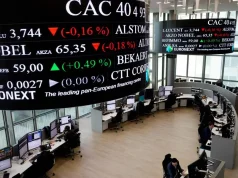
British stocks initially moved higher on Wednesday after U.S. inflation data showed price pressures eased in July as expected. However, the gains faded as investors turned their attention back to escalating geopolitical risks in the Middle East.
The FTSE 100 slipped 0.04% by 08:43 ET. Elsewhere in Europe, Germany’s DAX gained 0.48%, while France’s CAC 40 fell 0.21%.
Meanwhile, the British pound strengthened against the U.S. dollar, with GBP/USD rising 0.23% to 1.3538.
U.S. Inflation Cools in July
U.S. consumer prices increased 0.1% month over month in July, matching market expectations. That followed a 0.4% decline in June, according to data from the Bureau of Labor Statistics.
On an annual basis, inflation eased to 3.4% from 3.5%, also in line with forecasts.
Core CPI, which excludes food and energy prices, increased 0.2% during the month and 2.5% year over year.
Both readings matched economists’ expectations.
Shelter costs increased 0.1% and accounted for roughly two-thirds of the monthly rise in consumer prices. Energy prices fell 1.5%, while food costs increased 0.1%.
Iran Tensions Keep Investors Cautious
Despite the relatively reassuring U.S. inflation report, concerns surrounding Iran and the Strait of Hormuz continued to pressure market sentiment.
An Iranian source told Reuters that there had been no agreement to extend an interim arrangement with the United States.
The source said discussions through intermediaries were instead focused on Washington returning to the earlier agreement. According to the source, there had been no meaningful progress.
That statement contradicted an earlier report suggesting that the two sides had agreed to extend a 60-day ceasefire.
Strait of Hormuz Remains in Focus
Further uncertainty emerged after reports that oil from a spill had reached Iran’s Qeshm Island in the Strait of Hormuz.
Iranian authorities were investigating the source of the spill, while cleanup operations were expected to be completed later in the day.
The Strait remains one of the most closely watched areas in global markets because of its importance to international oil shipments.
IEA Cuts Global Oil Demand Forecast
The International Energy Agency also lowered its 2026 global oil demand forecast.
The agency now expects demand to fall by approximately 1.6 million barrels per day, compared with its previous projection for a one million barrel-per-day decline.
The IEA cited the continued disruption around the Strait of Hormuz and elevated fuel prices as key reasons for the downgrade.
U.S.-Iran Confrontation Adds to Market Risk
Geopolitical tensions increased further after U.S. Central Command said American forces had disabled the steering system of the Panama-flagged cargo ship M/V Vela Nova in the Gulf of Oman.
According to CENTCOM, the vessel attempted to breach restrictions on Iran-bound shipping and ignored repeated warnings.
The U.S. military said a Navy helicopter later fired missiles into the vessel’s engine room.
CENTCOM also reported that, as of August 11, U.S. forces had redirected 55 vessels, disabled three and boarded two.
Trump Reiterates U.S. Control Over Hormuz
U.S. President Donald Trump said on Tuesday that Washington maintained control over the Strait of Hormuz and warned Iran against retaliation.
The comments added to concerns that the confrontation could continue, keeping geopolitical risk elevated across financial markets.
Jefferies strategist Mohit Kumar said the situation offered no simple solution, as Iran was unlikely to surrender influence over the Strait while the United States was unlikely to accept Iranian demands.
He suggested that any near-term agreement could prove temporary rather than provide a lasting resolution.
Oil and Gold Prices Rise
Commodity markets reacted to the heightened uncertainty.
Brent crude rose 0.13% to $89.02 per barrel, while West Texas Intermediate increased 0.36% to $83.50.
Gold also attracted demand as investors moved toward traditional safe-haven assets.
December gold futures gained around 1.3% to $4,496.82, while spot gold rose approximately 1.5% to $4,433.70.
Balfour Beatty Raises Profit Outlook
In UK corporate news, Balfour Beatty raised its 2026 operating profit growth forecast to the low double digits.
The infrastructure group cited strong demand from its U.S. construction operations and UK power infrastructure projects.
Overall, the FTSE 100 remained under pressure as investors balanced encouraging U.S. inflation data against persistent geopolitical uncertainty surrounding Iran and the Strait of Hormuz.