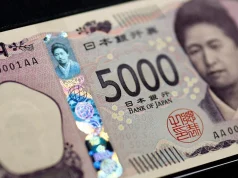
Asian currencies traded within narrow ranges on Tuesday as the U.S. dollar remained close to a one-month high.
Investors avoided taking major positions before the Federal Reserve’s upcoming interest rate decision. However, falling oil prices helped ease concerns about another increase in inflation.
The U.S. Dollar Index slipped 0.1% to 101.46. Meanwhile, the USD/JPY exchange rate remained near 164 yen.
Markets Await the Federal Reserve Decision
Investors continued to price in an estimated 38% chance that the Federal Reserve would raise interest rates by 25 basis points on Wednesday.
Markets are also waiting for new U.S. gross domestic product data and the core Personal Consumption Expenditures Price Index.
The core PCE index is the Federal Reserve’s preferred inflation measure. Therefore, the upcoming figures could provide important clues about the central bank’s next policy steps.
Japanese Yen Remains Near Multi-Decade Lows
The Japanese yen stayed close to its weakest levels in several decades.
The USD/JPY pair traded around 163.72, with investors waiting for the Bank of Japan’s policy announcement on Friday.
The central bank is widely expected to leave interest rates unchanged. However, traders believe policymakers may signal that additional monetary tightening remains possible.
Japanese officials have repeatedly expressed concern about the yen’s decline. Nevertheless, verbal intervention has done little to produce a lasting recovery in the currency.
Asian Currencies Deliver Mixed Performance
Other Asian currencies showed limited and mixed movements.
The South Korean won remained largely unchanged despite a sharp technology-led decline in the country’s stock market.
Taiwan’s dollar underperformed its regional peers. The USD/TWD pair rose approximately 0.4%, indicating further weakness in the local currency.
The Chinese yuan also traded within a narrow range. Both the offshore USD/CNH and onshore USD/CNY exchange rates showed little movement.
Lower Oil Prices Ease Inflation Concerns
Falling crude oil prices provided some support to Asian markets.
Oil extended the previous session’s sharp decline amid growing hopes for a diplomatic agreement between the United States and Iran.
Washington reportedly paused its daily strikes, while U.S. President Donald Trump said there was a good chance of reaching a deal.
The development reduced concerns about another energy-related inflation shock. Lower oil prices can also benefit Asian economies that rely heavily on energy imports.
Singapore Dollar Reacts to Policy Tightening
The USD/SGD pair edged approximately 0.1% higher as traders continued to assess the Monetary Authority of Singapore’s latest policy decision.
The central bank tightened monetary policy on Monday, giving investors additional information to consider as they evaluated the outlook for the Singapore dollar.
The Australian and New Zealand dollars also showed little movement.
USD/AUD and USD/NZD remained near their recent levels as investors balanced declining oil prices against caution before the Federal Reserve meeting.
Indonesian Rupiah Extends Its Decline
Indonesia’s rupiah remained the weakest-performing currency in the region.
The USD/IDR pair climbed approximately 0.5%, extending losses that followed the unexpected resignation of Bank Indonesia Governor Perry Warjiyo.
Deputy Governor Destry Damayanti was appointed acting governor. Investors are now evaluating what the leadership change could mean for monetary policy and central bank independence.
Warjiyo had led Bank Indonesia since 2018. During his tenure, the central bank used interest rate changes, liquidity measures and foreign exchange intervention to respond to major economic shocks.
It also maintained close coordination with the Indonesian government during the pandemic and periods of geopolitical instability.
Investors Seek Reassurance From Bank Indonesia
The resignation has increased concerns about policy continuity.
DBS Senior Economist Radhika Rao said investors would want reassurance that Bank Indonesia remains under experienced and independent leadership.
Maintaining confidence in the central bank’s monetary framework will be important for stabilizing the rupiah and preserving its institutional credibility.
Indian Rupee Benefits From Lower Oil Prices
The Indian rupee received support from the decline in energy prices.
The USD/INR pair slipped approximately 0.1% as geopolitical risk premiums continued to fade.
Reports of official market intervention also supported the currency. In addition, recent measures from the Reserve Bank of India aimed at attracting capital helped improve sentiment.
India imports a large share of its energy requirements. Therefore, lower crude oil prices can reduce pressure on the country’s trade balance and inflation outlook.
Philippine Peso Stays Near Record Low
The Philippine peso remained close to its record low of 61.85 per U.S. dollar.
However, the USD/PHP pair edged approximately 0.1% lower as declining oil prices provided some relief to the energy-importing economy.
Bangko Sentral ng Pilipinas Governor Eli Remolona said the central bank had intervened modestly in the foreign exchange market during the previous week.
The intervention was intended to maintain orderly trading conditions rather than defend a specific exchange rate.
Central Bank Decisions Take Center Stage
Investors are now preparing for several important central bank announcements.
The Federal Reserve will deliver its policy decision on Wednesday. The Bank of England and Bank of Japan will follow later in the week.
These meetings could influence global interest rate expectations and determine the near-term direction of the U.S. dollar and Asian currencies.
Until policymakers provide clearer guidance, regional foreign exchange markets are likely to remain cautious and relatively subdued.