What Is Leverage?
Leverage allows traders to control a larger position in the market using a smaller amount of capital.
Instead of paying the full value of a trade, traders only need to deposit a fraction of it, known as margin.
For example, with 10x leverage, a trader can control $10,000 with just $1,000.
Leverage amplifies both profits and losses.
How Leverage Works
Leverage is expressed as a ratio.
Common examples include:
2:1
10:1
50:1
If a trader uses 10:1 leverage, every 1% move in the market results in a 10% change in the trader’s position.
This is why leverage is powerful but also dangerous.

Example of a Leveraged Trade
Imagine a trader opens a position worth $10,000 using $1,000 capital.
If the market moves +5%, the position gains $500.
That is a 50% return on the trader’s capital.
However, if the market moves -5%, the trader loses $500.
This shows how leverage magnifies outcomes.
Risks of Using Leverage
Leverage significantly increases risk.
Even small market movements can lead to large losses.
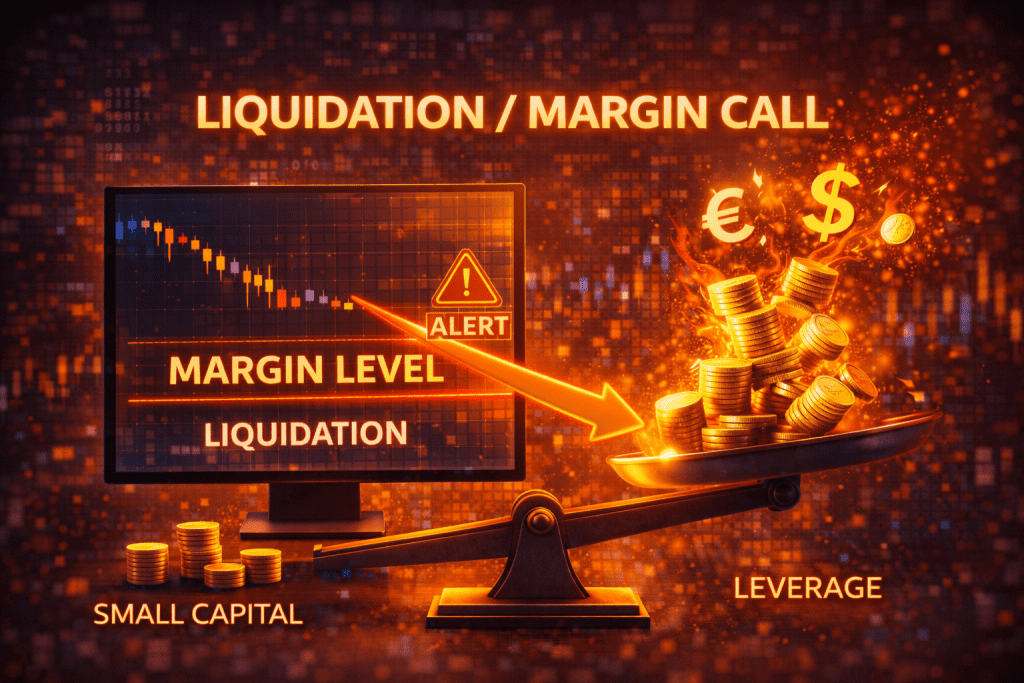
If losses approach the margin amount, the broker may close the position automatically.
This is known as a margin call or liquidation.
Many beginners underestimate how quickly losses can accumulate when using leverage.
Margin Calls Explained
A margin call occurs when the account equity falls below a required level.
At this point, the trader must either:
add more funds
or close positions
If no action is taken, positions may be closed automatically to prevent further losses.
Understanding margin requirements is essential for survival in leveraged trading.
Leverage in Different Markets
Leverage is widely used across financial markets.
In forex, leverage can be very high due to low volatility.
In crypto markets, leverage is also common but comes with extreme volatility.
In stock trading, leverage is usually more limited.
Each market has different rules and risk profiles.

Benefits of Leverage
Leverage allows traders to maximize capital efficiency.
It enables participation in larger trades without needing significant funds.
When used correctly, leverage can increase returns.
It is especially useful for short-term strategies.
Best Practices for Using Leverage
Professional traders treat leverage with caution.
They focus on:
small position sizes
strict risk management
clear stop losses
Leverage should be used as a tool, not as a shortcut to fast profits.
Common Mistakes Traders Make
Many traders misuse leverage.
They overexpose their accounts.
They trade without stop losses.
They assume markets will move in their favor.
These mistakes often lead to rapid account losses.
Final Thoughts
Leverage is one of the most powerful tools in trading.
It can accelerate growth, but it can also destroy capital quickly.
Understanding how leverage works is essential for long-term success.
Traders who respect leverage survive.
Traders who underestimate it rarely last.