
What Is Liquidity?
Liquidity refers to how easily an asset can be bought or sold in the market without significantly affecting its price.
In simple terms, a market is considered liquid when there are many buyers and sellers actively trading.
The more participants in the market, the easier it is to execute trades quickly and at stable prices.
Highly liquid markets include major forex pairs, large-cap stocks, and widely traded commodities.
Types of Liquidity
Liquidity is not a single concept. It can be divided into two main types.
Market Liquidity
Market liquidity refers to the ease with which assets can be traded.
If you can enter and exit positions quickly with minimal price impact, the market is liquid.
High trading volume and tight bid-ask spreads are signs of strong market liquidity.
Funding Liquidity
Funding liquidity refers to the availability of capital.
It describes how easily traders, institutions, or banks can access money to participate in the market.
When funding is abundant, markets tend to be more active and stable.
How Liquidity Affects Prices
Liquidity plays a major role in price stability.
In highly liquid markets, large orders can be executed without causing major price movements.
In low liquidity conditions, even small trades can cause sharp price changes.
This is why some assets experience sudden spikes or drops during low trading activity.
Liquidity helps absorb buying and selling pressure, keeping markets efficient.
Liquidity and Volatility
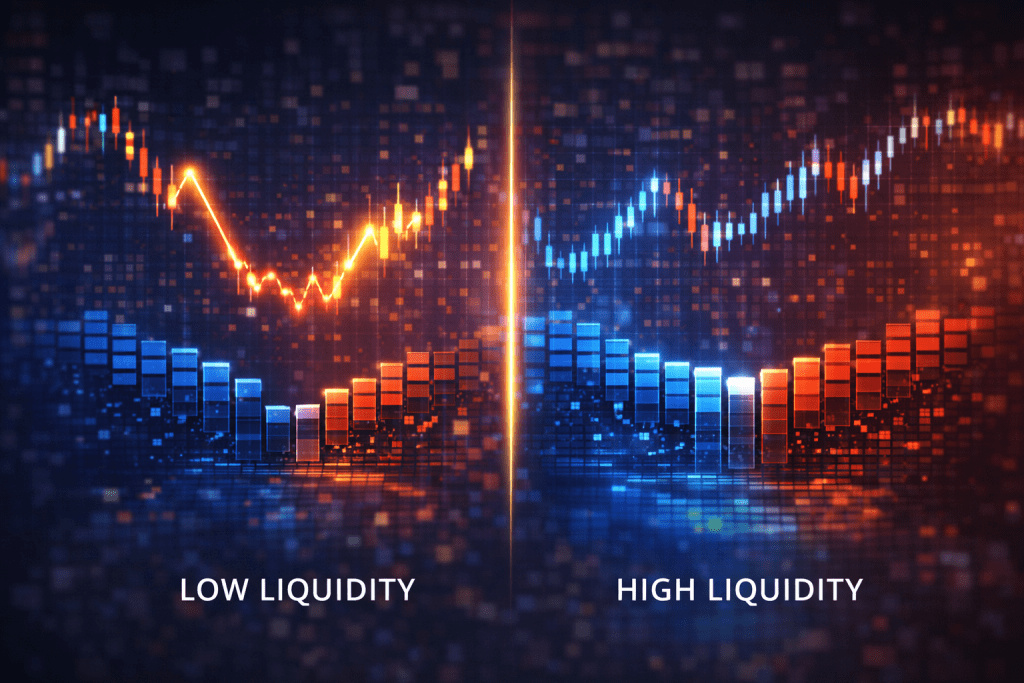
Liquidity and volatility are closely connected.
When liquidity is high, price movements tend to be smoother and more predictable.
When liquidity is low, volatility increases.
This is because there are fewer participants to absorb trades, leading to larger price swings.
Traders often see increased volatility during:
market openings
economic announcements
low-volume periods
Understanding this relationship is essential for timing trades.
Central Banks and Liquidity
Central banks play a crucial role in providing liquidity to the financial system.
Through monetary policy, they influence how much money flows into the economy.
Lower interest rates and stimulus programs increase liquidity.
Higher interest rates tend to reduce liquidity.
These actions affect all markets, including stocks, forex, and commodities.
Traders closely monitor central bank decisions because they can shift market conditions quickly.
Why Traders Must Watch Liquidity
Liquidity directly impacts trade execution, risk, and profitability.
In liquid markets:
spreads are tighter
execution is faster
slippage is lower
In illiquid markets:
spreads widen
price movements become unpredictable
risk increases significantly
Professional traders often prefer highly liquid markets because they offer more consistency.
Common Liquidity Traps
Many traders underestimate the risks of low liquidity.
Some common mistakes include:
trading during low-volume hours
entering large positions in illiquid assets
ignoring economic events that affect liquidity
These situations can lead to unexpected losses.
Liquidity Across Different Markets
Liquidity varies depending on the market.
Forex is the most liquid market globally.
Major currency pairs are traded constantly with high volume.
Stock liquidity depends on the company.
Large companies tend to be more liquid than smaller ones.
Crypto liquidity varies significantly.
Popular cryptocurrencies have strong liquidity, while smaller ones can be highly volatile.

Final Thoughts
Liquidity is one of the most important yet overlooked concepts in trading.
It affects how markets move, how trades are executed, and how risk is managed.
By understanding liquidity, traders can avoid unstable conditions and make more informed decisions.
In financial markets, liquidity is what keeps everything functioning smoothly.