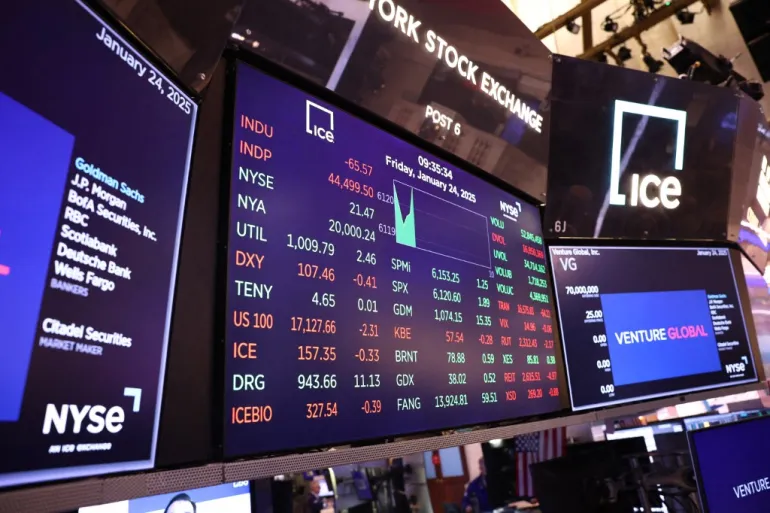
U.S. Stocks Extend Winning Streak on Ceasefire Optimism
U.S. stocks recorded a seventh consecutive day of gains on Thursday, supported by easing geopolitical tensions after Israel agreed to begin negotiations with Lebanon. The move helped stabilize an uneasy Middle East ceasefire, while oil prices pulled back from earlier session highs.
President Donald Trump stated that U.S. military forces would remain deployed in the region until a “real agreement” is reached and fully enforced.
S&P 500, Dow, and Nasdaq Close Higher
The S&P 500 rose 0.6% to close at 6,823.94, recovering from earlier losses of up to 0.3%.
The Dow Jones Industrial Average also gained 0.6%, ending at 48,185.80 and turning positive for the year after reversing an earlier decline.
The Nasdaq Composite outperformed, climbing 0.8% to 22,822.42, despite initial weakness during the session.
AI Disruption Weighs on Software Stocks
While broader markets rallied, technology stocks faced pressure, particularly in the software sector. The iShares Expanded Tech-Software Sector ETF (IGV) dropped 3.9%.
Market strategists pointed to renewed concerns around AI disruption. Anthropic’s advanced AI model, Claude Mythos, has reportedly demonstrated powerful capabilities in identifying software vulnerabilities. This has raised concerns about the long-term viability of traditional software businesses.
Inflation Data Keeps Fed Outlook Uncertain
Investors also focused on key economic data, including the February Personal Consumption Expenditures (PCE) price index — the Federal Reserve’s preferred inflation measure.
The index rose 0.4% month-over-month and 3% year-over-year, both in line with expectations. However, inflation remains above the Fed’s 2% target, signaling continued pressure on policymakers.
Importantly, the data does not yet reflect the impact of rising oil prices linked to the Middle East conflict, suggesting inflation could increase further in the coming months.
CPI Data in Focus as Next Key Catalyst
Attention is now shifting to the upcoming U.S. Consumer Price Index (CPI) report, which is expected to provide a clearer picture of inflation trends, including the impact of recent oil price shocks.
Analysts suggest that the CPI reading could play a critical role in shaping the Federal Reserve’s next policy moves, particularly regarding interest rates.
Mixed Economic Signals Emerge
Additional economic data painted a mixed picture. U.S. personal income declined by 0.1% in February, while GDP growth for Q4 2025 was revised down to an annualized rate of 0.5%.
Meanwhile, initial jobless claims rose to 219,000, above expectations, although continuing claims fell to their lowest level since May 2024.
Middle East Developments Drive Market Sentiment
Geopolitical developments remained a key driver of market sentiment. Israel confirmed it would enter negotiations with Lebanon, focusing on disarming Hezbollah and improving relations.
At the same time, uncertainty persists around the broader U.S.-Iran ceasefire. Iran has criticized ongoing Israeli operations in Lebanon and expressed reluctance to proceed with peace talks under current conditions.
Upcoming negotiations in Pakistan between U.S. and Iranian officials are expected to play a crucial role in determining the future of the ceasefire.
Oil Market Volatility Continues
Oil prices remained volatile. After plunging sharply on ceasefire news, Brent crude and WTI rebounded but retreated from session highs following Israel’s move toward negotiations.
Supply disruptions in the Strait of Hormuz and ongoing geopolitical risks continue to keep energy markets on edge.
Key Stock Movers: Tech Weakness, Consumer Strength
In individual stock movements, Palantir Technologies declined 7.3%, pressured by concerns over increasing competition and evolving AI dynamics.
On the upside, Constellation Brands surged 8.5% after reporting strong quarterly earnings, driven by robust demand for its beer portfolio, including Modelo Especial.