The U.S. dollar climbed to its highest level in more than five weeks on Monday, as escalating tensions between the United States and Iran boosted demand for safe-haven assets.
At 09:15 ET (14:15 GMT), the Dollar Index — which measures the greenback against a basket of six major currencies — rose 0.9% to 98.49. This marked its strongest reading since late January.
Dollar strengthens on Middle East escalation
Over the weekend, the United States and Israel launched military strikes on Iran, killing Supreme Leader Ayatollah Ali Khamenei. The conflict continued into Monday, with Iran responding through attacks reported across Israel, the UAE, Qatar, Bahrain and Kuwait.
President Donald Trump stated that further strikes would continue “for as long as necessary,” raising the risk of a prolonged conflict and increasing market uncertainty.
According to David Morrison, senior market analyst at Trade Nation, the sharp overnight rise in the Dollar Index highlighted the U.S. dollar’s status as the primary global safe-haven currency. He added that expectations of sustained dollar weakness due to de-dollarization trends may be premature.
Oil prices also surged following the U.S.–Iran escalation. Higher crude prices typically add to inflationary pressures, potentially limiting the Federal Reserve’s ability to cut interest rates.
Morrison noted that dollar gains could be capped by growing stagflation concerns. A hotter-than-expected U.S. Producer Price Index report on Friday reignited fears of persistent inflation, even as economic growth shows signs of slowing.
This environment creates a policy dilemma for the Federal Reserve. Cutting rates too soon could fuel inflation, while keeping monetary policy tight risks slowing the economy further.
Euro and sterling fall; Swiss franc gains
In Europe, EUR/USD dropped 0.9% to 1.1704, with the euro under pressure as rising energy prices threaten the region’s industrial recovery. Analysts at ING said higher energy costs could force investors to reassess expectations of a European manufacturing rebound.
However, ING also noted that the global economy is in a stronger position than during the March 2022 energy spike, supported by greater fiscal measures. Still, without early de-escalation, EUR/USD could retreat toward the 1.1575–1.1650 range.
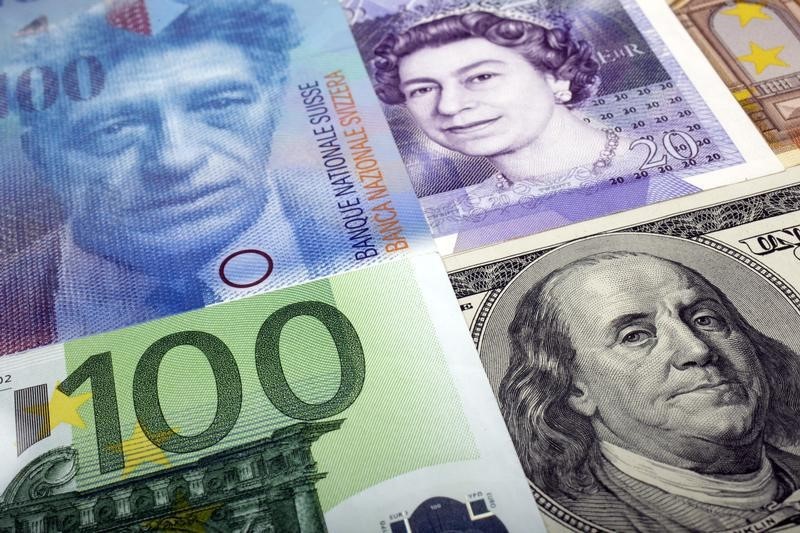
GBP/USD declined 0.7% to 1.3397, as sterling also weakened amid risk-off sentiment. Meanwhile, the Swiss franc strengthened sharply, with EUR/CHF rising 0.3% to 0.9107. The franc reached its strongest level against the euro in more than a decade, reflecting strong safe-haven demand.
ING analysts added that renewed franc strength could increase speculation about a return to negative interest rates in Switzerland, as markets price in further downward pressure on Swiss yields.
Yen weakens as oil prices rise
In Asia, USD/JPY jumped 0.9% to 157.51. Traders assessed the impact of higher energy prices on Japan’s oil imports, while heightened uncertainty may encourage the Bank of Japan to maintain a cautious policy stance and delay further rate hikes.
Elsewhere, USD/CNY rose 0.4% to 6.8821, rebounding from 34-month lows recorded last week. The Australian dollar weakened, with AUD/USD falling 0.8% to 0.7058, as the risk-sensitive currency reacted negatively to rising crude prices and geopolitical tensions.
Overall, the escalation in the Middle East has reinforced the U.S. dollar’s safe-haven appeal, while major global currencies remain under pressure amid higher oil prices and renewed inflation concerns.