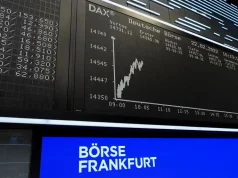
European stocks declined sharply on Monday, as global risk appetite weakened after the United States and Israel launched large-scale strikes on Iran over the weekend.
By 03:05 ET (08:05 GMT), Germany’s DAX index had fallen 2.5%, France’s CAC 40 dropped 2.1%, and the UK’s FTSE 100 slipped 0.8%.
Middle East Conflict Weighs on Global Markets
Equity markets across Asia and Europe moved lower, while U.S. stock futures also pointed to a weaker Wall Street open. The selloff followed coordinated U.S.-Israeli attacks on Iran that reportedly killed several senior officials, including Supreme Leader Ayatollah Ali Khamenei.
Iran responded with strikes targeting multiple Middle Eastern countries and U.S. bases in the region. The confrontation showed little sign of easing, with U.S. President Donald Trump stating overnight that military operations could continue for several weeks.
Iran’s top security official, Ali Larijani, reinforced Tehran’s hardening stance, saying the country would not negotiate with the United States. His remarks came shortly after Iranian officials had previously indicated a willingness to discuss a potential nuclear agreement with Washington.
Record Rally at Risk in Europe
The sharp drop in European stocks follows a strong run in recent months. On Friday, shares had closed at record highs, marking eight consecutive months of gains supported by better-than-expected corporate earnings.
The pan-European STOXX 600 index recorded its longest monthly winning streak since 2012–2013. However, the latest geopolitical escalation has shifted overall market sentiment.
Despite the broader downturn, some corporate results were still in focus. Smith & Nephew reported a 15.5% rise in annual profit, benefiting from cost-cutting measures and improved growth across its divisions.
Bunzl, however, posted a 9.8% decline in annual adjusted pretax profit, citing weaker performance in its North American operations and supply chain disruptions linked to tariffs.
Galp Energia reported solid operational results for 2025, supported by strong cash flow and a healthy balance sheet, even as oil prices had previously softened.
Economic Data in Focus
In economic news, German retail sales fell 0.9% in January on a monthly basis, significantly worse than the 0.2% decline expected by analysts.
Meanwhile, UK house prices rose 0.3% in February, leaving them 1.0% higher compared to a year earlier, according to data from Nationwide Building Society.
Later in the session, investors will monitor the final reading of the Eurozone manufacturing PMI for February, which is expected to confirm that the sector returned to expansion.
Oil Prices Surge on Strait of Hormuz Disruption
Crude oil prices jumped sharply after Iranian retaliatory actions reportedly disrupted shipping through the Strait of Hormuz, a key global energy chokepoint.
Brent crude surged 9.6% to $79.85 per barrel, its highest level since January 2025. U.S. West Texas Intermediate (WTI) crude rose 9.3% to $73.22 per barrel, reaching its highest level since June.
The spike followed reports that three oil tankers were damaged while passing through the Strait of Hormuz, a vital route connecting the Gulf to the Arabian Sea.
On a typical day, vessels carrying around one-fifth of global oil demand transit through the Strait, including shipments from Saudi Arabia, the UAE, Iraq, Iran and Kuwait.
A prolonged disruption or closure of the Strait of Hormuz would likely push oil prices even higher and could lead to supply shortages for major importers such as China and India.