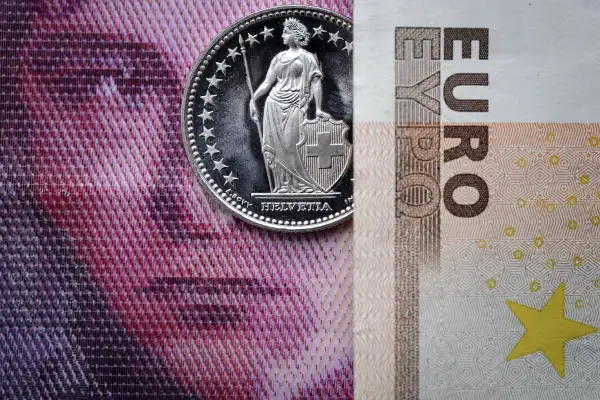
The Swiss franc surged to its strongest level in more than a decade against the euro on Monday, as investors rushed into safe-haven assets following U.S. and Israeli strikes on Iran. The escalation heightened fears of a prolonged conflict in the Middle East and triggered broad risk-off flows across global markets.
In early Asian trading, the franc climbed 0.7% to 0.9030 per euro, its strongest level since 2015. It also gained as much as 0.4% against the U.S. dollar, rising to 0.7661.
At the same time, the U.S. dollar strengthened. The dollar index, which tracks the greenback against the Swiss franc, euro and four other major currencies, advanced up to 0.3% to 98.273, its highest level since January 23.
Middle East Escalation Drives Safe-Haven Demand
The military strikes reportedly killed Iran’s Supreme Leader Ayatollah Ali Khamenei, triggering a sensitive succession process and raising geopolitical uncertainty. Iran responded with further attacks, including strikes on oil tankers and military targets across Israel, the UAE, Qatar, Bahrain and Kuwait.
Market participants focused immediately on the potential impact on global energy supply. Oil prices jumped around 9% early Monday amid concerns over disruptions to shipping routes, including the strategically important Strait of Hormuz.
BNZ strategist Jason Wong said uncertainty surrounding the duration of the conflict and potential energy price spikes was driving cautious positioning. Investors are closely monitoring developments as tensions continue.
Currency Markets React to Energy Shock
After an initial rise, the Japanese yen weakened 0.6% to 157 per dollar, as traders weighed the impact of higher oil prices on Japan’s import bill and the implications for Bank of Japan policy.
Analysts at Morgan Stanley MUFG noted that expectations for a near-term interest rate hike were already low, and rising Middle East uncertainty could push the Bank of Japan toward an even more cautious stance.
Among other currencies, the Norwegian krone strengthened 0.7% against the dollar, supported by higher oil prices. The Canadian dollar, also backed by energy exports, remained broadly stable.
The euro dropped 0.8% to $1.172525, pressured by concerns over potential energy supply disruptions in Europe. Sterling declined 0.9% to $1.3372. Cyprus’ president reported that a drone targeted the UK’s Royal Air Force base in Akrotiri, causing minor damage but no casualties.
Wells Fargo analysts warned that Europe faces a challenging period, as the region heads into its natural gas storage refill season with historically low reserves, potentially forcing purchases at elevated prices.
Risk-sensitive currencies also came under pressure. The Australian dollar fell as much as 1.2% against the U.S. dollar, while the New Zealand dollar dropped up to 0.8%.
China’s offshore yuan weakened 0.3% to 6.8801 per dollar, after the People’s Bank of China set a weaker daily reference rate to limit appreciation. As a major energy importer and key buyer of Iranian oil, China remains exposed to higher crude prices.
Israel expanded its military campaign on Monday to include Iran-backed Hezbollah militants in Lebanon. U.S. President Donald Trump told the Daily Mail that operations could last around four weeks, suggesting an extended period of geopolitical uncertainty for financial markets.