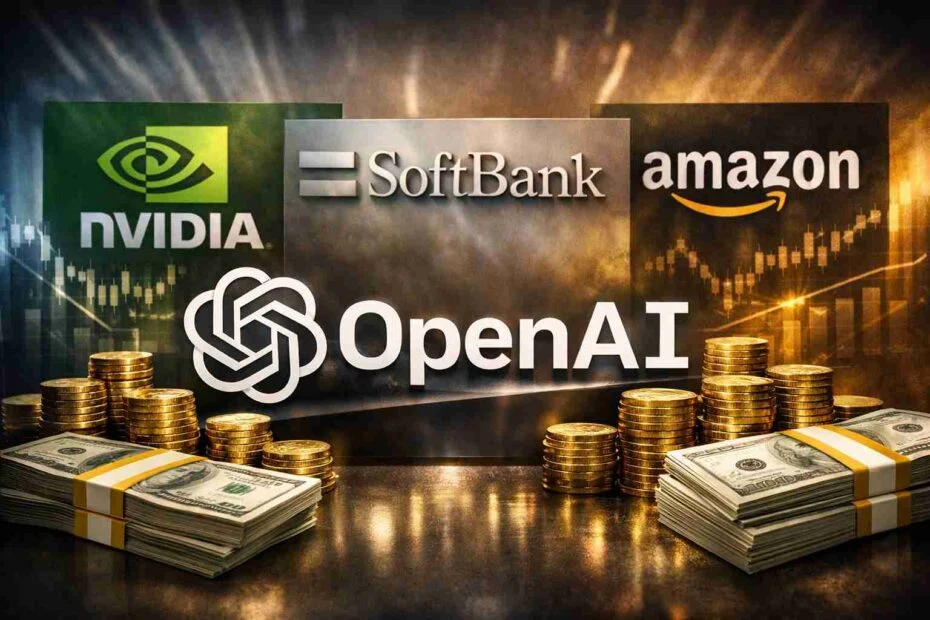
OpenAI has reached a staggering $840 billion valuation following its latest funding round, as major technology companies and Masayoshi Son’s SoftBank poured capital into a massive $110 billion private raise. The deal signals that the global AI investment race remains strong, despite recent concerns about inflated valuations in the sector.
This funding round — one of the largest private capital raises ever recorded — includes $30 billion from SoftBank, $30 billion from Nvidia, and $50 billion from Amazon. The investment is structured in phases and comes with specific conditions tied to future milestones.
The fresh capital arrives ahead of OpenAI’s expected mega-IPO later this year, as the ChatGPT maker faces rapidly increasing computing and research costs. The company said additional investors are likely to join the round as it progresses.
SoftBank Expands Its OpenAI Stake
Following the latest commitment, SoftBank’s total investment in OpenAI will rise to $64.6 billion, giving the Japanese conglomerate an ownership stake of approximately 13%. The funding will be deployed in three phases throughout the year, with the first $10 billion tranche expected to close by April 1.
SoftBank will initially receive preferred shares, which will convert into common shares if OpenAI proceeds with its IPO. The investment will be financed through bridge loans and capital raised from major financial institutions. To support the deal, SoftBank has also sold stakes in existing holdings, including Nvidia.
Nvidia Deepens Strategic Ties
The new funding will enable OpenAI to secure advanced AI chips and expand its computing infrastructure, strengthening its competitive position against rivals such as Anthropic and Alphabet’s Google.
However, the deal has intensified Wall Street concerns about so-called “circular financing,” where companies both invest in and supply one another, potentially inflating demand and revenue.
Nvidia faced investor pressure this week after announcing it would reinvest heavily into the AI ecosystem instead of increasing shareholder returns. Its $30 billion investment in OpenAI further solidifies its relationship with one of its largest customers.
OpenAI confirmed it will deploy Nvidia’s latest Rubin systems, providing five gigawatts of computing power — enough energy to power millions of U.S. households. It remains unclear whether this new commitment replaces Nvidia’s previously announced plan to invest up to $100 billion.
Amazon Partnership and Cloud Expansion
Amazon’s $50 billion investment plays a central role in OpenAI’s expansion strategy. In addition to capital, the companies have agreed that OpenAI will use two gigawatts of computing capacity powered by Amazon’s Trainium AI chips.
The partnership also expands their existing $38 billion cloud agreement. OpenAI plans to spend an additional $100 billion on Amazon Web Services (AWS) over the next eight years. Amazon will begin with a $15 billion investment, followed by another $35 billion once specific conditions are met.
AWS will serve as the exclusive third-party cloud provider for OpenAI Frontier, the company’s enterprise AI platform for developing and running AI agents.
Microsoft clarified that the new Amazon partnership does not alter its existing relationship with OpenAI. Microsoft Azure will remain the exclusive cloud provider for OpenAI’s APIs, while first-party products, including Frontier, will continue to be hosted on Azure.
Growth, Competition and AI Spending
Competition in artificial intelligence is intensifying. Google’s Gemini 3 launch strengthened Alphabet’s position, while Anthropic continues to dominate segments of the enterprise AI market.
OpenAI, which has yet to report a profit, is targeting approximately $600 billion in total compute spending through 2030. Despite the heavy costs, the company’s user base continues to expand rapidly.
ChatGPT now serves more than 900 million weekly active users and has surpassed 50 million paying subscribers. January and February are on track to become the strongest months for new subscriber growth, underscoring sustained demand for AI-driven tools.