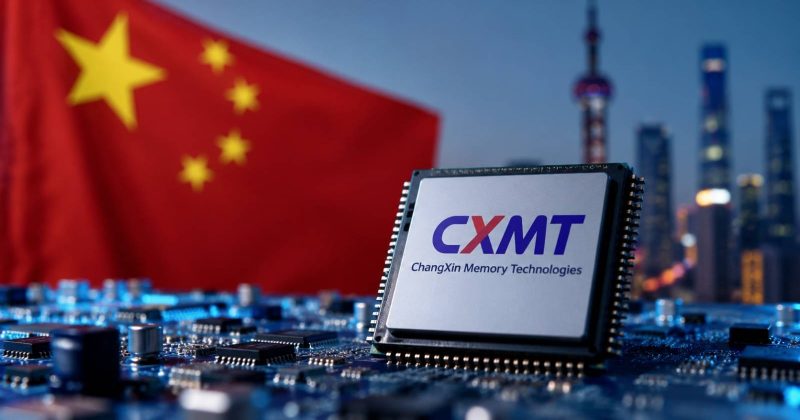
China’s memory chipmaker ChangXin Memory Technologies (CXMT) has unveiled plans to introduce advanced DDR5 memory technology by the end of 2026. However, Mizuho technology specialist Jordan Klein believes the announcement poses no immediate threat to major memory manufacturers, including Micron, Sandisk, SK Hynix, and Samsung Electronics.
Despite concerns about growing Chinese competition, Klein argues that CXMT’s ambitious technology roadmap lacks sufficient evidence of commercial readiness.
The analyst identified seven key concerns that suggest investors should remain cautious about interpreting the announcement as a major shift in the global semiconductor market.
CXMT’s DDR5 Technology Claims Raise Questions
CXMT plans to introduce a DDR5 registered dual in-line memory module (RDIMM) featuring an advanced 4F-squared memory cell architecture and vertical surrounding gate transistor technology.
According to Mizuho’s assessment, the proposed design could reduce memory cell size by approximately one-third compared with the conventional 6F-squared architecture currently used in DDR5 products.
In theory, smaller memory cells could improve production efficiency and increase memory density. However, Klein emphasized that technological claims do not necessarily translate into commercially competitive products.
One major concern involves CXMT’s development timeline.
While the Chinese manufacturer targets a product introduction before the end of 2026, Samsung reportedly expects to begin mass production of comparable 4F-squared DRAM technology in 2028.
Klein explained that these milestones represent fundamentally different stages of development. Introducing a product does not demonstrate the manufacturing efficiency, production yields, or cost structure required for large-scale commercial success.
Consequently, comparing CXMT’s planned launch with Samsung’s mass-production schedule could create a misleading impression of technological leadership.
Seven Reasons Analysts Remain Skeptical of CXMT
Klein outlined several weaknesses in CXMT’s announcement that limit its immediate significance for established memory chipmakers.
The main concerns include:
- Different production milestones: CXMT’s planned product introduction cannot be directly compared with Samsung’s mass-production target.
- Unproven manufacturing yields: The Chinese company has not demonstrated that its new memory architecture can achieve commercially viable production yields.
- Incomplete technical specifications: CXMT has yet to publish comprehensive performance and technical data supporting its claims.
- Missing customer qualification results: There is no verified evidence that major customers have approved the technology for commercial deployment.
- Uncertain shipment volumes: The company has not announced confirmed commitments for large-scale commercial deliveries.
- Unclear production economics: Smaller memory cells do not automatically guarantee cheaper chips, particularly when manufacturing complexity and integration costs are considered.
- Limited exposure to advanced AI memory: CXMT’s proposed product targets conventional server DRAM rather than the high-bandwidth memory segment driving substantial demand from artificial intelligence infrastructure.
Together, these uncertainties suggest that CXMT still faces significant challenges before its proposed DDR5 technology can compete effectively with established suppliers.
Klein also questioned concerns that the announcement could trigger an imminent oversupply of memory chips.
Without verified production yields, manufacturing capacity, and commercial performance, he believes predictions of a significant supply increase remain premature.
Why CXMT’s DDR5 Plans May Not Threaten the AI Memory Market
An important distinction involves the type of memory technology CXMT intends to manufacture.
The company’s proposed DDR5 RDIMM targets conventional server memory applications rather than High Bandwidth Memory (HBM).
HBM has become increasingly important for advanced AI accelerators, particularly systems built around graphics processing units (GPUs) and application-specific integrated circuits (ASICs).
Demand for these specialized memory products has supported growth expectations and premium valuations across leading semiconductor manufacturers.
However, CXMT’s announcement does not establish that the company can compete directly in this high-value segment.
Furthermore, the transition toward 4F-squared memory cells is not exclusive to Chinese manufacturers.
Both Samsung and SK Hynix are reportedly developing similar architectures, indicating that smaller DRAM cell designs represent a broader technological evolution across the global memory industry.
Klein also referenced a Digitimes report that offered a more restrained assessment of CXMT’s progress, reinforcing his cautious interpretation of the announcement.
Micron, Sandisk and Samsung: What Investors Should Watch
Although Klein sees little immediate reason for investors to reconsider their positions in major memory companies, he does not dismiss China’s long-term semiconductor ambitions.
CXMT continues to invest aggressively in expanding its memory manufacturing capabilities, particularly to serve domestic Chinese customers.
Meanwhile, Chinese NAND flash manufacturer Yangtze Memory Technologies (YMTC) represents another potential competitive challenge to established international suppliers.
Both companies could become increasingly important participants in the global memory market as China pursues greater semiconductor self-sufficiency.
Nevertheless, Klein maintains that CXMT must demonstrate reliable production, competitive manufacturing costs, verified performance, and meaningful commercial shipments before its technology roadmap can be considered a significant threat.
For investors in Micron, Sandisk, SK Hynix, and Samsung Electronics, the announcement appears to be a longer-term development worth monitoring rather than an immediate reason for concern.
Ultimately, CXMT’s ability to move from ambitious technological claims to profitable large-scale manufacturing will determine its future competitive position in the global memory industry.