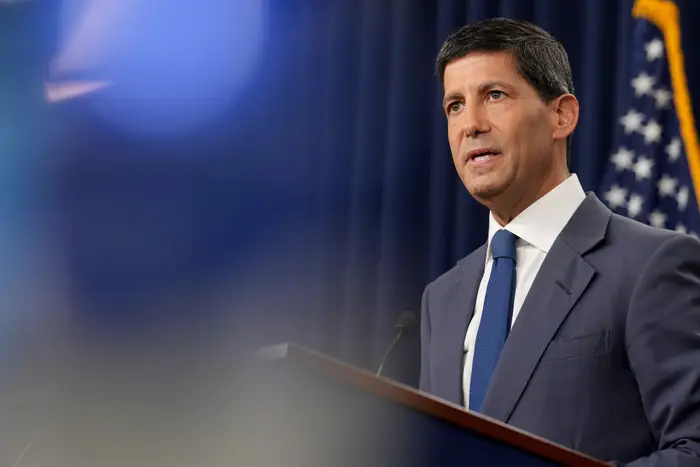
Federal Reserve Chair Kevin Warsh said on Friday that underlying inflation in the United States has not “meaningfully improved,” reinforcing the central bank’s focus on restoring price stability.
Warsh made the comments during his keynote address at the Jackson Hole Economic Policy Symposium, where investors closely watched for clues about the direction of U.S. monetary policy.
Jackson Hole Speech Puts Inflation in Focus
The annual Jackson Hole conference is organized by the Kansas City Federal Reserve and brings together central bankers, economists, policymakers and academics.
This year’s event is focused on financial innovation and its implications for payments and monetary policy.
Warsh’s speech quickly caught the attention of financial markets, particularly because inflation remains above the Federal Reserve’s 2% target.
Fed Rate Hike Expectations Increase
Traders increased their expectations for a Federal Reserve rate hike in September following Warsh’s remarks.
According to the CME FedWatch tool, markets were pricing in more than a 55% probability of a 25-basis-point increase, compared with roughly 35% one day earlier.
The shift reflected growing concern that persistent inflation could force the Fed to maintain a more restrictive policy stance.
Warsh Says Price Stability Remains the Priority
Warsh said the U.S. labor market currently appears consistent with full employment.
However, he expressed greater concern about the inflation side of the Federal Reserve’s dual mandate.
The Fed’s preferred inflation measure, the Personal Consumption Expenditures price index, rose 3.7% year over year in July.
Core PCE inflation, which excludes food and energy prices, increased 3.3% over the same period.
Both readings remain well above the Federal Reserve’s long-term target of 2%.
Inflation Remains Broad Across the Economy
Warsh also pointed to the broad nature of recent price increases.
He highlighted the 199 individual components included in the PCE price index as a useful way to assess underlying inflation pressure.
Over the past 12 months, around 54% of goods and services in the PCE basket recorded price increases above 3%.
That figure is below the post-pandemic peak of approximately 77%, but remains significantly higher than the 32% average seen during the two decades before the pandemic.
The data suggest that inflation pressures remain spread across a large part of the U.S. economy.
Labor Market Weakness Complicates Fed Policy
The Federal Reserve is also dealing with mixed economic signals.
Recent employment data showed weaker-than-expected nonfarm payrolls, while other economic indicators have pointed to resilient growth.
At the same time, elevated oil prices linked to continued tensions between the United States and Iran have added another potential source of inflation pressure.
This combination makes the Fed’s policy decision more difficult, as officials must balance inflation risks against signs of a softer labor market.
Fed Policymakers Remain Divided
The Federal Open Market Committee kept interest rates unchanged at its July meeting.
However, several regional Federal Reserve presidents disagreed with the decision.
Minutes from the meeting also showed that many policymakers believed additional rate increases could become necessary if inflation failed to decline.
That debate has become increasingly important ahead of the Fed’s September policy meeting.
Warsh Moves Away From Forward Guidance
Since becoming Federal Reserve chair, Warsh has taken a different communication approach from some of his predecessors.
He has launched a broader review of central bank operations while reducing the use of forward guidance, which is used to signal future policy intentions to financial markets.
Warsh again criticized the practice during his Jackson Hole speech.
He argued that excessive guidance can restrict policymakers and create confusion if economic conditions change unexpectedly.
Instead, he favors giving the Federal Reserve greater flexibility to respond to incoming data.
Treasury Yields Rise After Warsh Remarks
U.S. Treasury yields moved higher following Warsh’s comments as investors sold government bonds.
The benchmark 10-year Treasury yield rose to around 4.68%, while the more policy-sensitive 2-year yield climbed to approximately 4.30%.
Long-term U.S. borrowing costs have already faced significant pressure this year.
The 30-year Treasury yield recently reached its highest level in more than 19 years, while concerns over rising government debt have continued to affect bond markets.
U.S. Debt Remains a Major Concern
U.S. national debt has now moved above $40 trillion, adding to concerns about government borrowing and long-term interest costs.
Treasury officials recently increased long-dated bond buybacks in an effort to support market liquidity.
However, the move provided only limited relief as investors continued to focus on debt issuance, inflation and Federal Reserve policy.
Wall Street Reacts to Hawkish Fed Tone
U.S. stocks initially moved lower following Warsh’s speech.
The S&P 500 turned negative, while the technology-heavy Nasdaq Composite extended earlier losses.
Markets later recovered some ground, although price moves remained relatively modest.
Investors are now likely to focus on incoming inflation and employment data to determine whether the Federal Reserve will raise interest rates at its next meeting.
For now, Warsh’s message from Jackson Hole remains clear: inflation is still above target, and restoring price stability remains the Fed’s primary concern.