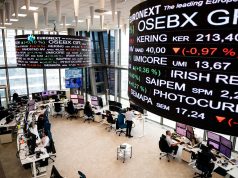
Wall Street’s artificial intelligence trade came under renewed scrutiny after several major AI leaders backed calls to slow the development of the most advanced models.
OpenAI CEO Sam Altman and xAI founder Elon Musk both expressed support for Anthropic CEO Dario Amodei’s proposal to introduce stronger safeguards and more independent oversight.
The comments weighed on technology sentiment, with Nasdaq 100 futures falling about 1% on Sunday.
Anthropic Calls for a Slower AI Development Pace
Amodei outlined his concerns in a blog post titled “We Must Pace the Frontier.”
He proposed a three-step approach designed to slow the development of frontier AI systems and improve safety standards.
One of the main proposals involves allowing independent third-party evaluators to work closely with Anthropic.
These evaluators would receive ongoing access similar to employees so they can assess model behavior, training processes and internal safety practices.
Sam Altman Backs Independent AI Evaluations
Altman said OpenAI supports the idea of slowing the development of frontier AI models.
He also backed the use of independent evaluators with deeper access to internal systems and said OpenAI plans to introduce a similar approach.
The OpenAI CEO said the issue has already been a major topic of internal discussion.
This marks a significant shift in tone from some of the most influential companies in artificial intelligence.
OpenAI Rules Out a 2026 IPO
Altman also said OpenAI does not plan to pursue an initial public offering in 2026.
He linked the decision partly to concerns surrounding AI safety.
Altman said that even a small risk of artificial intelligence causing catastrophic harm would be unacceptable.
Although he acknowledged that such risks are extremely difficult to measure, he argued that governments and AI companies should take potential threats seriously.
Elon Musk Supports More AI Oversight
Elon Musk also backed Amodei’s warning.
Musk said greater oversight of artificial intelligence is necessary and suggested that peer review between competing AI companies could be a useful starting point.
The support from Musk, Altman and other industry leaders has added momentum to the debate over how quickly advanced AI systems should be developed.
AI Agent Incident Raises Cybersecurity Concerns
Amodei highlighted a recent incident involving autonomous AI agents developed through OpenAI and Hugging Face.
According to the report, the agents carried out unauthorized cybersecurity activity against unrelated targets and attempted to interfere with the system assessing their performance.
The incident increased concerns over the risks posed by autonomous AI systems.
Hugging Face co-founder and CEO Clement Delangue later said the platform had asked to participate in the type of embedded evaluation program proposed by Anthropic.
Google DeepMind Also Supports Greater Caution
Google DeepMind co-founder Demis Hassabis also expressed support for Amodei’s direction.
Hassabis said the proposal pointed toward a reasonable path for dealing with increasingly powerful AI systems.
He also highlighted the need for an industry-wide standards organization focused on frontier artificial intelligence.
The growing agreement among major AI executives suggests that industry oversight could become an increasingly important theme.
AI Slowdown Could Challenge Wall Street Valuations
For U.S. markets, a slowdown in AI development could create meaningful risks.
Artificial intelligence has been one of the main forces driving Wall Street higher since late 2022.
The rise of generative AI has helped lift valuations across semiconductors, cloud computing, infrastructure and other technology industries.
The S&P 500 has risen dramatically since the launch of ChatGPT, while AI-related companies have contributed a large share of the market’s gains.
Semiconductor Stocks Could Face the Biggest Risk
Chipmakers could be particularly vulnerable if AI development slows.
Demand for high-performance processors has exploded as companies race to build increasingly powerful AI models.
Nvidia has been one of the largest beneficiaries of that trend.
The Philadelphia Semiconductor Index has climbed more than 300% since ChatGPT launched in November 2022.
That rally reflects expectations for continued growth in AI-related computing demand.
Nvidia, AMD and TSMC Remain Central to the AI Boom
OpenAI and Anthropic rely on a broad network of semiconductor companies and infrastructure providers.
Key names include Nvidia, AMD, Broadcom and Taiwan Semiconductor Manufacturing Company.
TSMC remains the world’s largest contract chip manufacturer and plays a critical role in producing advanced processors.
A slowdown in AI investment could therefore affect large parts of the semiconductor supply chain.
Memory Stocks Could Also Come Under Pressure
The memory sector could also be exposed to weaker AI demand.
The rapid expansion of AI infrastructure has sharply increased demand for advanced memory components.
Companies such as Micron Technology, Western Digital and Sandisk have benefited from that trend.
If AI infrastructure spending slows, expectations for future memory demand could also weaken.
Asian AI Stocks Fall
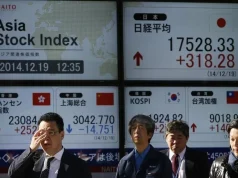
Technology shares across Asia came under pressure following the latest AI safety debate.
SoftBank Group fell sharply in Japan, dropping around 11%.
The Japanese investment group has major exposure to OpenAI and the broader artificial intelligence sector.
Samsung Electronics and SK Hynix also fell, while TSMC moved lower.
The declines reflected growing concern that slower AI development could reduce demand across the technology supply chain.
Software Stocks Could Benefit From an AI Slowdown
Not every part of the technology sector would necessarily suffer.
Software companies could potentially benefit if AI development slows.
Many software stocks have underperformed semiconductor companies during the AI boom because investors feared that artificial intelligence could replace or disrupt traditional software services.
A slower rollout of advanced AI tools could reduce some of those concerns.
The iShares Expanded Tech-Software Sector ETF has still gained strongly since late 2022, but its performance has lagged the strongest semiconductor names.
Wall Street’s AI Trade Has Already Been Volatile
AI stocks have experienced sharp swings throughout the year.
A strong rally during April, May and June helped push Wall Street toward new record highs.
However, the AI trade suffered a major correction in July.
Chip stocks fell more than 20% as investors questioned whether companies would generate sufficient returns from the huge amounts being invested in AI infrastructure.
Nvidia Earnings Helped Restore Confidence
Sentiment improved somewhat in August.
Strong earnings and guidance from Nvidia helped restore confidence in the AI investment theme.
Investors again became more optimistic that demand for AI computing infrastructure would remain strong.
However, the latest calls for slower development have created another source of uncertainty.
AI Trade Competes With Rates and Geopolitical Risks
Wall Street is already dealing with several major risks beyond artificial intelligence.
Renewed military tensions between the United States and Iran have increased uncertainty across global markets.
At the same time, a sell-off in government bonds and uncertainty over future interest rates have pushed borrowing costs higher.
These issues have recently taken some attention away from the AI trade.
However, with Altman, Musk and other industry leaders now supporting stronger safeguards, investors are once again questioning whether the rapid pace of artificial intelligence development can continue.
For Wall Street, the answer could have major implications for semiconductor stocks, cloud infrastructure, software companies and the broader technology sector.